Category Archives: Christianity

Maundy Thursday Liturgy

Maundy Thursday.pngBelow is suited for a sanctuary or chapel.

Maundy Thursday Pot-Luck Liturgy is meant to be shared around food.

Maundy Thursday

Liturgist:     Jesus spent his life teaching us the meaning of love.  Through word and deed Jesus showed us how to love God and to love one another.  He fed the hungry.  He healed the sick.  He invited the women and the children and the tax collectors and the sinners to come to his table.  He broke bread with the least and the lost and shared the cup of redemption with them all.  He crossed boundaries of race, nationality, ethnicity, gender, and class.  He challenged religious authority, and he scoffed at pomposity and self-absorbed grandeur.  He called out the hypocrites.  He admonished the scribes and the Pharisees for their hardened hearts.  He brought a simple message: Love God, love yourself, and love one another.

All:       We gather in the name of Jesus and remember the way that he showed us.  We gather to remember not just his death, but his life.

UM Hymnal #174 – His Name is Wonderful

Liturgist:     The way of Jesus goes through the cross, but we are not there yet.  It is close.  We can see its shadow.  We can feel the cold, dark, night. We know that the enemies of God are conspiring.  They have had enough of him.  He threatens their comfort.  He threatens their way of life.  He threatens their power.  They will come for him.  First though, we will gather.  We gather with Jesus and his closest friends.  We gather with those that called him teacher, Rabbi, friend.  We gather for the Passover meal, to remember that God saved the people from slavery.  God saved once.  God saves forevermore.

All:       God saved the Israelites at Passover, and revealed that it is God who reigns, not the Pharaoh.  Our God saved once.  God saves forevermore.

UM Hymnal #448 – Go Down, Moses

Liturgist:     Even as they were sharing this sacred meal together, the disciples were not of one heart.  Jesus knew that he was asking much from these men, and he knew that they would fail him.  Judas had already agreed to betray Jesus to the religious authorities.  Was he angry at some slight?  Was he disappointed that Jesus would not raise an army against the Romans? Was he upset with the value of the oil that the woman “wasted” when she anointed Jesus?  We will never know Judas’ heart, but Jesus knew that he would be betrayed.  And did Jesus do with the man that would betray him?  He broke bread with him. All of the disciples were deeply saddened, and they asked:

All:     I would never betray you, Lord.  It’s not me, is it?

Leader One:      On the night in which Jesus was betrayed by his friend, he took the bread, gave thanks to God, broke the bread, gave it to his disciples, and said: “This is my body, which is broken for you.  Do this in remembrance of me.”

Leader Two:    When the supper was over he took the cup, gave thanks to God, gave it to his disciples and said, “Drink from this all of you, this is my blood of the new covenant which is poured out for you and for many for the forgiveness of sins.  Do this, as often as you drink of it, in remembrance of me.”

Leader One:      And so, in remembrance of these your mighty acts in Jesus Christ we offer ourselves in praise and thanksgiving as a holy and living sacrifice, in union with Christ’s offering for us, as we proclaim the mystery of faith.

All:       Christ has died. Christ is risen.  Christ will come again.

Leader One:    Pour out your Holy Spirit on us gathered here, and on these gifts of bread and the cup.  Make them be for us the body and blood of Christ, that we may be for the world the body of Christ, redeemed by Christ’s blood.  By your Holy Spirit make us one with Christ, one with each other, and one in ministry to all the world, and we feast at his heavenly banquet.  Through your Son Jesus Christ, with the Holy Spirit in your Holy Church, all honor and glory is yours, almighty Father now and forever.

Communion in silence

Liturgist:     When the holy meal had been shared, the disciples began to argue over which one would be the greatest.  Even here, at the end of their time together, they did not seem to understand what Jesus had been teaching them all along.  He reminded them that to be great in the Kingdom of God meant to serve.  After Jesus’ talk of betrayal, the disciples’ argument, and Jesus’ rebuke of them, the disciples seemed to be growing anxious. Peter proclaimed:

All:       “Lord, I am ready to go with you to prison and to death.”

Liturgist:     And Jesus replied, “I tell you, Peter, the cock will not crow this day until you have denied three times that you know me.”

The Faith We Sing, Hymn #2112 – Jesus Walked This Lonesome Valley

Liturgist:     Afterwards, Jesus led his disciples to the Garden of Gethsemane.  He asked them to pray for him, for he wanted to be alone.  There, Jesus prayed.  He asked his friends to keep watch, but they kept falling asleep.  He prayed for another way out.  He prayed in anguish.  He prayed as a man who could feel pain, who would be hurt by betrayal, who would be scarred by the scourge, and would bleed when nails were driven into his arms and legs.  He prayed as a man who knew that if he followed God’s will, he would be charged, convicted, mocked, humiliated, abandoned, and nailed to a cross.  Knowing all of this full well he prayed, “Not my will, but yours.”  Then he stood up for all that he had lived for.  When he got up from prayer, he came to the disciples and found them sleeping, “Why are you sleeping? Get up and pray that you may not come to into the time of trial”

All:       Judas said to Jesus, “Rabbi” and kissed him.  Then they came and grabbed Jesus and arrested him.

UM Hymnal #290 – Go to Dark Gethsemane (verses 1-3 only)

Liturgist:     There was a brief skirmish at the arrest, but his disciples quickly scattered.  Peter, who had only hours before promised to go with Jesus to prison, even death, followed from a distance.  During the trial, Peter remained hidden in the shadows.  First a servant girl saw him and said, “This man was also with him.”

All:       “Woman, I do not know him.”

Liturgist:     A little later someone else, on seeing him said, “You also are one of them.”

All:       “Man, I am not.”

Liturgist:     Then about an hour later still another kept insisting, “Surely this man was with him; for he is a Galilean.”

All:       “I do not know what you are talking about.  I do not know Jesus.”

Liturgist:     At that moment, while he was still speaking, the cock crowed.  The Lord turned and looked at Peter.  Then Peter remembered what Jesus had said to him, and he wept bitterly.

UM Hymnal #288 – Were You There

Stripping of the table (All of the items that adorn the Lord’s table, and all of the liturgical banners are removed in silence)

There will be no sending forth or postlude.  People are asked to leave in reflective silence, and return for Good Friday service and Easter Sunday service.

Good Friday Stations of the Gospel through Luke

Follow the Fat Pastor on Facebook

Follow on Twitter

7 Comments

Filed under Christianity

Journey to Hope: Work

Ray Kinsella introducing his Dad (a ghost playing baseball) to his wife and daughter in “A Field of Dreams”

This is Part 4 of the series Journey to Hope, a Rethink Church study.

Introduction

Week One: Relationships

Week Two: Self-Esteem

“A Field of Dreams” has long been my favorite movie, but probably not for the reason you think.  I’ve seen it so many times, I can practically recite it for you, word for word.   Most people think of it as a baseball movie about a man’s relationship with his father.  Much of the main character’s motivation is to “prove he’s not like his father.”  The two suffered an emotional detachment, manifested in Ray’s refusal to play catch with his father.  The emotional climax of the movie for Ray Kinsella is when he sees that among those that have come back from “the corn” to play baseball is his Dad.  Ray then introduces his Dad to his wife and daughter, and the tears begin to flow freely when he says, “Dad, Wanna have a catch?”  I still get choked up whenever I see this part of the movie.

While reconciliation and healing is one of the primary themes of the movie, another is vocation.  Ray’s pursuit of the mystical inner voice telling him “if you build it, he will come” drives the story.  His ability to pursue his own dream over the demands of society, bills, and culture provide the primary conflict.  Vocation is also the primary theme for two other characters: Moonlight Graham and Terrance Mann.

Archibald “Moonlight” Graham was a ballplayer that got into one major league baseball game as a late-inning defensive replacement.  He never got to bat.  Through the movie’s strange turn of events Ray finds Moonlight Graham as an old man.  Moonlight Graham is now “Doc” Graham, the doctor in a small Minnesota town.  Ray tries to convince Doc Graham to come with him to Iowa, but Graham refuses.  He knows his place is in Chisholm, Minnesota.  Exasperated, Ray says, ” Fifty years ago, for five minutes you came within… y-you came this close. It would kill some men to get so close to their dream and not touch it. God, they’d consider it a tragedy”

“Son,” Doc says, “If I had only been a doctor for five minutes, that would have been a tragedy.”  Later in the movie Graham appears as a wide-eyed youth, getting to play baseball with his heroes on Ray’s magical field in the corn.  Once again, he chooses to be a doctor over a ballplayer and saves Ray’s daughter.

The Terrance Mann character is loosely based on JD Salinger.  During the movie he is described as “the voice of his generation… He coined the phrase ‘make love, not war.'”  As an adult, Mann becomes a modern-day hermit.  After being on the cover of Time, and hanging out with the Beatles, Mann withdraws from the public eye.  He grew weary of everyone looking to him for answers.  He became burned out by “leading the cause.”  Kinsella pursues him, and takes him to Iowa.  It is Mann that recites the famous “People will come Ray” monologue.  It is a beautiful ode to baseball, and the character’s deep love of baseball is clear.  All through the movie though, Mann’s role is unclear.

Finally, after one of the games between the All-Heaven’s All-Stars, Joe Jackson invites Mann to come with them “out there.”

In the heated exchange between Ray, Joe, and Terrance, the three come to realize why Terrance was there.  Terrance, who hadn’t written a book in twenty years says that he will write a story about it.  “You’re going to right about it?” Ray says, with not a small hint of hope in his voice.  “It’s what I do,” Terrance replies.

“It’s what I do.”   Mann was a writer.  Moonlight Graham was a doctor.  These were not just the things they did, these things are their vocation.  It is who they are.  The entire movie is about a search.  It is about a man with a mid-life crisis, trying to discover who he is.  He discovers that he is a husband and a father and that is enough.  A doctor relives his boyhood dream, but knows that in the end he is defined by being a healer, not as an outfielder.  A burned-out activist remembers what is deeply inside him, and he promises to write again.

This week’s study on Journey to Hope is about work.  Do you find hope in your work?  I think there is an important distinction between work and vocation.  I have had a lot of jobs.  I’ve been a painter, a gas station clerk, a coach, a sportswriter, a bag boy, and many more things.  All of those jobs paid me, but only some of them fed me.

My hope is not in my work.  Though this is easy to say as one that is gainfully employed.  I understand that to some, finding work would be a great source of hope, but I’m talking about something deeper than a paycheck.  My hope is in my vocation.  It is in knowing that God has created me with a mission.  God has gifted me with talents, but more than this, I have been given a reason for living.  My vocation is writing, preaching, and teaching.  These are the things that feed my soul.  These are the things that feed my fire and passion for God.  They are more than the things I do.  They are a part of who I am.

I am lucky because my job aligns closely with my vocation.  I am able to be compensated for doing those things that I would be doing otherwise.  I think it was the football player Ray Lewis that said, “They (the team that pays me) get Sundays for free.  They pay me for the rest of the week.”  That is similar to how I feel.  I worship, preach, and teach for free.  It is the other stuff that the church has to pay me for.

When you think about your job and your vocation, how are they related?  Spending time and energy in pursuit of things that are not your vocation will lead to tiredness, exhaustion, and burnout.  If your job and your vocation are closely aligned, then you can count yourself blessed.  If they are not, then you need to be extra vigilant.  I would suggest to search deeply for what feeds you, and pursue that in addition to your job.  Sabbath rest becomes crucial when you are spending energy in places that do not feed you.  Sabbath provides a time and space for you to be refilled by the Spirit.  It gives you a chance to discover your vocation through prayer and quiet time.

Hope is eternal.  A job isn’t, so if your hope rests in your job I pray that you will find something else more eternal in which to place your hope.  Seek out your vocation.  Remember that it is “not as a goal to be achieved but as a gift to be received. Discovering vocation does not mean scrambling toward some prize just beyond my reach but accepting the treasure of true self I already possess. Vocation does not come from a voice ‘out there’ calling me to become something I am not. It comes from a voice ‘in here’ calling me to be the person I was born to be, to fulfill the original selfhood given me at birth by God.” (Parker Palmer, “Let Your Life Speak”, p. 10)

Listen to your inner voice.  It might be telling you to build a baseball field in the middle of a cornfield.  The neighbors, the bank, and the rest of society might think you’re crazy.  Pursue your vocation anyway.  Be who you were called to be.

Follow the Fat Pastor on Facebook

Follow on Twitter

2 Comments

Filed under Christianity

“Welcome to beautiful West Point”

John Kofi Asmah School

These pictures of are of the John Kofi Asmah School in the West Point community of Monrovia, Liberia. On the left was the project as my group left it in February 2011. The picture on the right was taken by Michael Whitaker. He was a part of the IGRC group that went in March 2012 and saw the dedication of the completed school.

I went to Liberia last year as a part of newly ordained clergy from the Illinois Great Rivers Conference of the United Methodist Church.  Illinois Great Rivers and Liberia have had  a flourishing partnership since 2006.  Hundreds of clergy and laity have made the journey between the war-torn West African nation that is struggling with a fledgling democracy and the heart of Illinois.

During the last six years much has been built through this partnership.  Along with schools, wells, clinics, and churches, things like trust, friendship and community have been built.  The partnership between Illinois and Liberia is a strong one, and it has helped bring hope to the people of Liberia and Illinois.  There is hope that churches can rise up out of years of decline with the power that comes with reaching beyond the walls of the building.  There is hope that a nation can rise up from the ashes of civil war with the power that comes with education, clean water, and friendship.

I was forever touched by the people of Liberia.  One place that especially touched me was West Point.  I cannot properly describe West Point.  It is a small peninsula that juts off of Monrovia, and has two roads that enter it.  Once inside, the roads are so narrow that a car can barely pass, and only when the vast amounts of people get out of the way.  At its widest, it is less than a kilometer, and it is about a kilometer in length.  In this tiny land area, there are approximately 75,000 people.

Towering over most of the community of West Point is John Kofi Asmah School.  This school is one fruit of the partnership between the Illinois Great Rivers and Liberian Conferences of the United Methodist Church.  It is the only middle and senior high school in West Point.

When I was in Monrovia in February 2011, I spent two brief days on the third floor of the school, mixing mortar for the walls of the school.  During my brief time there, we build a couple of interior walls of the third floor.  The work I did there was almost insignificant.  It was but one thread to the larger fabric of this partnership.  We were told it could take another $50,000 to buy the materials and pay the labor to finish the project.  Most of us came back to Illinois with a very clear mission – complete that school.

In February 2012, another group of ordinands from Illinois traveled to Liberia (about 3-4 work groups a year make the journey.  Each group consists of laity and clergy.  They can work on a variety of projects, and there is one trip each year that is especially geared for teachers to go to train other teachers at the schools that have been built).  They came back with wonderful news.  In the year since my group left, the project has been completed.  They were a part of the dedication service.  I was told that at the dedication, some of the students thanked the people of Illinois for their help.  I wish I could return that thanks.

I am thankful for the partnership between Illinois Great Rivers and Liberia.  I know I am better for having been to Liberia.  I am better for working in the heat of the Liberian sun.  I am better for singing songs of praise with Liberian people.  I am better for knowing Sam.

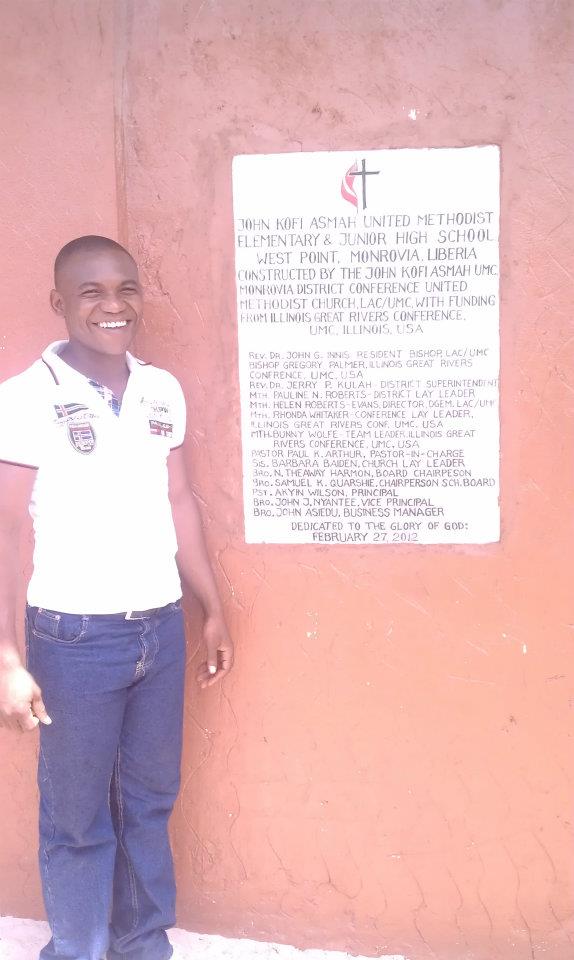
“Welcome to beautiful West Point.”  That is how Sam Quarshie  welcomes people to his church and his school.  Sam is the associate pastor, but is known to the people of West Point as “Uncle Sam.”  Below, Sam is standing next to the cornerstone plaque on the school.  Sam is an inspirational man.  As amazing as that school is, my hope for Liberia does not rest in buildings.  Even though my own sweat is in the mortar, my hope is stronger than any concrete mixture.  My hope for Liberia and my hope for Illinois lies in people like Sam Quarshie.  My hope rests in the power of Jesus Christ to make all things new.

Associate Pastor Sam Quarshie in front of the cornerstone of the John Kofi Asmah United Methodist School in West Point, Monrovia. Photo taken by Michael Whitaker.

Click here to read more about Liberia and to watch a video about the 2011 trip.

Click here to learn more about the partnership between IGRC and Liberia and get information about how you can help or go.

Follow the Fat Pastor on Facebook

Follow on Twitter

3 Comments

Filed under Christianity

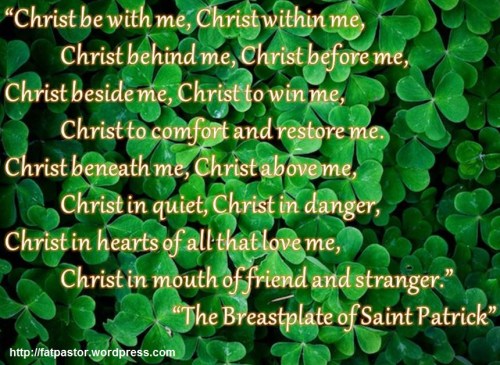
The Breastplate of Saint Patrick

The Breastplate of Saint Patrick

1 Comment

March 17, 2012 · 1:23 pm

Journey to Hope: Self Esteem

“Believe it or not, I’m walking on air.  I never thought I could be so free. Flying away on a wing and a prayer, who could it be?  Believe it or not, it’s just me.” These are the words to one of my favorite songs.  When I was a kid I loved “The Greatest American Hero,” and this was the show’s theme song.  I don’t remember a lot of details about the show, but it was about a guy that was given a suit with superpowers.  He promptly loses the instruction book, and hilarity ensues.  A psychologist (or just anyone that knows me) could have a field day explaining why this show was important to me.

If I’m in the right mindset, I still get goosebumpy and teary-eyed when I hear this song.  Sometimes when someone shares with me who much they enjoyed a sermon, or when a blog post gets popular, or when I get a letter from someone who’s life I shaped, I find myself wondering, who could it be?  Believe it or not, it’s just me.  I mean really?  I’m the one that did that good thing?  There are so many times in ministry that I’m simply flying away on a wing and a prayer.  Is it possible to be at the same time supremely confident and terribly insecure?

At any given moment, I could be either of those things or both, but overall I find hope in self-esteem, because my self-esteem is paradoxically not all about me.

This week’s Journey to Hope about self-esteem asks a few very good questions.  The first is, “Is your self-esteem formed from the outside in or the inside out?”

My answer is, “Yes.”  Let me explain: It was when I discovered the true power of the love of God that I realized that I could love myself. Once I started to love myself, I could truly experience the love of God.  I don’t think I can separate these two events, because it was a process of self-discovery that cannot be drawn out in a linear explanation.

During my middle school years I discovered two things.  At about the same time I discovered that I was good at something, and I discovered that I didn’t need to be good at anything to be loved by God.  The result was a confidence in self that was at the same time selfless. I cannot point to a day or time that I “met Jesus,” or was “born again.”  I can point to a few people (Steve A, Heather H, Mrs. Schmidt, Mrs. Martin, Mr. Graba, and above all, my family) that loved me, appreciated my input, and encouraged me to be and do more than I ever thought possible.

My self-esteem comes from outside-in.  It comes from the God that created me, and breathes life into me.  It comes from the knowledge that no matter what, God is with me, empowering me and sustaining me. It comes from the knowledge that my talents, skills, and intellect are not enough to save the world, but I don’t have to do it on my own.

My self-esteem comes from the inside-out.  It comes from the knowledge that my talents, skills, and intellect can be used to change the world for good.  It comes from my experience, my failures, and my victories.  It comes from the knowledge that today I can do something powerful.

Another question that is posed asks “How do you define yourself?  Who defines you?”

I define myself as beloved child of God.  Nothing more, nothing less.  Everything else that describes me is a subset of my primary identity.  I am a father, a son, a brother, a friend, and a pastor.  I am educated, affluent, American, Irish, and Italian.  I am strong, athletic, intelligent, and compassionate.  I am forgetful, lazy, fearful, and overweight.  These things are all descriptors.  None are definitions.  My hope does not rest on any of these characteristics.

My hope doesn’t rest on the power of a special suit, or on the hope that I might find the instruction book someday.  It resides in the knowledge that I am a beloved child of God.  I am created in the image of God.  I am redeemed by the love of Jesus.  I am sustained by the power of the Holy Spirit.  This defines me.  Nothing else.

 Follow the Fat Pastor on Facebook

Follow on Twitter

Greatest American Hero movie? Nope.

I think this might be my new Facebook cover photo after the NCAA tournament is over.

1 Comment

Filed under Christianity

Journey to Hope: Relationships

Week One of the Journey to Hope is about relationships.  Here is a seven minute discussion about the connection between friendship and hope.  The hosts of the program talk to a mother of an autistic boy.  She talks about how shattered she was when she first heard the news, and how relationships gave her strength.  Brian, one  of the hosts, Brian, said:

“Sometimes we don’t have the words.  Sometimes we don’t know what to do, but we can just be. And just sit, and perhaps hold someone’s hand and walk with them.  It’s not always about doing or saying something.  That bond can be transformational.”

I’m immediately reminded of Job’s friends.  There are times when I hear about a friend’s problem, and I feel like I need to rush in to solve the problem.  I often have to remind myself that a friend might not be looking for solutions.  It’s easy to offer answers.  It takes time, commitment and compassion to offer myself.  Friendship – true friendship – isn’t an easy endeavor, but it is so worth it.

When I start to think of the friends in my life, I can easily become choked with emotion. I think about people with whom I’ve shared a moment in time:

High school friends with whom I shared a television show, a “secret club,” a perfect night on the roof of The Odyssey, parties at Weed’s (not weed parties), and one great victory over the BBC.  I think of fraternity brothers with whom I shared a few beers, a few all-nighters, a few meetings of the TNC, a couple of trips to Virginia, and more than a few long, heart-felt talks.

I can think of the faces that have come in and out of my life and thank God for the moments that we shared.  I can think of teammates, classmates, and colleagues that populate my memories.  Even if we aren’t in contact anymore, I am so grateful to the people that have been the in the movie of my life.

And then I think of the co-stars.  The ones that have done more than shape me.  They are the ones that have formed me.  So much of my hope comes from my friends.

My friends have loved me through difficult times.  They have (as my Dad often says) “Multiplied my joy and divided my sorrow.”  We’ve been together trough the valley of the shadow of death, and we have celebrated the greatest joys.  There’s nothing like calling  a friend with good news, or lightening my load with a quick phone call that turns into an hour-long conversation.

I love my friends, and I probably don’t tell them that enough.  But then again, they probably know.  To my friends, thank you.  Thank you for being a source of hope, for showing me what it is like to walk with God.  Thank you for offering me forgiveness when I don’t deserve it, and helping me when I could never pay you back.  Thank you for revealing the love of Christ in your smile, your listening, your tears, and your embrace.  Thank you, above all, for reminding me that I am never alone in this world.

When I think of hope, I think of my friends.  And Jesus did to.

“‘As the Father has loved me, so I have loved you; abide in my love. If you keep my commandments, you will abide in my love, just as I have kept my Father’s commandments and abide in his love. I have said these things to you so that my joy may be in you, and that your joy may be complete.  This is my commandment, that you love one another as I have loved you. No one has greater love than this, to lay down one’s life for one’s friends.'” (John 15:9-13, NRSV)

It was to his friends that he entrusted his life.  He was abandoned, denied, and betrayed, but his faith in his friends held fast.  He knew that it would be his friends that carried out his mission in the world.  Jesus wrote nothing save for what he wrote on the hearts of his friends.  His friends would become the Church.  All that claim Christ as their friend today do so because Jesus trusted his friends so long ago.  For this we may all be grateful, for we are all offered the love that Jesus described – the love that is so strong that he would lay down his life.

The Journey to Hope: The Beginning

Follow the Fat Pastor on Facebook

Follow on Twitter


6 Comments

Filed under Christianity

Dinner’s Ready!

“Dinner’s Ready!”  Man, did I love hearing those two words when I was a kid.  My Mom is a great cook, and I loved dinner time.  Most of the time I would drop everything to get to the table.  There were times, however when I might not answer the call right away.  There were two main questions that determined my reaction time: What was I doing at the time?  What was for dinner?

There were times when I’d be playing a game on the computer, and I just needed to finish one more level.  There were times I was watching TV, and just wanted to wait until the commercial.  There were times my buddies and I were playing basketball in the yard, and we just had to finish this game.

If heaven has a smell, I think it is garlic browning lightly in olive oil.

If dinner was spaghetti, it didn’t really matter what I was doing.  I don’t think I ever had to be called twice to come for spaghetti.  Whenever Mom made spaghetti the aroma would fill the entire house.  It took several hours to cook, creating a crescendo of anticipation as I waited for the moment I could twirl that first forkful of garlic bliss.  On those days, “Dinner’s Ready!” were my two favorite words, and there was no delay.

There was one thing however, that I did not like to eat as a kid.  I need to try it again because my pallet has probably matured, but when I was a kid there was nothing worse than navy bean soup.  I’m sure my Mom made great navy bean soup.  It just wasn’t my favorite.  For me, navy bean soup meant one bowl doused in ketchup, and then peanut butter and jelly.  When I knew that navy bean soup was coming, “Dinner’s Ready!” was not exactly a clarion call.

Now that I’m an adult, “Dinner’s Ready” remains two of my favorite words.  Now I’m usually the one calling out to my family.  It is no longer so much the quality of the food that gets me excited about calling out “Dinner’s Ready!”  I get excited because I know that shortly after saying those two words, the most important people in my world are going to be coming.  Shortly after calling out “Dinner’s Ready!” I will hear the toys being put away (or dropped randomly).  I will hear the distinct pitter-patter of my 18 month old daughter, and the much louder stomps of my 5-year-old daughter running into the kitchen.  I know that soon the four of us will sit down together and eat.  We will pray together.  We will talk about our day.  We will tell jokes.  We will correct the baby when she throws her cup.  We will pick up spills.  We will be nourished in mind, body and soul, and we will be drawn a little closer together.  There are few things I enjoy more than sitting around the table with the people I love most in the world.

Today – right now – God is calling out to all of us, “Dinner’s Ready!”  God wants desperately for us to come to the table, sit down and enjoy the feast.  God yearns for a chance to draw us closer together – all of us.  God wants us to laugh, talk, cry, pray, correct each other when needed, forgive each other when needed, and love each other always.  God invites all to the table, but not everyone will come.

Jesus tells a story in the Gospel of Luke about the great banquet.

 Jesus replied, “ A certain man hosted a large dinner and invited many people. When it was time for the dinner to begin, he sent his servant to tell the invited guests, ‘Come! The dinner is now ready.’ One by one, they all began to make excuses. The first one told him, ‘I bought a farm and must go and see it. Please excuse me.’ Another said, ‘I bought five teams of oxen, and I’m going to check on them. Please excuse me.’ Another said, ‘I just got married, so I can’t come.’ When he returned, the servant reported these excuses to his master. The master of the house became angry and said to his servant, ‘Go quickly to the city’s streets, the busy ones and the side streets, and bring the poor, crippled, blind, and lame.’ The servant said, ‘Master, your instructions have been followed and there is still room.’ The master said to the servant, ‘Go to the highways and back alleys and urge people to come in so that my house will be filled. I tell you, not one of those who were invited will taste my dinner.’ ” (Luke 14:16-24, Common English Bible)

This story tells us a lot about God and how desperate God is to have the table full.  If we are honest with ourselves, it tells us a lot about us too.  God is willing to go to any length to fill the table with God’s children.  The banquet has been prepared, all God needs now is guests.  When we deny the invitation, God might be frustrated, but God will keep sending servants to find someone to come.

We all deny God’s call at some point.  I know that God has called me to the feast over and over again.  There are times when I have responded, and I have tasted grace.  I have tasted forgiveness.  I have tasted reconciliation.  I know what it is like to take a seat at the gospel feast and feel the love of God.  I have had a taste of the power of the Holy Spirit.  I also know that there are too many times when I have ignored the invitation.

I have come up with my list of excuses.  Like a child not wanting to come have bean soup, I have decided I’d rather play another inning of wiffleball, or solve another Carmen San Diego case.  I’ve used lots of excuses to ignore God’s call.  Like the excuses of the men in Jesus’s parable, they all seemed legitimate at the time, but they were all empty.  Who would buy a field or a yoke of oxen sight unseen?  These two excuses are probably just outright lies.  And a marriage? How does getting married prevent anyone from going to a banquet?  The excuses seem good on the surface, yet a closer look at them reveal just how shallow they are.

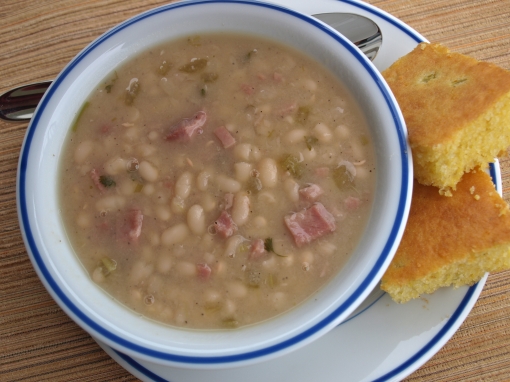
Some people love navy bean soup. I'm just not one of them.

Aren’t most of our excuses?  What are the reasons we tell ourselves we cannot answer God?  We lack the time.  We lack the training or talent.  We think someone else can do it.  How many excuses do we come up with, but all of them are foolish.  I mean, we’re not talking about an invitation to choke down some liver and onions.  We’re invited to the greatest banquet that has ever been spread.  God is calling to you, “Dinner’s Ready!”

Maybe you’re invited to your first taste at the table.  You are invited.  You are invited even if you are blind, lame, sick, hurting, broken, shattered, worried, fearful, or poor.  If you are human, you are invited.  Maybe you’ve been to the table before, and God is calling you for more.  Maybe God is calling you for greater service, deeper Bible study, healthier living, fuller prayer, or more passionate worship.

Wherever you are on the path of life, whatever you’ve done, no matter who you are, you are invited.  The banquet is ready – and it is ready now.  It’s not ready in some distant and unreachable future.  It’s not ready by and by when we all go to heaven.  It’s ready now.  God is ready now.  The dinner is ready.  Come and get it.

Follow the Fat Pastor on Facebook

Follow on Twitter

This blog post is a condensed form of a sermon I preached at Riverside United Methodist Church on February 26, 2012.  If you are interested in CD with the entire worship service, please let me know in the comments, and I will contact you in private email about mailing information.

2 Comments

Filed under Christianity, Sermons

Journey to Hope

Where do you find hope?

It is an interesting question, and one that starts an online Bible study produced by rethinkchurch.org.  “A Journey to Hope” is a seven-week look at where hope can be found.  Hope can be found in the most unlikely of places.  In the midst of brokenness and disorder, hope can emerge.  Like a lone sprout emerging from dry, cracked ground, hope defies the odds.

For the next few weeks, I am going to follow this study as it looks at relationships, self-esteem, work, money, suffering, and ends with hope.  The study will include questions for reflection and discussion, video presentations and Biblical commentary.  I’m looking forward to taking this journey, and I invite you to take it with me.

The introduction of the study can be found here.  It poses another question: “Is it possible for something on the horizon to transform your life now?”  As you look out into the horizon, what do you see?  As you think about hope, I offer you this quote from Laura Rossbert, one of the online guides of the journey:

“Hope is rooted in the foundation that God prepares the way for us…  There is a Spirit that is at work in our world that is making a difference with us… It is knowing that it is not all up to me.”  Laura Rossbert

Week One: Relationships

Week Two: Self-Esteem

Week Three: Work

Week Four: Temptation

Week Five: Money

Week Six: Suffering

Week Seven: Hope

Follow on Facebook

Follow on Twitter

4 Comments

Filed under Christianity

My hope rests

The United Methodist Church is dying. I have heard the numbers, and they don’t lie. I’m not going to quote them here, but trust me.  The numbers aren’t pretty.  And it’s not just the United Methodist Church.  In the United States, churches of all brands, denominations, theology, and politics are seeing decline.  There are some that celebrate the death of religion.

But I’m here to tell you that the reports of the death of the United Methodist Church have been greatly exaggerated.  Is it the same Church it was 50 years ago?  No – Thank God.  The numbers tell one story, and it is an important story that we need to pay attention to.  There are many reasons why churches have been in decline for the last forty years.  I was reminded this week that the United Methodist Church is about more than numbers.

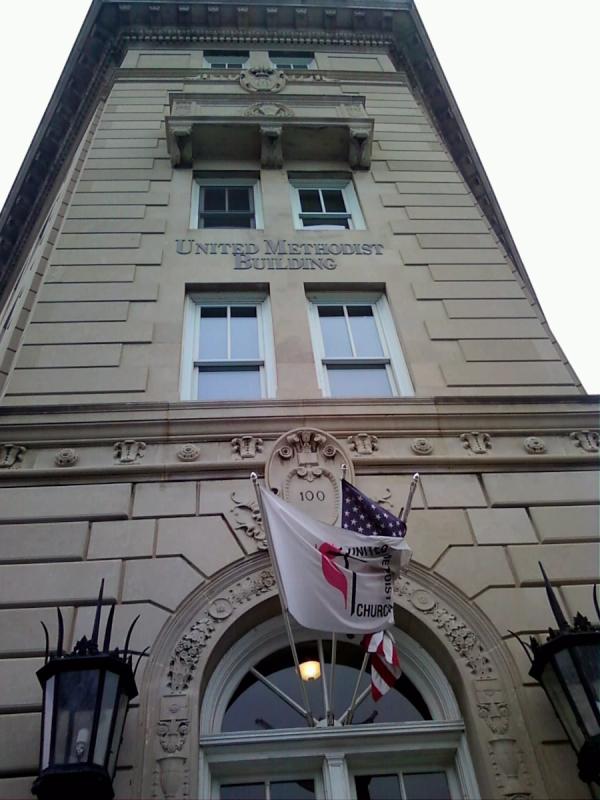
Today I celebrated the wonderful and holy meal of Communion.  I enjoyed this meal in a conference room of the United Methodist Building in Washington DC.  It is a building that sits at a corner.  Across one street is the Supreme Court building.  Across the other street is the US Capitol.  I’ve spent the last few days amongst leaders in the United Methodist Church with the General Board of Church and Society.  It has been a full week.

It has been full of information, meetings, inspiration, prayer, walking, fellowship, and friendship.  I have met two Congressmen, and a General Secretary.  I have stood in awe of the great monuments dedicated to the history of this nation.  My greatest thrill however, has been the chance to meet the amazing young leaders that have dedicated their lives to serving Christ in the United Methodist Church.  I’ve met real people with hopes, passion, talent, and skill.  I’ve shared stories, ideas, and laughs.

This whole experience has been incredibly uplifting.  Today as I walked toward the bread and the cup, I was filled with hope.  I felt an amazing rush of power – Holy Spirit power.  I looked around at the faces of people that were once colleagues, and are now friends.  I saw Jordan, Becky, Chris, Beth, Chris, Bethany, Jessica, Ann, Andrew, and so many others.  I looked at the faces of these servant leaders, and I felt the power of hope.

I still know all the numbers.  I’m not hiding my head in the sand as the church is in decline.  Even while I’ve been here I have heard the stories of church decline, and of the struggles that we face across the United States connection.  This week though has been a great reminder that our church – the imperfect, troubled, struggling church I love – is about more than numbers.

My hope rests above all in the Jesus’ love and righteousness.  My hope resides also in the leaders that are working to open hearts, minds, and doors in the name of Jesus Christ.


Follow The Fat Pastor on Facebook

Follow on Twitter

4 Comments

Filed under Christianity

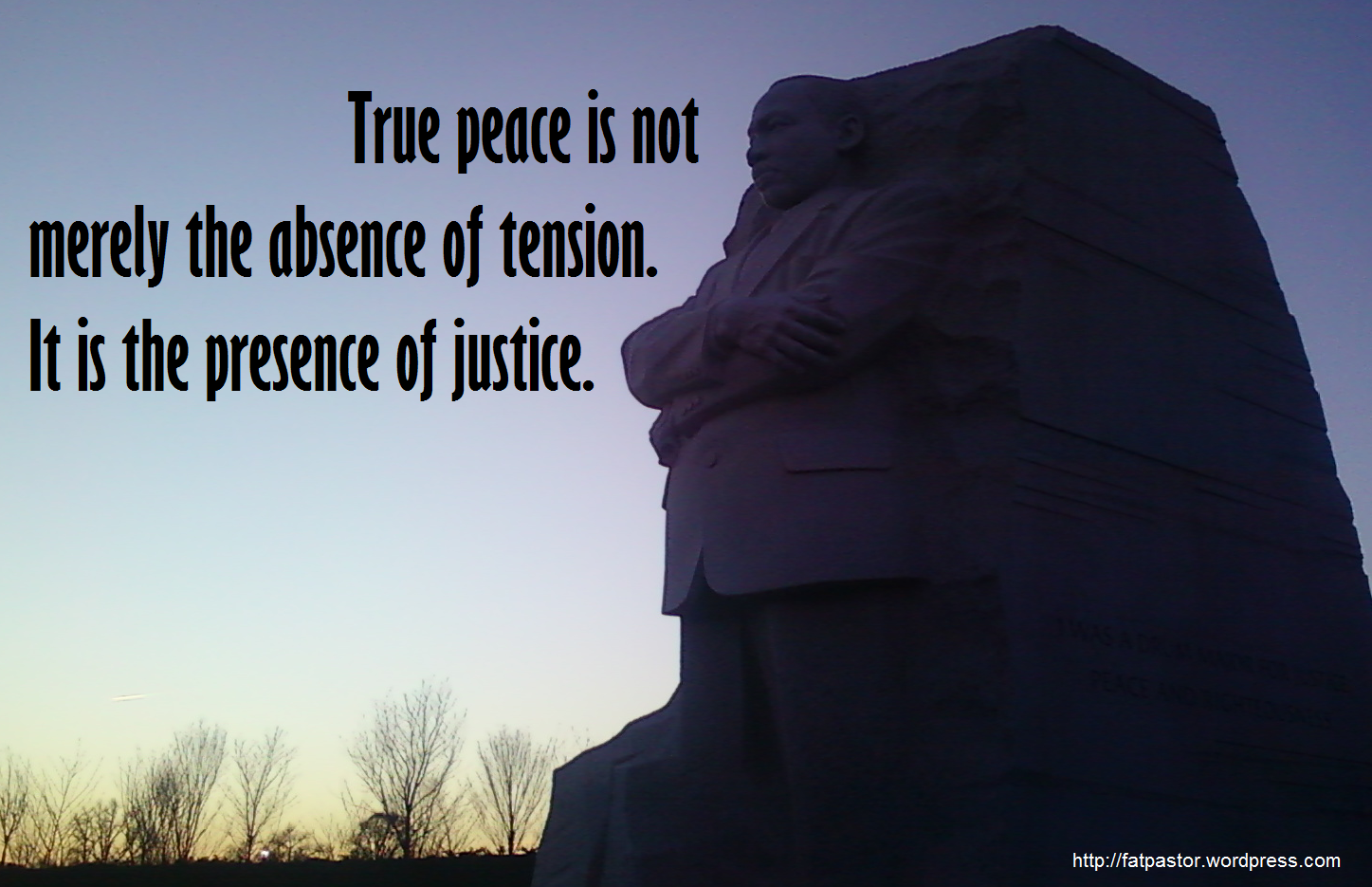
True Peace


Follow The Fat Pastor on Facebook

Follow on Twitter

1 Comment

Filed under Christianity