Category Archives: Christianity

The Grandmothers: Rahab

Part two of four in this Advent series on the women of Jesus’ genealogy.

“Rahab the prostitute” is named twice in the New Testament as a model of faith in action. Both James 2:25 and Hebrews 11:31 praise her and cite her as an example of someone who should be honored. She is named in Matthew 1:5 as one of the mothers in Jesus’ genealogy.

Rahab’s inn seemed to serve as a part of the wall that surrounded Jericho (this was a common way to build ancient cities, with the “wall” being a combination of large buildings and walls forming the perimeter of the city). She received Israelite spies who were sent by Joshua to learn about the city’s defenses. This was the first stage of the Israelite’s occupation of the “Promised Land”

Rahab’s actions are incredible in this brief story. It can be argued that she manipulates three parties, all of whom are much more powerful than her. First, she manipulates the Jericho guard. When they confront her, she sends them on a wild goose chase to find the Israeli spies. Second, she manipulates the spies themselves, keeping them relatively safe but still in a precarious spot when she negotiates for the lives of her and her family. Last, she manipulates God’s plan.

The Exodus tradition is clear about how the Israelites should occupy the land. “I will hand over to you the inhabitants of the land, and you shall drive them out before you. You shall make no covenant with them and their gods.” (Exodus 23:32). Yet Rahab’s story continues in Joshua 6:25 “Joshua let Rahab live, her family, and everyone related to her. So her family still lives among Israel today.”

In other words, Joshua made an agreement with a Canaanite, in direct opposition to God’s decree in Exodus, and this agreement helped lead the Israelites to victory. From the very first battle in the occupation, there were Canaanites who were spared. The agreement between Rahab’s family and the Israelites allowed them both to prosper.

This reveals a deeper tension that is found throughout the Hebrew Bible. There are elements of Scripture that suggest that the Israelites must be pure. They must take total control of the Land and completely destroy all of their enemies. There are truly disturbing calls for genocide found in the stories of occupation. These flow from the promises made to Abraham that are eternal. The covenant of the Land is described as unwavering and pure. The Land belongs to Israel. Period.

But Deuteronomy provides the giant “If.” The ‘if’ is found many places, but is pronounced In the final speech of Deuteronomy. “Now if you really obey the Lord your God’s voice, by carefully keeping his commandments… then the Lord your God will set you high above all nations” (Deut. 28:1). “But if you don’t obey the Lord your God’s voice by carefully doing all his commandments and his regulations… all these curses will com upon you” (Deut. 28:15).

The promises made to Abraham were made for a purpose. Five times in Genesis it is repeated that Abraham is blessed for a reason: to be a blessing  to all (Gen 12:3, 18:18, 22:18, 26:4, 28:14). Deuteronomy backs up this claim, if Abraham ceases to be a blessing to all, then the promises made will turn to curses.

This is an element of the Biblical story that many ignore. As people of God, our unwavering support should be on the side of justice and peace. Drawing direct lines from the Biblical story to modern national politics and wars is a always a fraught endeavor. Within the Bible is a strong tension between isolation from and care for “the other.”

There should be a tension in all of our convictions about what is happening right now in Gaza. Multiple things can be true. Israeli people should feel safe. We grieve the 1,200 deaths and reprehensible violence that occurred on October 7. Palestinian people and children should not be collateral damage, even in the pursuit of terrorists and militants. We grieve the 18,000 Palestinian deaths and the rising humanitarian crisis in Gaza. Hostages should be released. Aid should be given. A path to a just cease-fire must be found.

Antisemitic violence against Jewish people is evil and the rise of it is disturbing. Holocaust-denial is on the rise and needs to end. Islamophobic violence against Muslims is evil and the rise of it is disturbing. The rhetoric and actions of Hamas is deplorable and cannot be justified. The apartheid policies of Israel in Gaza should be challenged and criticized. The death of innocent Israeli and Palestinian people should end. The self-determination of Israeli and Palestinian people should be protected. These should not be seen as political, partisan, or even controversial statements.

I do not have the expertise to untangle the problems in Israel/Palestine, but our Biblical story doesn’t support sweeping generalizations or unwavering support for anything but peace and justice. Rahab the Canaanite saved the Israelites in a city in what is now known as the West Bank and her family lived with them in peace.  There is an Advent hope that a Jewish boy born in a West Bank town called Bethlehem could be the Prince of Peace.

A Pulpit Fiction interview with Walter Brueggemann

A thoughtful piece about avoiding antisemitism by ReformJudaism.org

Jews for Peace is a progressive Jewish voice for peace

Opinion piece from The Forward, an independent Jewish news source that both calls out both Hamas for the terrorism it has inflicted and the government of Israel for mistakes it has made. An excerpt: “Tunnel warfare is dirty, complicated, costly and requires lengthy efforts and campaigns, not the short and swift operations upon which Israel’s military doctrine is built. Rather than weakening Hamas, which is underground, the current Israeli military operation in the strip is killing supporters and opponents of the group alike, inflaming the region, exacerbating anti-Israel sentiments worldwide, silencing political opposition to Hamas inside Gaza, complicating efforts at normalizing relations with Arab countries and achieving precisely what the group wanted in the first place: to reinvigorate the Palestinian cause and force Israel to act in a manner that in essence proves Hamas’ claims.”
Leave a comment

Filed under Sermons

Affirmation of Faith honoring the Grandmothers

*AFFIRMATION OF FAITH

We honor the women who gave birth to hope, who were lifted up by Matthew as the foremothers of the One who came at Christmas.

We honor the women who used their own agency in a world that tried to rob them of it, so that their families could survive and their stories could be told.

We believe in God the mother and father of us all, creator of heaven and earth, whose promise to renew the Earth was embodied in an infant and lives in a promise yet to be fulfilled.

We believe in Christ who was made flesh in an infant child and was born to Mary, whose humanity was proven in his tears, hunger, and blood; and whose divinity was revealed in his feeding, healing, and resurrection.

We believe in the Holy Spirit who indwells with us today, and gives strength to women and men who continue to give birth to hope.

1 Comment

Filed under Christianity, Liturgy

The Grandmothers: Tamar

Part one of four in this Advent series on the women of Jesus’ genealogy.

This Advent I will take four weeks to write about the grandmothers of Jesus. These are the women who were named in the genealogy of Jesus in the first chapter of Matthew. These four women were all either explicitly Gentile or connected intimately connected to Gentiles. Tamar’s father was from a Canaanite city. Rahab was a Canaanite living in Jericho. Ruth was called “Ruth the Moabite,” and Bathsheba was married to “Uriah the Hittite.”

They also all had sordid scandal connected to them. They were all victims of a patriarchal system that valued them more for their womb or sexuality than for their own agency, but they all survived. They all refused to be subjugated, and all four were called “righteous.” History, commentators, and “the religious,” have tried to defile their name. They have been called sinners, adulterers, and harlots, Scripture calls them righteous, and Matthew named them up for a reason.

We will remember the grandmothers of Jesus. We will remember their persistence, their cunning, their loyalty, and their courage. As we prepare for the coming of Jesus, we will remember those who prepared the way for him to come for us.

Tamar, Genesis 38:1-30

The Pharisees asked Jesus when God’s Kingdom would come. He told them a few parables, including one about a poor widow who was denied justice, but persisted in pestering the judge until he granted her justice. Perhaps Jesus was thinking of his Grandmother Tamar while he told the parable of the persistent widow (Luke 18:1-8).

He must have known her story, and that she was the mother of Perez, whose line continued to King David and of course, to Joseph (Matthew 1). Tamar’s story is not one that is told much these days. It comes in the middle of the more well-known story of Joseph and brothers. Wedged in between Judah and his brothers selling Joseph to traders on their way to Egypt, and Joseph gaining favor with Potiphar before getting entrapped by his wife, we get the story of Judah and Tamar.

It is a story with the cringe-factor turned up to 10. It is disturbing on many levels. For one, we are reminded that women’s agency was extremely limited. We are dealing with a patriarchal society where women were extremely vulnerable. Yet through the difficult circumstances, Tamar’s cunning and persistence brings her the justice she deserves.

Judah’s oldest son marries Tamar, but he dies. To fulfill the levirate law (Deuteronomy 25:5-10) she must marry Judah’s second son. This is so that Tamar may live within the clan and get the protection that is due her. It is also to ensure that she may bear a son to “carry on” her husbands line. Onan, her second husband, realizes that giving his brother an heir would mean that his inheritance would be reduced to a third of Judah’s estate instead of half. So he “spills his seed,” (thus giving rise to the “Sin of Onan”) so that his inheritance will not be further divided. As punishment of this evil deed, God strikes Onan down.

Now only one son remains, Shelah, but he is too young to marry. Judah then sends Tamar back to her home to wait until Shelah is of age. After some years pass, Shelah is old enough, and Tamar has not been recalled by Judah (he thinks she is cursed), so she plots her course. When Judah comes to her home town, she puts her plan into action.

She poses as a prostitute at the gate. He takes the bait and sleeps with her. As a deposit for payment she asks for his seal, cord, and staff (all of which would be unique to Judah. This is the ancient equivalent of leaving your ID for a bar tab).

Eventually Judah hears through the grapevine that his daughter-in-law Tamar is a prostitute, and she is pregnant. He cannot bear this shame upon his name, and decides to have her killed. Then she tells him, “I’m pregnant by the man who owns these things.” When he realizes what has happened, he declares “She is more righteous than I.”

It is a crazy story, to say the least. And lest you think, “well, it’s really old, it was a different time,” you should know, it was shocking then, too. And that is the point. Tamar is never judged for her action. In fact, she is deemed righteous. She was denied the justice that she deserved—that Torah demanded. In a patriarchal system that kept women in a perpetually vulnerable state, it was Judah’s duty to protect her. When he failed, she did what she had to do.

Scholars and commentators have not been kind to Tamar. She has been called a sinner, and her inclusion in Jesus’ genealogy a sign that he could redeem even a sinner such as her. Yet neither God nor anyone else in Scripture calls her a sinner. Perhaps our puritanical sexual ethic must be re-thought. Tamar – despite posing as a prostitute and having sex with her father-in-law, is called righteous. She is the original persistent widow who demands—and receives—justice.

That the Torah includes this interlude in the Joseph story suggests that she saved not only herself but helped the development of Judah. Here, he is able to see Tamar in a new light and grow from his mistake. This is a story of Judah’s growth and development. Remember he is the brother who sold Joseph into slavery, but later he is the one who puts his life on the line for Benjamin.

That Matthew includes Tamar in the genealogy of Jesus suggests that she is a part of Jesus’ life, ministry, and legacy. Jesus, the one who criticized the religious for “devouring widow’s homes,” who raised the widow’s son, and told a story of a persistent widow, probably remembered the story of Grandma Tamar.

We should remember her, too. Remember her predicament—the product of a patriarchal system. We should remember her persistence and her triumph. We should remember our grandmothers who overcame patriarchal systems that still exist. Tamar’s cunning and persistence is an important step in the line of Christ. We can honor her by remembering the women who continue to preach, pastor, prophecy, advocate, and work for justice.

Leave a comment

Filed under Christianity, Sermons

The Great Thanksgiving honoring the Grandmothers of Jesus

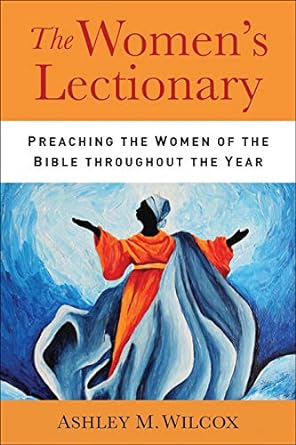
This year I will be preaching from the The Women’s Lectionary: Preaching the Women of the Bible throughout the Year by Ashley Wilcox. The year begins with Advent, and the four Advent readings include the stories of the four women included in the genealogy of Mary’s husband as told in the Gospel of Matthew. This year, the first Sunday of Advent is also the first Sunday of the month, which means it is a Communion Sunday. I have written this Communion liturgy for this Sunday to honor the grandmothers of Jesus.

Feel free to use it at any time. Just drop me a comment letting me know where you are using it in worship.


The Lord be with  you

And also with you

Lift up your hearts

We lift them up to the Lord

Let us give thanks to the Lord our God

It is right to give our thanks and praise

It is a good and joyful thing, always and everywhere to give thank to you, Almighty God, creator of heaven and earth. You formed us in your image and breathed into us the breath of life. You who are father, mother, and parent of all gave us the gift of parenthood and told us to be fruitful and multiply. You set parents in a garden and called them to partner with you in caring for it. They outgrew the garden and the peace and balance – the Shalom – that you created was disrupted.

Still your love was passed down from generation to generation. You guided your chosen family of people so that they could be a blessing to all the families of the earth. When they fell into slavery, your power liberated them. When the family was threatened by external foes, your grace delivered them. When the family threatened to pull itself apart, your forgiveness saved them.

A family set apart to bless the world was itself saved many times by women who acted boldly and with righteousness. Threatened time and again by foes internal and external, four women emerged out of the messiness of life and were called righteous. Each of them saved their family and preserved the family line that stretched from Abraham to Christ.

And so with your people on earth and all the company of heaven we praise these women who saved the family of Christ. But first and foremost we praise your holy name and join the eternal hymn of the Saints of God:

Holy Holy Holy Lord, God of power and might, heaven and earth are full of your glory. Hosanna in the highest. Blessed is he who comes in the name of the Lord. Hosanna in the highest.

Holy are you, and blessed is your Son Jesus Christ, who was born of a woman and was adopted by Joseph, a Son of David, and a child of Abraham. We give thanks for Tamar the Canaanite, Rahab the Canaanite, Ruth the Moabite, and Bathsheba the wife of a Hittite. They proved that all the families of the earth are a part of your plan of Salvation. Through their agency, intelligence, courage, and loyalty, they were called righteous. They proved that those who persist for justice will be heard. Through them the line of Jesus was preserved.

Through slavery and liberation, exile and restoration, you have been our God. The Law and the Prophets declare describe your justice and your steadfast love that endures forever. After being visited by an angel, Mary went to her relative Elizabeth who was the first to declare that Jesus, still in utero, was “My Lord.”

Mary magnified you, and confessed that you show mercy to everyone, from one generation to the next. You scatter the arrogant and pull down the powerful from their thrones. You lift up the lowly. You fill the hungry with good things. You come to the aid of your servant. We remember your mercy and the promise you made to our ancestors, Abraham and Sarah, which was kept through the agency of these women until the Word became flesh.

Christ humbled himself in obedience to the Divine Will and freely accepted death on a cross. By the baptism of his life, ministry, suffering, death, and resurrection, you gave birth to your Church, delivered us from slavery to sin and death, and made with us a new covenant by water and by Spirit.

Words of Institution

On the night Christ was betrayed…

1 Comment

Filed under Christianity, Liturgy

Pentecost and hope yet unseen

IGRC for Unity Devotional: 5/28/2023

Scripture: Acts 2:1-4; Romans 8:18-31

On this Pentecost Sunday, the Narrative Lectionary gives us the regular Acts 2 story, but combines it with a part of Paul’s letter to the Romans. Romans 8:28 always brings me back in time – to circa 2002 and the very first sermon I preached. I was hired at age 24ish to be youth director at Mackinaw UMC by Rev. Dan Powers.

One Sunday early in my tenure there, I was given a chance to preach. Being 24ish, I picked “And we know that in all things God works for the good of those who love him, who have been called according to his purpose” (NIV) as my text.

I don’t remember much about that sermon, but two things stand out. The first are the words of encouragement Rev. Dan (he’ll always be Reverend Dan to me) gave me afterwards. “You really picked a tough one,” he told me without an ounce of sarcasm or incredulity at my hubris for trying to tackle the age-old problem of theodicy in my very first sermon. It was good enough that he asked me to preach again and again, and eventually guided me in my candidacy and helped lead me to seminary. I’ll be forever grateful to him for the patience and guiding care he gave me in my two years at Mackinaw UMC.

The second thing I remember is the face of my Mom after I was done. My Mom was the one who first planted the seed of my call into my heart when I was a teenager. I’ll never forget the look on her face when she saw me living into the role she had seen for me years before.

My relationship with this verse however, has evolved over the years. Twenty years later I do not think I could summarize my view of “all things happening for good” as succinctly or as confidently as I did that day in Mackinaw. I know a deeper sense of loss, of frustration, and grief than I did that day. I’m not saying I have felt great suffering, but I have questioned many times the goodness of all things. I am more acquainted with lament today than I was then.

15 years after that sermon in Mackinaw, I sat beside my mother as she was dying with cancer gripping her brain. At that bedside I experienced the verse that comes a few before v. 28, “Likewise the Spirit helps us in our weakness, for we do not know how to pray as we ought, but that very Spirit intercedes with groanings too deep for words.” (Romans 8:26, NRSV).

Paul reminds the Romans that suffering is a part of life. Indeed, for those who follow Christ, it should be an expected part of life. Not because God wills suffering on the faithful, but because the world will pour out suffering on those who follow Christ. And God will pour out grace to overcome it all. The way of Christ is a way of love, patience, generosity, forgiveness, and justice. This way is often met with fear and reprisal. In fact, Paul’s message of the Cross is that love will suffer these things. The Cross is a reminder that love will bear these things for the sake of love, even in the midst of suffering.

God doesn’t give us suffering, but the Cross is a reminder that Jesus endured suffering for the sake of love, and resurrection is a reminder that love wins. Christ crucified and Christ resurrected reveals God can transform the worst suffering the world can dole out.

It is the Holy Spirit that raised Christ from the dead. It is the Holy Spirit that blew through an upper room in Jerusalem and swept the disciples out in the public square to testify to the Risen One. It is the Holy Spirit the empowered those disciples with visions and dreams and words of prophecy and love. It was the Holy Spirit that gave Paul confidence to hope for what is to come despite all worldly evidence that said he should fear.

It was the Holy Spirit that swept over me this past Sunday as I laid my hands on my nephew being confirmed in a Lutheran Church near my hometown. I heard my Mother’s voice as we sang her favorite hymn. I saw my mother’s face look down upon Luke in the same way she looked upon me that day in Mackinaw. I felt the Holy Spirit which gives me hope for things yet unseen.

It is the Holy Spirit that is sweeping through churches still. When the world is swept up in anger and violence. When wayward teens looking for directions are greeted at porches with guns. When nations are invaded by despots. When rainbow stickers on Target trigger anger and threats, the Holy Spirit speaks prayers of groaning too deep for words. The world experiencing labor pains, but the joy of the Kingdom is coming. The suffering we endure will be transformed.

The Holy Spirit, which raised Christ from the dead, will raise this Church up too. When the wind of the Holy Spirit sweeps through our sanctuaries and pushes us out into the world in desperate need of love and grace. When the Holy Spirit reconciles the Church to the ones who have been harmed by dogma. When the Holy Spirit gives us the confidence we need to stand strong for justice and compassion. When we recognize the power of the Holy Spirit working in the lives of all people. When the Holy Spirit fills all people with the power of love instead of the love of power, we will know peace. We will know Resurrection. May the winds of the Holy Spirit blow.

2 Comments

Filed under Christianity, IGRC for Unity, Sermons

Two Easter stories

Matthew 28:1-15

They say this is the golden age of television. The streaming services, hungry for content, have empowered new story tellers to tell incredible stories. The stories being told are incredibly entertaining. They wrestle with true emotion, blend lines between comedy and drama, create fantastic new worlds, and reveal truths about society, masculinity, racism, inclusion, and emotional intelligence. There are so many new, incredible stories being told and so many ways to watch them it can be overwhelming.

Thank God for the “Previously On…” feature. We can jump from show to show and get caught up real quick on what’s going on. The “previously on” segment usually gives clues about what is coming in the show at hand. There are often so many story lines and threads running through a show, the “previously on” can give us a reminder, “oh yeah, I remember that guy” or “oh, so they did meet at that one party.”

On Easter, we might need a “previously on.” Especially if we left off at the Triumphal Entry. The fact is, a lot happened during the week. We may need a summary reminder of all that is happening, because Good Friday was a heck of a cliff-hanger. The season ended with Jesus dead and sealed in a tomb. But Matthew gives us one little detail that we could easily miss (and is unique to Matthew).

Matthew 27:62-66 would be easy to miss, but consider this your “previously on” reminder. The powerful men that had Jesus killed were scared. They were afraid that they had just made a martyr, and that his violent and shameful death wouldn’t be enough to erase him like they wanted. So they went to Pilate and asked for a guard. They asked for a guard because they had been listening. “He told his followers that he would rise, so let’s make sure we have guards there.”

They put armed guards at the tomb to make sure Jesus’ disciples didn’t come, steal the body, and spread crazy rumors about resurrection (and just in case he did actually rise, they would be there to kill him again).

Then, very early on the first day of the week something happened. The women showed up. It is commonly understood that the women came to anoint the body. This is the story in Mark and Luke. In Matthew however, they did not bring in oils or spices. Jesus had already been anointed – back in 26:6-13 (and perhaps it was one of these women who did it). Maybe, instead of showing up to anoint a dead body, they were showing up because they believed what he had told them so many times. Perhaps the women were there for the same reason the guards were – because they remembered that Jesus said he would be raised. And then…

The earth quaked. Lightning flashed. And angel of the LORD appeared, and the guards were paralyzed with fear. The women however, were faithful. They heard the words of the angel and believed. They knew that Jesus was risen and they went to tell. Then on the way back to the disciples, they knew completely. Christ had risen. He was risen indeed, and the greatest story ever told had reached its series finale.

The stories we well entertain us, but the stories we believe shape us. When we believe stories of justice, we make be inspired to work for justice. When we believe stories of hope, we may hold onto hope when it seems to be gone. When we believe stories of new life, we may know new life. When we believe in the Kingdom of Heaven, we may live in the Kingdom of Heaven.

Matthew tells us that Jesus rose, and he also told us that two stories emerged that day. Two stories were born on Easter morning. One story was the one the guards told. Paralyzed by fear, paid off by the powerful who wanted to end the Christ story, they told a story of death. They told a story of grave robbers and lies.

The women told another story.

And both stories remain to this day. The story of Empire is still told. It is a story of exploitation disguised as liberty, prejudice disguised as holiness, destructive conspiracy disguised as truth telling, and money buying power disguised as care for the poor. The story of Empire is thriving. Its aim is to paralyze with fear and incite mobs to release Barabas. Its aim is to mock those who wish to stay awake in the garden of Gethsemane. Its aim is convincing people that everyone who disagrees is an enemy, and that opposition is demonic. Its aim is to keep peace at all costs, but their peace is not a peace of Christ. It is not a peace won by justice or love. It is a peace won by the sword. It is a peace won by dominance and fear. The Roman guards told a story of lies that Matthew says persists to this very day. They told a story that said “Jesus is dead.”

But the story of the women persists as well. The women told a story of a different kind of Kingdom. The women told the story of the Peace of Christ that ends not at the Cross but at an empty tomb. The women told the story of an earth-shattering new reality. They told the story of worship and adoration. They told the story that the Kingdom of Heaven was at hand. They told the story that “Jesus is risen!”

The stories we tell may entertain us, but the stories we believe shape us.

Which story will we believe?

1 Comment

Filed under Sermons

Inspiration and Purpose

IGRC For Unity Devotional for October 16, 2022

2 Timothy 3:14-4:5

Thomas Edison famously said that “Genius is 1% inspiration and 99% perspiration.” The writer of 2 Timothy claims that Scripture is 100% inspiration. Yet what is inspiration? The Greek word translated to “inspiration” is theopnuestos. In this word we can see the roots for “God” and “Breath.” So inspired seems to literally mean “God-Breathed.”

Is this the same however, as God-authored, or God-dictated? It seems to me that the leap from “inspired” to infallible or inerrant, as some make, stretches credulity. Scripture is inspired by God, but what does that mean?

Inspiration is often described as a moment. It is the moment a tune enters a song-writer’s head. Whistled out of nowhere as they walk through the park. The birthplace of the tune cannot be located or named. It seems to have breathed out of the artist from nothing. The painter sitting at the easel begins to create. Why does the brush move the way it does? How is each color chosen, mixed, and applied?

There are years of work, study, technique, and practice behind every stroke of a brush. The same is true behind every note of a trumpet of the jazz player. Yet in that moment when the air pushes through the instrument or when the brush touches the canvass, that is inspiration. Is that a God-moment? Some artists would certainly attest to being inspired by God. Few however, would say that God moved the brush. The inspiration moved the artist, and the artist created. God and humanity are co-creators of things inspired.

More important than the nature of inspiration however, is the purpose of that inspiration. Scripture has a purpose. It is “so that the person who belongs to God can be equipped to do everything that is good.”

Too many use Scripture for harm. They use it to perpetuate preconceived prejudices. They use it to strengthen their flimsy understanding of biology, history, and culture.

“They will collect teachers who say what they want to hear because they are self-centered. 4 They will turn their back on the truth.” They build echo-chambers of their opinions, ignore evidence and science and instead listen to rumors, click-bait YouTubers, or conspiracy theorists with an agenda. Scripture is meant to lead us to good and not harm.

If your use of Scripture is not doing good, then you’re using it wrong. Scripture is inspired by God and is meant to inspire good. God who is good created humanity who is good, and gave us Scripture to help us find the good and do good in the world.

Leave a comment

Filed under Christianity, IGRC for Unity

Will we still fear the “giants in the land”?

There are moments when I read a passage of Scripture and think, “how can this possibly apply to the real world?” Sometimes Jesus’ command to “turn the other cheek,” his call to “release the captives,” or the Torah’s system of forgiving all debt feel like impossible dreams that couldn’t work in modern society. Other parts, like Jonah being swallowed by a fish, Balaam’s donkey speaking to him, all the water in Egypt turning to blood, or Paul reviving a man who fell out of a building push my understanding of how the world works, and feel more like the stuff of legend than history.

Then sometimes I read a passage of our story and it screams at me with its authenticity and timeliness. Numbers 13-14 is one of those stories that feels incredible because of how credible it is.

The people have fled Egypt. They have traveled through the wilderness. They have received the Law of God and are now on the brink of the Promised Land. Promises made to Abram 500 years ago are about to be fulfilled. They have lived through a series of signs that defy understanding. They have witnessed the destruction of the greatest army in the world. They have journeyed through a difficult terrain. Now on the borders of Canaan, they send out scouts into the land.

The report is mixed. The land is everything that had been promised. It is fertile—flowing with milk and honey. But it is occupied. There are people there, and they are strong. They have cities and fortifications. Occupying this land is not going to be easy. They have been through so much together and now they stand on the precipice of something new, and they are fearful.

There is no question that the task in front of them was daunting, but they brought back with them fruit of the land. A couple of the scouts reported that they should move into the Land despite the obstacles, knowing that God would be with them. Think, after all, of all they had seen God do for them up to this point. Caleb and Joshua believed that with God on their side, they would be able to move into Canaan, even with the difficulty that lie in front of them. And then the story gets real. Like, uncomfortably, unnervingly timely:

“But the men who went up with him said, “We can’t go up against the people because they are stronger than we.” 32 They started a rumor about the land that they had explored, telling the Israelites, “The land that we crossed over to explore is a land that devours its residents. All the people we saw in it are huge men. 33 We saw there the Nephilim … We saw ourselves as grasshoppers, and that’s how we appeared to them.”

They ignore the evidence (the fruit in their hands). They make up rumors. They say they saw Nephilim (a legendary people with an obscure reference in Genesis that talks of a race of giants who were related to angels. The stories of the Nephilim were much like ancient Greek stories of the cyclops or centaurs. They were a legend that most understood as fiction, but were still a source of cultural fear).

Instead of trusting the evidence—the land is fruitful, not terrible. Instead of trusting God who had delivered them already, the people were gripped by the fear of lies and rumor. Then this is the part that feels truly familiar. They decide they want to go back to Egypt.

Progress is scary. The unknown future of a new land and a changing people was too much for them to face, so they decided that they would rather go back to a simpler time. Nevermind that in that time they were slaves. Nevermind the struggle that they have overcome thus far. Nevermind the promise of God to lead them to a better place. The fear was too much and the people wanted to go back.

And here we stand. We have been through so much as a people. We have overcome. We have seen God do great things. We have been through the wilderness and have experienced God’s provision through the difficult times. There is still much to overcome. The future has real obstacles. We have real difficulties in front of us. Are we going to fall prey to a toxic sense of nostalgia? Are we going to listen to the rumors that destabilize our society? Are we going to believe the lies that there are “giants in the land?” Are we going to fear the boogeymen and regress back to Egypt? Are we going to submit ourselves to slavery again?

Or will we trust in God? God showed great signs and wonders and overcame Pharaoh. God delivered the  people from slavery and brought them to the brink of the Promise. Will we trust in the promise of God or the lies of the fearful? We face a turning point as a people.  Where will we place our trust?

Leave a comment

Filed under Christianity

Jesus forgave them from the cross, but didn’t come back to hang out with them.

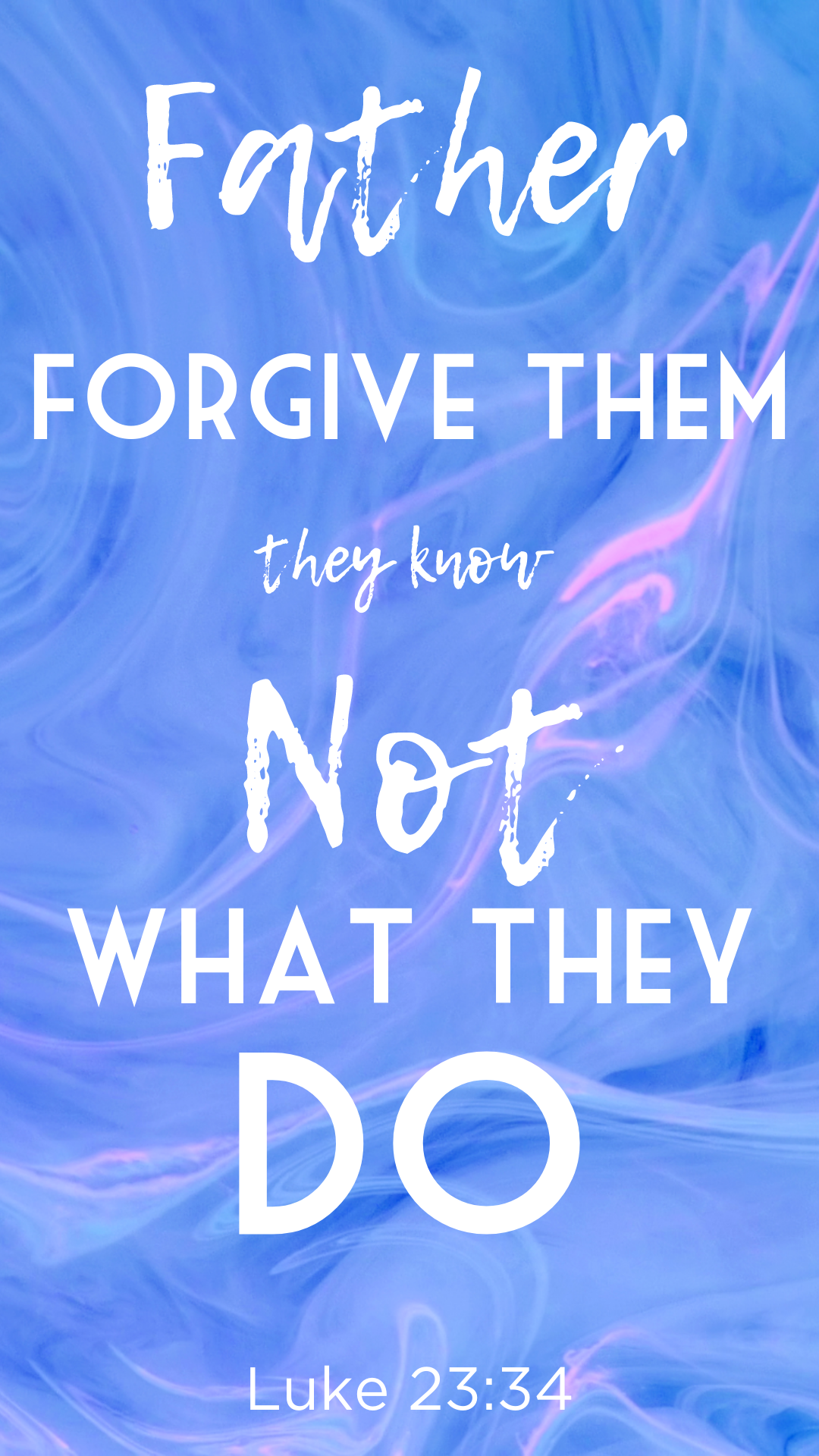
Forgiveness is at the heart of Christianity and is an important theme in the Gospel of Luke, in particular. In this passage we have the famous line, “Father forgive them, for they know now what they do.” It is statement that is unique to Luke’s story, and it is emblematic of Jesus’ entire ministry. That words of forgiveness were on his lips as he breathed his last are fitting.

Looking backward and forward you see that forgiveness is a part of the message. Even before Jesus was born, John the Baptist was preaching about forgiveness. After the resurrection, Jesus’ last command before his ascension is for the disciples to bring the word of forgiveness to the world.

Forgiveness is an integral part of the Kingdom of God. That Jesus himself forgave others was a part of why he was even on the Cross. The tensions between him and the religious leadership began when Jesus started to forgive sins.  In chapters five and seven, Jesus heals someone in front of the religious leadership. They are not upset with his healing, but they grumble when he claims to forgive their sins.

In the prayer Jesus taught us, our own forgiveness seems linked to the forgiveness we offer to others (that was always my least favorite part of the Lord’s Prayer). Forgiveness, both receiving and offering, is an important part of the Christian faith.

Modern psychologists and social scientists agree. Forgiveness is an important part of a healthy life. Many studies have been done to show that forgiveness leads to greater health outcomes—both physical and mental. Forgiveness is an act of tearing down boundaries. Sin can be seen as something that destroys relationship. It puts obstacles between people and between people and God. Forgiveness is the act of tearing down those obstacles and restoring right relationship. Forgiveness is the path toward shalom.

God’s shalom is the origin of all creation. Shalom has been lost, but restoring Shalom is the purpose of Jesus’ life, ministry, death, and resurrection.

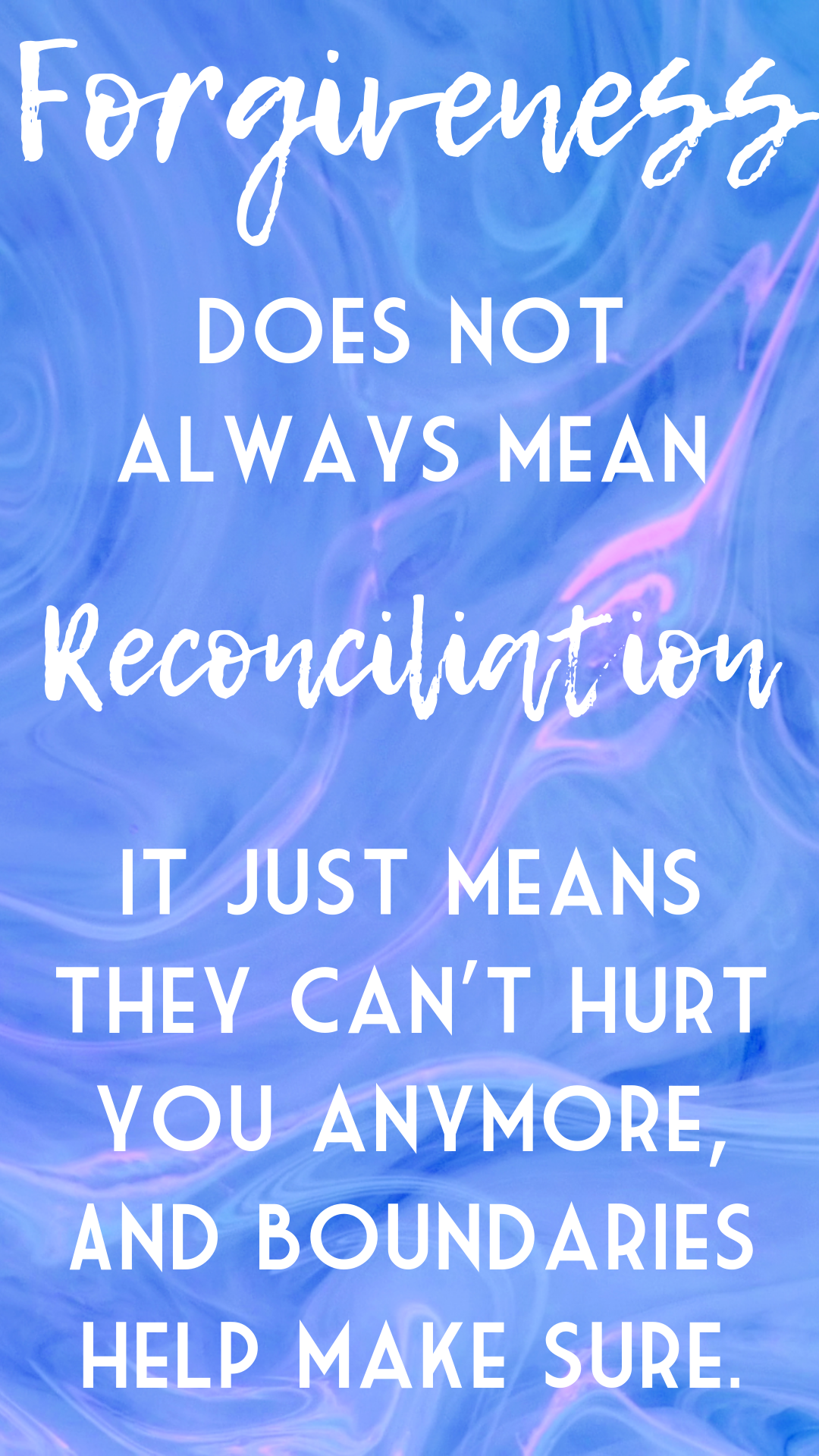
Yet rushing into forgiveness is not true forgiveness. One cannot get to forgiveness without first processing pain, experiencing anger, and allowing time and space for forgiveness to take root. Forgiveness cannot be forced upon anyone. Forgiveness is not the same as acting nice for propriety’s sake. Forgiveness is not about making everyone get along so that we can have a picture of a happy family for the Christmas card.

Forgiveness is about returning to yourself. It is about getting past barriers of pain, fear, resentment. Forgiveness restores our hearts, but it does not always lead to restored relationship. Jesus forgave those that mocked him while he was on the Cross, but when he came back on Sunday morning, he didn’t hang out with them. He broke bread with his disciples in Emmaus, not with the leaders and soldiers who mocked him. He forgave those who hurt him, but he didn’t come back to them. Dr. Thema Bryant first pointed this out to me at a lecture I attended, and it hit home.

Jesus forgave those that mocked him. It was an incredible act of grace in the midst of his pain and suffering. He looked down at those who had hung him on that tree, felt compassion through all of the pain and suffering, and forgave them. It is a powerful moment in the Gospel of Luke and should never be overlooked. But as Dr. Bryant pointed out to us, when he came back, he didn’t hang out with the soldiers and the leaders and the people who insulted him. He came back to be with his friends.

When we go through trauma, abuse, or emotional torment, boundaries are particularly important. It is possible to forgive someone and not walk back into a relationship that will hurt you again. God wills forgiveness in our lives, but God does not will for you to be hurt over and over again.

Reconciliation is God’s ultimate will for all relationships, but on this side of eternity, it is not always possible. Sometimes in order to protect our own shalom, relationships must end. Boundaries are an important part of self care and self love. God wills shalom in your life, and that might mean firm boundaries with some relationships. It means forgiveness, but it doesn’t always mean reconciliation.

Leave a comment

Filed under Christianity, Personal Reflection, Sermons

Call them by name

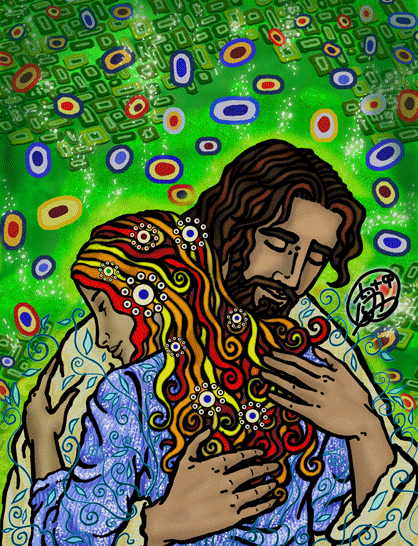
“Abrazo de Jesus” by Felix Hernandez http://www.felixhernandezop.com/internet.php#

Scripture: John 20:11-19

11 “Mary stood outside near the tomb, crying. As she cried, she bent down to look into the tomb. 12 She saw two angels dressed in white, seated where the body of Jesus had been, one at the head and one at the foot. 13 The angels asked her, “Woman, why are you crying?”

She replied, “They have taken away my Lord, and I don’t know where they’ve put him.” 14 As soon as she had said this, she turned around and saw Jesus standing there, but she didn’t know it was Jesus.

15 Jesus said to her, “Woman, why are you crying? Who are you looking for?”

Thinking he was the gardener, she replied, “Sir, if you have carried him away, tell me where you have put him and I will get him.”

16 Jesus said to her, “Mary.”

She turned and said to him in Aramaic, “Rabbouni” (which means Teacher).

17 Jesus said to her, “Don’t hold on to me, for I haven’t yet gone up to my Father. Go to my brothers and sisters and tell them, ‘I’m going up to my Father and your Father, to my God and your God.’”

18Mary Magdalene left and announced to the disciples, “I’ve seen the Lord.” Then she told them what he said to her.


He called her by name, and everything changed.

Weeping, inconsolable, desperate for any information anyone could give, she was stopped in her tracks with one word. Her name.

She was unfazed by two angels standing in a tomb that she just saw was empty. When they were no help, she turned toward a gardener, and cried out, “I do not know where they have put my Lord.” She was searching frantically. She watched him suffer. She watched him die. She could still smell the scent of the oils she had poured over his feet (although this is ambiguous, there is a strong argument by Diana Butler Bass among others that claim that the Mary who anointed Jesus’ feet is this same woman known as Mary Magdalene). The feet she had washed with her tears and hair were pierced in front of her. He was dead.

And now he was gone. Adding insult to shameful injury, he was gone. She must have turned her head again after asking the gardener about him because when he spoke her name the Scripture says she had to turn again to face him.

“Mary,” he said, and everything changed.

Reading between the lines, I am pretty sure that she said “Teacher!” then threw her arms around him and they embraced (Why else would he say, “Do not hold onto me,” unless she was already holding onto him?).

Why didn’t she recognize him? Was he transformed in some way? Was his resurrected form intrinsically different? Was she just too frantic to notice? Was it just too improbable to believe? Whatever reason she did not recognize him, that all changed when he called her by name. He saw her, and she saw resurrection. In that moment she experienced the new life in Christ. She was the first person to experience Easter. She was the first person to witness Resurrection, and she knew it in one beautiful moment when he recognized her first. He called her by name and new life began.

Call her by her name. Call him by his name. Is it too much to ask? She might have transformed in ways you may not recognize. He may have cut his hair shorter than you’re used to. They might use awkward pronouns that you’re not used to using. Call them by name, and you might give them new life.

Call them by name, and they might recognize love that they feared was dead. Call him by name – maybe  not the name you are used to, maybe not the name you know. Call him by the name he has chosen, not the dead name he has left behind.

Call her by name – maybe in clothes you find odd, or after treatments you do not understand. Call her by name because she has earned that much. Call her by name because Christ calls her by name. She has agonized in a prison she was born in. She has hidden for so long. She is fearful every time she claims her name. She is fearful of the strange looks, the scornful whispers, the outright violence that is done to women and men like her every day.

Call him by name.

Call her by name.

Call them by name.

That they might know that they are beloved.

Call him by name.

Call her by name.

Call them by name.

And in that moment they may know eternal life.

1 Comment

Filed under Christianity, Sermons