Category Archives: Sermons

Why God?

The Starry Night, by Vincent van Gogh from the NYC MoMA

On a beautiful evening in northern Michigan, I was laying on the beach.  I was surrounded by  most of the people I love in this world.  My daughter lay asleep on a towel.  My other daughter was wrapped in the loving arms of a family member.  The sun had set.  The sky had done its marvelous shift from blue to red to purple.  The stars were beginning to appear and slowly. Almost imperceptibly, more were making their debut.  It is a scene that has been repeated since the dawn of humanity.  A group of people, surrounded in love, adoring the awesome specter of a night sky.

I don’t know about the rest of my family, but I knew that I was participating in the oldest form of religious ritual.  For as long as humanity has been walking, eyes have turned skyward at night.  The seemingly endless chaos of stars in the sky has inspired awe and wonder a thousand generations.  My little human mind started to do what little human minds do – I started to label and categorize.  I remembered little snippets of my Astronomy 101 class and was able to identify the Big Dipper, the North Star, Cassiopeia.  I thought to myself, “I think that might be Mars.”  We strained to see satellites, and were envious of those that caught a glimpse of a shooting star.  Even though my analytical mind knew that was not a shooting star, but a piece of space debris being burned in our atmosphere, my wondering mind wished I could catch a glimpse of one.   I was lost in a sense of wonder and astonishment, and couldn’t help but ask myself that age-old question, “How many stars are there?”  I tried in vain to count, but gave up quickly.  “I wonder what that bright star is?” I wondered.  “Is that a constellation?” I thought to myself.

Then someone, perhaps wondering the same things as me, pulled out their iphone.  In an instant they were using it to look at the stars, and it was telling them the names of each constellation, each bright star, each planet, each galaxy and nebula.  It was an amazing little app (and it was free).  There, on secluded beach in the midst of my naive wonder, technology came in to save the day.

My wonder was gone.  And yet, it was really gone before the iphone appeared.  I know that there are more stars in the sky than I can count. Google can tell me there are between 2,000 and 6,000 on any given clear night that we can see with no aid.  I know that what we can see is but a tiny speck in the greater universe.  There are about 100-200 billion stars in our galaxy, and we inhabit an average galaxy.  Conservative estimates say there are about 100-200 billion galaxies.

In ancient times people gazed at the stars and thought that they must be hung in the sky from a firm dome that covers the earth.  There were a few odd “moving stars,” and they just increased the sense of amazement.  Today we know better.  We know that stars are out in a seemingly infinite thing called “space.”  We know that there are more stars than we could ever name or group into neat little patterns.  We know that stars are not tiny pins of light, but instead are giant gaseous nuclear reactions.  We know that the stuff from which we are made – elements – are created in the great furnaces of stars, and more are made in the cataclysmic explosions that occur when stars die.

There are thousands of other mysteries that we have explained, riddles that we have unravelled, questions that we have answered.  All of our progress and discovery has taken us places that seemed unfathomable only a few generations ago.  In the span of 66 years humans went from Kitty Hawk to the moon.  As more and more is explained, there seems to be less and less need for God.  The myths of our ancestors, used to explain things like sunset and sunrise, seem like silly childhood stories.  More and more people ask, “Who needs God?”  Besides being the title of a wonderful book by Harold Kushner, this is a question that has been on the minds of modern people for decades.

I cannot answer that question for you.  Maybe you don’t need God.  I think it is perfectly possible to live a full, rich life without ever believing in God.  I also believe, however, that there is something in us that yearns for more.  I need God because when I look at the stars at night I see from two distinct perspectives.

When I gaze up into the stars I may, at the same time, participate in two of the most basic human instincts.  I desire to name, count, label and categorize.  There is a part of my humanity that makes me want to know more.  It is a driving curiosity that makes me want to get a star map.  I feel comfort in being able to order the seemingly chaotic universe.  I feel comfort in knowing that there is not pure mystery.  Discovery and advancement is a holy work.  Science, knowledge, technology have given us many wonderful gifts.  I am in awe of the capability of the human mind to create and of the human will to advance.  Yet there is something in me that is equally human that knows that there is more up in the stars than a vast collection of hydrogen gasses and nuclear reactions.

I stop and wonder at the sheer magnitude of it all.  I wonder about my own place in this vast and seemingly chaotic universe.  I am drawn into a deep conviction that there is more to all of this than one life.  There is more to this world than even our collective lives.  While at the same time feeling dwarfed by it all, I am strengthened in knowing that I have a place in it.  There is something for me here to do.  I’m not exactly sure what it is, but I know that it has a lot to do with loving one another.  I lay down on a beach surrounded by people I love and know that there is something powerful and real that is surrounding us.  I may not be able to name it.  I may never understand it, but I know it is real.

And for me, this is the beauty of being human.  You can call it the analytic and artistic – the objective and subjective – the intellect and the emotion – the yin and the yang.  I call it the sublime paradox of being human.  It is the mystery of faith – the drive to advance, to know, and to understand, held in juxtaposition with the humility of surrender, knowing that there are some places our intellect will not be able to bring us.  Ultimately it is there – the place where humanity’s drive to be more, and our humility to seek God, that is our greatest hope.  It is there – between the extremes of religious fundamentalist tyranny and amoral scientific advancement – that the Kingdom of God is realized.
1 Comment

Filed under Christianity, Sermons

Come to the Feast

“The Five Thousand” by Eularia Clark, 1962. Click on the image to be taken to the Methodist Church Collection of Modern Christian Art.

As an athlete, one of my favorite times was the few moments before a game.  I loved the anticipation of getting ready – putting on the uniform just right, lacing up the shoes, sharing eye contact with a teammate communicating a sense of common purpose in nothing more than a nod.  I loved getting ready with music playing.  It was like I was in my own movie, and the song I chose was my soundtrack.

Come to the Feast, by Christopher Grundy

Today I go through a similar ritual before worship.  I get myself ready.  I breathe a little deeper.  My adrenaline starts to flow.  I sit in my office for a few moments, and sometimes I crank up the music.  Often it is the same song: Come to the Feast, by Christopher Grundy (Grundy is professor at Eden Theological Seminary and a great musician. You should go to the link and listen to and buy his music).

“Come to the Feast” speaks to the heart of the gospel.  “Come to the feast.  There’s always room for one more and there’s all you can eat.  Come and take some to go. Gather all you can hold and then go.  Go spread the feast.”  We are a people of the feast.  We are a people of the Table.

At the heart of everything we do as Christians is the table of Jesus Christ.  How we think about the table informs how we think about everything else.  Where does the pastor stand?  Behind the table in a gesture of welcome and inclusion, not with her back to the congregation.

What do we serve?  Bread and grape juice as a sign of hospitality to those that cannot have alcohol.

Who is invited?  Everyone.  Children?  Yes.  They may not understand what is going, but then again, are we kidding ourselves if we think we do understand?

Unbaptized?  Yes.  The moment of communion is so powerful that it can be a moment of conversion and transformation.

Democrats and Republicans? Yes. We don’t bar you for voting a certain way.

Rich and Poor? Yes – and they each get the same amount.

Black and White?  Yes, although we repent for times when this wasn’t true.

Gay and Straight? Yes, for God created all and said it is “good.”

The Lord’s Table is a table for all.  On it holds the feast which has transformed lives.  On it rests the bread that has been broken for us all.  Jesus broke the bread and told us to “do this in remembrance of me.”  It was not simply to remember that Jesus’ body was broken.  It was remember that his body held life.  When we break the bread we are to remember that Jesus was more than a sacrificial lamb led to the slaugher.

When we hear “Do this in remembrance of me,” we should hear Jesus saying: “When we got together in the home of tax collectors and sinners – Remember that.  When the women came to me and broke free from their man-made roles of servitude – Remember that.  When you guys tried to keep the children from getting to me, and I said ‘let them come’ – Remember that.  When we sat in the crowd of 5,000 people and all we had were five loaves and two fish and you all thought there was no way that we would have enough, and then everyone ate – Remember that.”

“Remember when the Pharisees tried to use the Law to put up barriers between who is in and who is out – Remember that I broke those barriers as easily as I break this bread.  When they used the Law to condemn and tried to trap me in legal issues –   Remember when they asked me what was the greatest commandment, hoping that I would trip on my words – Remember what I told them?”

“And things aren’t looking good right now.  The Romans and the leaders are coming.  They are going to beat me and crucify me.  After that happens I want you to remember me at this table saying to you, my body is broken for you.  And when I come back, maybe then you will get it.  Maybe then you will finally see.  Maybe then you understand all the things I did and said and showed you.  I break the bread so that you may have life.”

When we come to the Table of Christ we are invited to a feast.  We are invited to a table of plenty.  We are invited without merit.  We are invited without deed.  We are simply invited to come and be loved.

But when we are invited to come to the feast, it is imperative to remember that we are also sent.  We are not invited to get full and go home fat and satisfied.  We are invited to be fed so that we may feed. We are invited to forgiveness so that we may forgive. We are invited to be empowered so that we may go out and empower.  So, as the words of the song so elegantly say, “Come and then go. Go spread the feast.”

“Come to the Feast” is (c) by Hand and Soil Music.  Visit www.christophergrundy.com to listen to more music.

2 Comments

Filed under Christianity, Sermons

Translators Needed

From Top Left: Winking smiley, the twitter bird, the cross and flame of the United Methodist Church, hulu, The logo for the greatest blog ever written, the Orwellian behemoth known as Google, an iphone, the logo for Riverside United Methodist Church, another winking smiley, Oh My Gosh (cry of astonishment), facebook, youtube, Laugh Out Loud (something people are rarely doing when they type those letters) an icon for a Bible iphone app, Yahoo.

I wonder how many people would be able to look at the picture above and know what all of these pictures mean.  Considering one of the images is the logo from this blog, and another is the logo from my church, I’m guessing that very few would know all of them.  I wonder though, how many from our churches would know what the little blue bird represents?  How many people in our congregations haven’t the slightest idea what a tweet is?   

Many of the same people who are (sometimes proudly) technophobic, digging in their heals against the use of social media, technology, and other new forms of communication, are also despondent about the lack of young people sitting amongst them in their pews.  They talk longingly of the “good old days” when the churches were full and the Sunday school was bustling, and the building was growing, and the budgets were plentiful (never mind that the good old days also included silence on issues like domestic violence, racial equality, and an utter lack of understanding or compassion surrounding gender issues).

Youth culture has always been misunderstood by adults.  That is why it is called “youth culture.”  Youth have a different way of communicating and relating to their friends.  They have a different understanding of what it means to be a citizen, what good music is, and what is funny.  Youth are no longer satisfied with consuming media – they want to participate in it.  Things like twitter, facebook, youtube have given young people a platform to broadcast every detail of their lives.  And the funny thing is – people are listening.  A video of some kid lip syncing a song in front of their computer camera has been watched by millions of people.  Millions!  Big downtown cathedrals that were filled in the 50s might have reached 5,000 – maybe.

All this boils down to this: If you want to communicate to young people, you need to know a new language.  The church needs translators.  In order to reach people with the good news of Jesus Christ, people need to be able to speak the language of those we are trying to reach.  And if we are trying to reach young people, you have to at least know what those things are. 

The images above represent vast changes in culture and language.  Google used to be a number.  Then it was a website.  Now it is a verb.  Hulu – and other technologies – have rendered such cultural stalwarts like Primetime Network Programming obsolete.  There are no networks.  There is no prime time.  Facebook has changed the way we think about things like privacy, photo albums, prayer, politics, and even wedding invitations.

There is a new language, and if we are going to translate the language of Jesus Christ – the language of grace, forgiveness, compassion, justice, and love, we need to know the new language.  It doesn’t mean that you have to run out and get a twitter account, but you should at least learn what it is.  Translation however, is about more than facebook pages, blogs, and tweets.  Translation is about taking the time to build relationships.

It is my deepest conviction that the heart of the Gospel message is relationship.  It is about our relationship with God and our relationship with one another.  The best way to translate the Good News of Jesus Christ is to live the Good News of Jesus Christ.  The best way to teach a young person about a faith that changes the world is to go out and change the world.  Jesus Christ has the power to transform lives, but it doesn’t always happen with a well-reasoned argument or an insightful Bible lesson.  It happens when someone who is already in love with Jesus tells somebody else about that love.

We need translators of the Gospel.  We need people who are willing to take the time to live authentic relationships with young people.  And authentic is the key.  We cannot put on airs.  Young people are savvy.  They see through BS.  That is why knowing the language is so important, we can’t fake it.  Translation only happens when people sincerely care.  Translation begins at home.  Young people might rebel, but their most important influence always has been and always will be their parents.

But here’s a warning for you:  If you are willing to be a translator of the Gospel, that means you are willing to put the power of the Bible into the hands of inexperienced, energetic young people.  It means that you are going to open up the power of the Holy Spirit to speak directly to people that might not think about church the way we think about church, people that might not think of music the way we think about music, people that might not think about God the way we think about God.  They might not think of our institutions, our meetings, our buildings, our worship, or our barriers in the same way we think about them.  Young people with the Holy Spirit might not do things the way we want them to because they might stop listening to us and start listening to God (Kendra Creasy Dean, Almost Christian, p.   130).  So be warned.  Translators are needed, but translate at your own risk.

3 Comments

Filed under Christianity, Sermons

Lazarus: Miracle and Motive

Listen to a podcast of the sermon “Lazarus: Miracle and Motive”

The lectionary text on Sunday is about Lazarus.  The Gospel of John tells us of the illness, death and raising of Lazarus.  This Sunday is exactly why I am not a lectionary preacher.  All too often, the lectionary cuts off stories just when they start to get interesting.

(A note to non-preachers: the lectionary is a tool used by preachers in many denominations to help guide worship.  It is a three-year cycle that offers four different Biblical texts from the gospels, the epistles, the Psalms, and the Hebrew Bible.)

It doesn’t just cut off the story before it gets interesting, it cuts off the story before the most important part is revealed.  The raising of Lazarus, as it is found in the lectionary, is about the power of Jesus.  The story, in typical John fashion, has Jesus almost floating around in his divine cloud, then raising his dead friend with only words.  The one glimpse of Jesus’s humanity is revealed in words of the story, “Jesus wept.”

To me though, the story of Lazarus is not so much about the power of Jesus.  The story of Lazarus is about how people react to this miracle.  The lectionary selection ends with, “Many of the Jews therefore, who had come with Mary and had seen what Jesus did, believed in him” (John 11:45, NRSV).

It sounds like a happy ending.  Jesus raises his friend.  Everyone rejoices.  Many people believe in him – “Woo Hoo!”  Here’s the problem: that’s only part of the reaction.  Ending the story here is irresponsible, and I think is symptomatic of a much greater problem we have in the church (and our culture) today.

Everyone likes the happy ending.  I can understand that, but focusing on the happy ending without also seeing the dangerous ramifcations of what Jesus accomplished simply capitulates to a christianish way of knowing Jesus.

Read more of the story – the part that the lectionary (and thus thousands of churches on Sunday) cuts out:

But some of them went to the Pharisees and told them what he had done. So the chief priests and the Pharisees called a meeting of the council, and said, “What are we to do? This man is performing many signs. If we let him go on like this, everyone will believe in him, and the Romans will come and destroy both our holy place and our nation.” But one of them, Caiaphas, who was high priest that year, said to them, “You know nothing at all! You do not understand that it is better for you to have one man die for the people than to have the whole nation destroyed.” He did not say this on his own, but being high priest that year he prophesied that Jesus was about to die for the nation,and not for the nation only, but to gather into one the dispersed children of God. So from that day on they planned to put him to death. (John 11:46-53, NRSV)

Here we see the other reaction to Jesus.  In Lazarus, we see Jesus’s greatest earthly demonstration of his power.  We see Martha recognize Jesus as the “Mesiah.”  We see many come to believe in Jesus.  We see Jesus offer life, and ultimately, we see those in power respond with death.

It can be difficult to understand their motive.  Why would they want Jesus dead?  He offers life.  Why would they respond with death?  It is hard to understand. Didn’t they understand what they were doing?  Why would they respond with death?  Didn’t they understand that Jesus offered life? Didn’t they know his power?

The answer is: Yes.  They understood, and that is why they were scared.  Their response was motivated primarily by fear.  They feared Jesus because his was a power they could not abide.  They feared Jesus because he was threatening their way of life.  He was threatening their comfort, their position, and ultimately their power.  The Chief Priests were in power because they had capitulated to the greatest power that the world had ever known – the Roman empire.

They killed Jesus because he offered life, and they knew that the only thing that Rome had to offer was death.  They killed him because he offered life.  They killed him because they understood what his message was, and now they realized that he had real power behind him as well.  Until Lazarus, he was just another reformer.  He was just a vagabond with some followers stirring up trouble here and there.  After Lazarus they knew his power.  They knew they were in trouble.

It is unfortunate that in most churches on Sunday, no one will hear this part of the story, because hearing this part of the story makes us answer the question: What is our response to Jesus?  Who are we going to be like, Martha – calling Jesus the Mesiah, or the Chief Priests – fearing what Jesus might do if he were allowed to live.

Before you jump to an answer, let me offer this: If you don’t have a little bit of fear, then I think you might be christian-ish, or as Kendra Creasy Dean would put it, you might be Almost Christian.  I say this because I think the Chief Priests had it more right than most people give them credit for.  Jesus is dangerous.

Jesus has the power to turn your life upside down.  Jesus offers life, but he also offers a cross.  He offers life, but only to those that would turn their life away.  He offers comfort, but only to those that mourn.  Jesus came to afflict the comfortable.  He came to turn sons against fathers and daughters against mothers.

If we don’t have at least a little bit of fear about what discipleship really means, than I’m not sure we really get it.  Following Jesus can lead people into dark places – uncomfortable, dirty, smelly places.  It can lead us into danger, and bring us into contact with dangerous people.  Following Jesus calls us to our pews and our hymns and our rituals, but it also demands that we go out into the world.  Jesus calls us to love.  And love can be difficult sometimes.

Following Jesus means that we have to love, and its okay if that scares you a little.  It should.  It means that you’re paying attention.  It means that you have your eyes wide open to the cost of discipleship.  It means that you didn’t stop reading the story of Lazarus with the “Woo Hoo!” moment.

The Church, by and large, on Sunday will end the story of Lazarus with a happy ending, but they will forget to see the danger of what Jesus did.  Jesus revealed that his power was of God, and those that held onto Earthly power reacted in the only way they knew how.  But here’s the part the chief priests didn’t understand: they thought the death they gave him would be the end of him.

They thought the cross they hung him from would break him.  They thought the tomb they sealed him in would keep him.

How wrong they were.  And how wrong we are if we think that the power of Jesus is something that shouldn’t be feared.  I hope that when the Church hears Jesus cry, “Lazarus, come out!”  all the people heed his words.

Church, Come out!  Come out of your comfort zone.  Come out of your fortress.  Come out of your “good old days.”  Come out of your sin.  Come out of the lies that tell us how to succeed, consume, spend, buy, then donate and be happy.  Come out of your slumber, and go into the Kingdom.  Come out of your slumber, and go into your  mission.  Come out of your slumber, and go and make disciples of Jesus Christ for the transformation of the world.

Go knowing that it can be dangerous.  Go knowing that Christ is with you.  Go knowing that the Holy Spirit will sustain you.  Go knowing that love is the only power that lasts.

Follow The Fat Pastor on Facebook

Follow @FatPastor on Twitter

scare

4 Comments

Filed under Christianity, Sermons

My last sermon at CUMC

Thanks to Lisa, who was able to record my final service at Chenoa UMC on her Flip Video camera.  With the Scripture reading, it lasts about 25 minutes, and is divided into two parts.

Leave a comment

Filed under Christianity, Sermon Podcast

Gethsemane

The Garden of Gethsemane has always been one of my favorite passages of Scripture.  The most vivid description of it is found in the Gospel of Mark.

They went to a place called Gethsemane; and he said to his disciples, ‘Sit here while I pray.’ He took with him Peter and James and John, and began to be distressed and agitated. And he said to them, ‘I am deeply grieved, even to death; remain here, and keep awake.’ And going a little farther, he threw himself on the ground and prayed that, if it were possible, the hour might pass from him. He said, ‘Abba, Father, for you all things are possible; remove this cup from me; yet, not what I want, but what you want.’ He came and found them sleeping; and he said to Peter, ‘Simon, are you asleep? Could you not keep awake one hour? Keep awake and pray that you may not come into the time of trial; the spirit indeed is willing, but the flesh is weak.’ And again he went away and prayed, saying the same words. And once more he came and found them sleeping, for their eyes were very heavy; and they did not know what to say to him. He came a third time and said to them, ‘Are you still sleeping and taking your rest? Enough! The hour has come; the Son of Man is betrayed into the hands of sinners. Get up, let us be going. See, my betrayer is at hand.’

Immediately, while he was still speaking, Judas, one of the twelve, arrived; and with him there was a crowd with swords and clubs, from the chief priests, the scribes, and the elders. Now the betrayer had given them a sign, saying, ‘The one I will kiss is the man; arrest him and lead him away under guard.’ So when he came, he went up to him at once and said, ‘Rabbi!’ and kissed him. Then they laid hands on him and arrested him. But one of those who stood near drew his sword and struck the slave of the high priest, cutting off his ear. Then Jesus said to them, ‘Have you come out with swords and clubs to arrest me as though I were a bandit? Day after day I was with you in the temple teaching, and you did not arrest me. But let the scriptures be fulfilled.’ All of them deserted him and fled.

A certain young man was following him, wearing nothing but a linen cloth. They caught hold of him, but he left the linen cloth and ran off naked.

Mark 14:32-52 (New Revised Standard Version)

It is interesting to me that in later Gospels, this story gets truncated.  In Luke, which most scholars agree was written after Mark, Jesus’ experience in Gethsemane was much briefer, and the sorrow and agony he experienced was not as graphic.  The Gospel of John, which most scholars agree was the last of the four Biblical gospels, does not include the agony in Gethsemane at all.

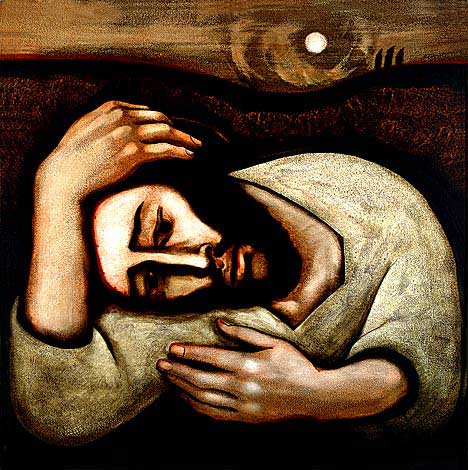
“Christ in Gethsemane” by Michael O’Brien. Go to http://www.studiobrien.com/ for more from the artist.

I think this reflects an emotional response that is still common to people when they first read about Jesus’ agony in Gethsemane.  Here we have Jesus tormented and upset.  We have him begging his Father to let him pass from the cross.  It makes us uneasy.  It seems strange to think of Jesus having fears and doubts.  It makes us wonder how close he was to turning.  What would have happened if Jesus decided, “Not your will, but mine,” and left.  What if there had been no cross for Jesus?  In this moment of Jesus in Gethsemane, we can imagine it for a moment.  We wonder, with bated breath, what he will do.  This is unsettling.

Yet at the same time, this story of Jesus in Gethsemane may be the most important passage in all of the gospels.  It is here that Jesus is most human.  It is here that Jesus is most vulnerable.  And it is here that Jesus is most courageous.  What makes this passage so powerful is the idea that it could have gone either way.  We have the luxury of reading the gospels knowing the end of the story.  We know his decision.  We know how the story ends, but if we allow ourselves to enter the drama of the moment, we can see Jesus making the decision to go forward.

Jesus spent his ministry teaching about love.  Through word and deed Jesus showed us how to love God and to love one another.  He fed the hungry.  He healed the sick.  He invited the women and the children and the tax collectors and the sinners to come to his table.  He broke bread with the least and the lost and shared the cup of redemption with them all.  He crossed boundaries of race, nationality, ethnicity, gender, and class.  He challenged religious authority, and he scoffed at the pomposity and self-absorbed granduer.  He called out the hypocrites.  He admonished the scribes and the pharisees for their hardened hearts.  He brought a simple message: Love God, and love one another.

And for all of that – for the criticism and the invitiation and the healing and the challenge he represented to the comfortable and powerful – he knew he was going to the cross.  He knew if he stood up for all that he lived for, for all that he believed, for all that he held dear, he would be killed.  He knew that if he followed God’s will it would lead to a cross.  Not because God needed him to die, but because men could not allow him to live.  We would not allow him to live.

So he sat there in Gethsemane and he prayed.  He prayed for another way out.  He prayed in anguish.  He prayed as a man who could feel pain, who would be hurt by betrayal, who would be scarred by the scourge, and would bleed when nails were driven into his arms and legs.  He prayed as a man who knew that if he would follow God’s will, he would be charged, convicted, mocked, humiliated, abandoned, and nailed to a cross.  Knowing all of this full well he prayed, “Not my will, but yours.”  Then he rose and stood up for all that he had lived for.

Stengthened by his prayer and with the power of the Holy Spirit he stood, and he went to the cross.  He did not go as a lamb to the slaughter, for a lamb knows not where it is going.  He went as a man who had decided to follow God.  He went as a man that would endure a punishment he did not deserve.  He went as a man that would heal and forgive and love even to the very end.

Gethsemane reminds us that Jesus chose his fate, but more importantly, it reminds us that we choose our own as well.  When we see Jesus in agony in the garden, we know that we will face our own Gethsemane, but we will never do so alone.  Every day we have the choice.

We can follow the way of the world – we can be selfish, we can look out for number one, we can work hard to get what we deserve, we can acquire more stuff, we can ignore the outcast, we can condemn the poor, we can tread on the orphan and the widow, we can judge the sinner, and we can build our nice comfy walls which no one will breach accept those we deem worthy.

Or we can follow Jesus.  We can pray to God, “Not my will, but yours,” and mean it.  We can fail from time to time, but we can know that we are always struggling, like Jesus in the Garden, to do God’s will.  And we can do it knowing that as we struggle, as we are mocked, as we are belittled, as we fail, as we triumph, as we suffer and as we celebrate, Jesus is with us.

Follow on Facebook

Follow on Twitter

6 Comments

Filed under Christianity, Sermons