Tag Archives: faith

Gospel According to the Peanuts liturgy

I am finishing up a sermon series at my church called The Gospel According to Peanuts. It is not really based on the book of the same name, although I did use it as a resource. Each week we looked at a different Peanuts character and found insight into our faith. The six-week series focused on Charlie Brown, the seeker; Lucy, the foil; Schroeder, the artist; Linus, the sage; Franklin, Peppermint Patty, and Marcie, the friends; and Snoopy, the dreamer. You can read the sermon recaps by scrolling to 10/13/24 through 11/17/24. Here are two prayers I wrote for this series:

A Prayer of Lamentation

All:       God of the front page and the funnies, we come together to recognize our common struggle captured in the pages of both. We curse the kite-eating tree. We wonder if we will ever win a baseball game. We wait in vain for the Great Pumpkin, who never shows up. We get rocks for trick or treats. We lose the spelling bee. We think this time will be the time we will finally kick the football. We mumble “Good Grief.” We shout “You block head!” Sometimes it feels like there is nothing in life but disappointment and loss. Help us to find our people and our path in the process, and give us a chuckle along the way.

(Pause for silent lamentation and prayer)

One: Prayers of lamentation can be a release. They are an expression of faith in the midst of trouble. Expressions of lament can take a load off of one’s mind and bring peace to one’s spirit.

All: Sound theology has a way of doing that. Amen.

An Affirmation of Community

All:           O God, we are the Peanuts. We are frustrated seekers like Charlie. We are fierce, vulnerable, and sometimes cruel like Lucy. We are passionate and dedicated like Schroeder. We are philosophical and faithful like Linus. We are marginalized and embraced like Franklin, Patty, and Marcie, We are dreamers and dancers like Snoopy. We are complicated, messy, and full of curiosity and hope. Wrap us like a warm blanket in your love. Hold us together as we find happiness every day in Jesus. Together. Amen.
 

Leave a comment

Filed under Liturgy

Ellie’s Lenten reflection

I have written many times about being a Dad on this blog. Today I offer this space to a reflection that my oldest daughter wrote. She is a 17-year-old junior in high school. She was baptized in a United Methodist Church. She was confirmed in a United Methodist Church. She has danced in the aisles and led from the pulpit in United Methodist Churches. Last summer at a United Methodist Church camp called Little Grassy, she found an intimacy with Christ and community that she had never before experienced. 

On Ash Wednesday she had a powerful spiritual experience and sent me a message the next day. I was moved by this incredible text and asked if I could share it with a wider audience, but wasn’t sure when I would find the right time. This past weekend I was in a small group of clergy talking about our upcoming General Conference. We were hearing informal reports from a General Conference delegate about the work they are doing to build coalitions and initiate reform in the Church. One of pastors asked, “What can we do? What can we do now about General Conference so that we can see the church that we want?” Their first answer was simple: “Pray.”

It was then that I decided, with Ellie’s permission, to share her reflection. After reading it to that group, they encouraged me to share it to a wider audience. Again, with Ellie’s permission, here it is. In a way, this is her response to the question, “What can we do?”

An Ash Wednesday reflection, by Elizabeth McCoy:

I have never known what it feels like to be hungry, not really. Sure, I’ve felt the absence of food in my stomach, the gurgling annoyance because I woke up too late to eat breakfast or couldn’t find a good snack at home. But that is not hunger, not really. I have always lived in a house full of food. With parents who have the means to keep me fed. 

This Lent I am fasting. I will not consume anything but water while the sun is in the sky. I will do this because I want to know what it feels like to be hungry. I am not stepping on this Lenten path so that my peers will praise me for my righteousness. I do not yearn for a pat on the head from my elders, telling me how mature and dedicated I am for taking on such a task. I want to sacrifice something I take for granted and sit in the unpleasantness that its absence will surely provide. 

This spring, General Conference will come together and vote on whether I belong in the church. They will sit in a giant room with loudspeakers blaring legislation that will determine if my ‘lifestyle’ has a place in the church that has raised me. When I came out to my congregation last year, I wasn’t afraid that they wouldn’t accept me, not really. Even though my congregation is mainly made up of folks from older generations, love has always been the defining factor in their vocabulary, and I have never questioned their empathy. Sure, I’ve felt the unease that comes with holding hands with your girlfriend in public, and my palms were sweating when I called my self ‘queer’ from the pulpit; but I’ve never been afraid, not really.  

This Lent I expect to be closer to God than I ever have been, because I am hungry. I am hungry for justice. I am sick of my presence being debated. I am a member of the United Methodist church. I love the United Methodist Church, but I cannot remain loyal to an institution that believes my right to love is debatable. 

On Ash Wednesday I was reminded of the power of testimony before God. With ashes spread, I vowed, on behalf of my siblings in Christ, to never forget who and who’s I am. I am a holy. My dedication to this ancient practice does not prove my worth to the church, it is not an apology for my queerness. I have nothing to apologize for. Instead, this Lent my hunger will drive me to remember the very foundation of my faith. I am good, as God created me. God has called me good. Indeed, I am very good.

I may not know what true hunger feels like, but rest assured I will be hungry this Lent, for more reason than one. 

4 Comments

Filed under Christianity, E and Me Podcast, Personal Reflection

The Grandmothers: Ruth

Part three in this four part series on the women in Jesus’ genealogy

According to some ratings statistics, the Hallmark Channel has been the top entertainment network on basic cable in the fourth quarter of the year for several years. They are not the top network the other three quarters of the year. The difference? Hallmark knows Christmas.

The Hallmark Channel website claims that they have a new original movie every Friday, Saturday, and Sunday night starting on October 20. That’s 31 new original movies. Well, original might be a stretch. Everyone knows that these movies are all basically the same story. And we’re all okay with it.

The fact that they are full of cliché, trite story lines, predictable plot points, and catalog-model attractive actors, is why we watch. We know what to expect. Like a big platter of Christmas fudge and hot chocolate, there’s not much sustenance, but it feels good to consume.

The Book of Ruth could be read critically. We could question the agency of Ruth. We could wonder about Naomi’s motivations. We could ask what “uncovered his feet” means. We could ask Boaz why he apparently allowed his men to assault other women in his fields. We could lament that the child born to Ruth is called “Naomi’s.” We can bring up issues of trafficking, abuse, patriarchy, and exploitation. These are all worthy questions of the text, and I’m thankful for scholars like Wilda C. Gafney who challenge these kinds of texts—but right now, as I ponder the Grandmothers, I’d rather see the story of Ruth as a Hallmark Christmas Movie.

Let’s plug in the characters. A hard-working woman (Ruth)who has experienced grief and a lot of bad luck. She has a dear friend (Naomi) who is older and wiser, but their bond is secure. New in town, the woman gets a job for a man of integrity (Boaz). He makes sure she is safe and shows he cares about her with little gifts and benefits. Eventually, the older friend arranges a romantic setting for Ruth and Boaz to take the next step in their relationship. They fall for each other, but they have to conquer one more obstacle (the unnamed redeemer). In the end, Boaz and Ruth marry, have a child, and Naomi joins their household. They live happily ever after as the snow falls in town square and the Christmas lights twinkle.

This could honestly be the next Hallmark movie, but there’s one more character who isn’t named in the story. He casts a pall over the entire story, revealed not by any character, but by how Ruth is described.

Over and over she is called Ruth the Moabite. The reader cannot forget where Ruth came from. Like all the women in this Advent sermon series, she is called righteous. Her integrity, friendship, courage, and loyalty leads to the joyful climax of the story—King David is her great-grandson. The righteousness of the Moabite wife leads directly to the birth of King David.

And this stands in direct tension with the other unnamed character—Ezra. The work of Ezra-Nehemiah was probably written at about the same time as Ruth. Though the story of Ruth takes place far before Ezra, they stand as contemporary voices from post-exilic Judah. As the exile ends and the people return to Judah from Babylon, they have a problem. How to rebuild? How do they put life back together. Some have been there in Judah the entire time.

Ezra-Nehemiah poses the twin projects of rebuilding the city wall and the Temple. They are also adamant that the only way to restore the people to their former greatness is to close ranks, stick to their own, and be pure. Among these purity laws is the ban of marrying outside of Israel. Moabites are among the groups specifically named to avoid.

Ezra-Nehemiah and Ruth pose competing understandings of how to move forwards as a people. Ezra-Nehemiah reminds the people of the Law, the rules they must follow, the duty they have to worship, and to protect themselves. Ruth tells a story of love, friendship, and embracing “the other.”

Ruth is more than an a Hallmark Movie. The story is a reminder that when people are in relationship, walls are broken down. Divisions that we put up to protect ourselves crumble. Relating to outsiders is a more fruitful way to be a people of God. “The other” will always be among us. Ezra-Nehemiah thought the answer was to avoid and isolate. Ruth comes back saying love and embrace.

When the writer of the Gospel of Matthew decided to tell the story of the savior of the world, he reminded us of the women that made it possible. He reminded us of Ruth the Moabite. He reminded us of a Hallmark-worthy story of friendship, courage, loyalty, and love. He reminded us that the path to the Kingdom runs through a love story. It seems appropriate that Jesus, the one who told his disciples to “make disciples of all nations,” had a Moabite Grandmother.

Leave a comment

Filed under Christianity, Sermons

Guest Blogger: Beautiful Child of God #ShapedByGod

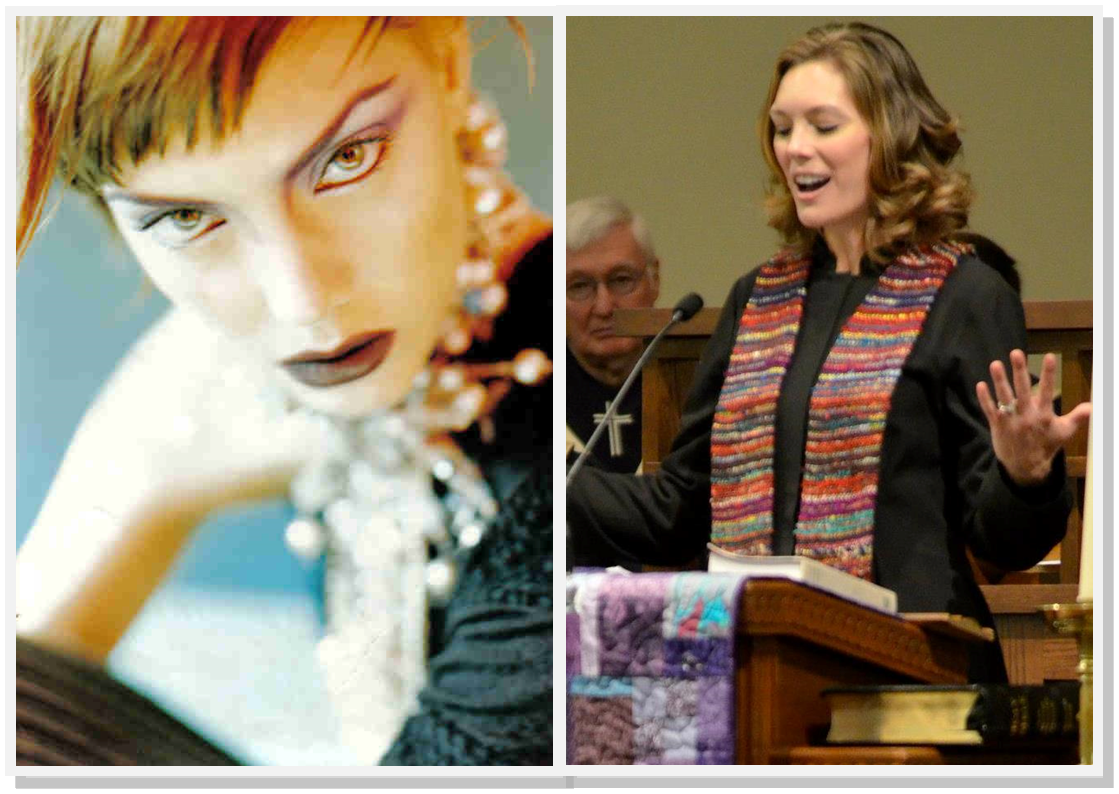
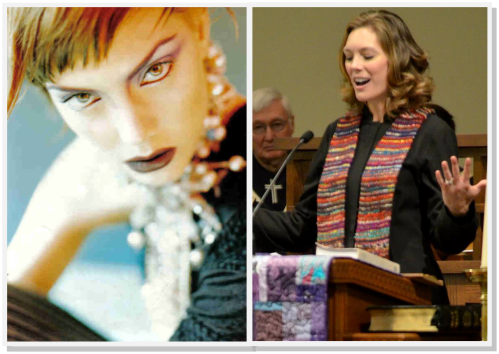
Rev. Sarah Renfro, former fashion model. Now preaching the good news of your body.

Rev. Sarah Renfro, former fashion model. Now preaching the good news of your body.

I discovered Rev. Sarah Renfro’s blog after she quoted a part of The Pulpit Fiction Podcast in a post.  I read her post because she quoted me, but was quickly drawn into her story.  Her blog is called Embodying the Divine: Body Image, Media, and Faith.  Sarah is a former fashion model, who is now a pastor preaching the good news of your body.  In her blog, she not only goes to phenomenal resources, but she expresses her struggles and joys as a pastor, woman of faith, Mom, wife, and Beautiful Child of God.  Her website also describes “body image workshops that dispel the myths of media and ‘ideal beauty’ in fashion magazines, and empower participants to claim their diverse and wonderful inner beauty given by God.”  

I love her holistic approach to faith.  As a father of two young girls, I am deeply invested in Sarah’s message.  I want to share it with others, and encourage everyone to check out her blog, schedule her for a workshop, and like her facebook page.  That’s enough of my words about her.  Here’s her story: 

I was born and raised in the Christian Church (Disciples of Christ).  I was active in youth group and worship.  After high school, I left Kentucky to pursue modeling full-time, living in Tokyo, New York, Los Angeles, and Europe for a bit.  I had the opportunity to see the world, but at the same time, the fashion industry is competitive and harsh.  I struggled with disordered eating and depression after constantly being told that I wasn’t good enough just as I was.  I wasn’t thin enough or blond enough or big-busted enough or . . . I was the one of one percent of the population who is in the magazines and catalogs and on billboards and in commercials; yet, I had low self-esteem and a negative body image.

During my travels, I did not maintain a faith community.  Oh sure, I attended on Easter and came home for Christmas, but that was about it.  I was not grounded in a church that reminded me that I was a child of God.  But deep down I knew.  So when I retired at age 21, I moved home, attended the University of Kentucky, and went to church.

I became a youth group sponsor and loved it!  I was invited to share my story from the fashion world for the first time, and I realized that I just might have something to say to young people about body image.

Fast-forward a few years, a failed marriage, and another stint in LA, and I came back home, finished college, and continued to work with the church.  I received my call to ministry soon thereafter.  At no time had I envisioned God calling a former Hollywood-type to the share the Word.  But alas.  Here I am.

So now I am a former model, ordained minister, married-again (to a minister), and mom to Miriam (almost three-years-old).  My passions about body image have only increased as I continue to lead workshops and retreats with youth and women.

Media reinforces over and over and over again that we are not okay just as we are.  That we are to subscribe to some “ideal beauty,” which is impossible to achieve and devalues the diversity of God’s creation.  There are many passages from the Bible on which I base the title of my website and workshops “Beautiful Child of God: Embodying the Divine.”  Perhaps, my favorite is how God created humankind in God’s own image (imago Dei), and called us not just good, but very good.

Most of us, women and men, young and old, of all colors and ethnicities, struggle with the reflection in the mirror.  Media has much to do with our dissatisfaction.  In my talks, I seek to expose the myths that reinforce negativity for capitalist gain, and I attempt to enforce the Truth that we are created beings, body and spirit, incarnated, imprinted with the Divine.

Robb asked how I came to use #ShapedByGod.  That was an idea by a friend and colleague, Rev. Sarah Taylor Peck, who mentioned it as Lenten discipline.  I immediately asked to join in her journey, because I believe we were molded out of the soil of the earth to be exactly who God shaped us to be.  Some tall and thin, most not so.  Some light skinned, most not.

When we look in the mirror, it is God whom we reflect.  It is the Divine spark that shines from our eyes and in our bodily actions and spirit-filled prayers.  We are shaped by God to be God’s hands and feet and ears and voice in the world.  We are not supposed to all have the same shape (tall and thin for women, “manly” and muscly for men), but we are to love the bodies that we were given, take care of them, and use them to bring about the Kin-dom of God.

There’s your sermon for the day, but I realize that this is easier said (or typed) than done.  I still struggle.  Fifteen years removed from modeling full-time, I can still pick my body apart if I let myself, even though I eat well and exercise.  But I try not to.  I try to love my whole self because I lead workshops about this type of thing (duh), I am mom to a daughter whom I desperately wish maintains the love of her belly, the good foods she eats, the exercise she gets, the joy she has in her body and spirit, and I am a child of God.  A beautiful child of God.  And so are you!

Thanks for letting me share a bit of my story.

Follow Sarah Renfro on Facebook

Follow @revRenfro on Twitter

Follow The Fat Pastor on Facebook

Leave a comment

Filed under Christianity