The Ancient Celts spoke of “Thin Places,” where the distance between the spiritual world and the material world was thin. This is an interesting idea, and one I touch upon in this sermon.
The Lord’s Prayer is one of the first things that children are taught in Sunday school. It has been prayed by the congregation in nearly every worship service I have been a part of. For many Christians, the words “Our Father” trigger the rest of the prayer to flow easily. There is power in having the words of Jesus so readily available. There is also a danger. The danger is that the power of the words in the Lord’s Prayer can lose their edge. They can become something that we recite without thought. That is partly why I love the Common English Bible’s translation of the prayer. It is different from the prayer that I memorized as a child, and the difference points to something that is important that is sometimes lost. I’m lucky to have studied with a great pastor who opened up the Lord’s Prayer to me in a powerful way. The translation of the Common English Bible picks up on this:
When you pray, don’t pour out a flood of empty words, as the Gentiles do. They think that by saying many words they’ll be heard. Don’t be like them, because your Father knows what you need before you ask. Pray like this: ‘Our Father who is in heaven, uphold the holiness of your name. Bring in your kingdom so that your will is done on earth as it’s done in heaven. Give us the bread we need for today. Forgive us for the ways we have wronged you, just as we also forgive those who have wronged us. And don’t lead us into temptation, but rescue us from the evil one.’ (Matthew 6:7-13, Common English Bible)
“The Lord’s Prayer can’t be just words that we recite. It is a prayer that we live. It is one thing to say the words of the Lord’s Prayer, but it is an entirely different thing to live the Lord’s Prayer… When you live the Lord’s Prayer, it becomes more than words that you say. It is the choices you make, the grace you show, the forgiveness you give, and the bread you share.”
“God has called you to your life. Let it speak. Let nothing get in the way of being the person that you are. Zachariah claimed in his prophecy that through the birth of Jesus, “we have been rescued from the power of our enemies so that we could serve him without fear.” We need no longer fear. We need no longer hide from God or from each other. We are free to use the gifts that God has granted us for God’s purposes. We can serve God in our homes, in our churches, and in our workplace. We can serve God with our hearts, hands, feet, and minds. We are free to love God, because it is only in freedom that love is possible. We are free to love ourselves because we know that we were created in the image of the God that is love. We are free to love one another because God has called us to do no less.”
Scripture:
Luke 1:65-79
Fear came over all their neighbours, and all these things were talked about throughout the entire hill country of Judea. All who heard them pondered them and said, ‘What then will this child become?’ For, indeed, the hand of the Lord was with him.
Then his father Zechariah was filled with the Holy Spirit and spoke this prophecy:
‘Blessed be the Lord God of Israel,
for he has looked favourably on his people and redeemed them.
He has raised up a mighty saviour for us
in the house of his servant David,
as he spoke through the mouth of his holy prophets from of old,
that we would be saved from our enemies and from the hand of all who hate us.
Thus he has shown the mercy promised to our ancestors,
and has remembered his holy covenant,
the oath that he swore to our ancestor Abraham,
to grant us that we, being rescued from the hands of our enemies,
might serve him without fear, in holiness and righteousness
before him all our days.
And you, child, will be called the prophet of the Most High;
for you will go before the Lord to prepare his ways,
to give knowledge of salvation to his people
by the forgiveness of their sins.
By the tender mercy of our God,
the dawn from on high will break upon us,
to give light to those who sit in darkness and in the shadow of death,
to guide our feet into the way of peace.’
As you may know, I have started posting sermons on this blog. It has been a great source of excitement for me because I consider myself a preacher. I don’t consider myself a great preacher – I just believe that preaching is a deeply-seeded part of who I am.
As I’ve been slowly posting sermons, I have been reflecting on how I can be better. In this process, I’ve started to get a little worried. I’m fearful that I’ve been preaching the same thing over and over. I wonder if I’ve been as creative as possible. I wonder if I’ve gotten into a rut. In the midst of this, I was given a gift.
Grace comes in the most amazing of places, from the most amazing of sources. Today I was given the amazing gift of grace by an 11-year-old girl at a church camp. A group of five people – three junior high girls, an adult volunteer, and myself – have come to a weekend retreat. This morning we were gathered for our small group time and we were reflecting on the fact that God not only loves us, but that God likes us.
In the discussion, I directed each of them to say one thing about everyone else that they like. “I like this about…” Each person had to simply listen as the four people said one thing they like about that person. When it was my turn, I was a little reluctant. Then I received my gift.
“Pastor Robb,” one of the girls said, “I like that when you talk at church – during your what do you call it? sermon? I like that when you do those you always talk about how God loves us. You always seem to work it in. You always make sure we know that God loves us no matter what.”
OK, so maybe I have been a little redundant. And maybe that’s okay.
First Reading: Where the Wild Things Are, by Maurice Sendak
Date: Mother’s Day, 2012
Scripture passage: Luke 15:1-10
All the tax collectors and sinners were gathering around Jesus to listen to him. The Pharisees and legal experts were grumbling, saying, “ This man welcomes sinners and eats with them. ”
Jesus told them this parable: “Suppose someone among you had one hundred sheep and lost one of them. Wouldn’t he leave the other ninety-nine in the pasture and search for the lost one until he finds it? And when he finds it, he is thrilled and places it on his shoulders. When he arrives home, he calls together his friends and neighbors, saying to them, ‘Celebrate with me because I’ve found my lost sheep.’ In the same way, I tell you, there will be more joy in heaven over one sinner who changes both heart and life than over ninety-nine righteous people who have no need to change their hearts and lives.
“ Or what woman, if she owns ten silver coins and loses one of them, won’t light a lamp and sweep the house, searching her home carefully until she finds it? When she finds it, she calls together her friends and neighbors, saying, ‘Celebrate with me because I’ve found my lost coin.’ In the same way, I tell you, joy breaks out in the presence of God’s angels over one sinner who changes both heart and life. ”
Most of the time, when I talk to someone about the god that they have rejected, it turns out that I’ve rejected that god too. You know, the god of fear and closed-mindedness. The god of rejection and shame. The god that supports oppression, injustice, and bullying. The god that calls people to violence. The god that uses religion and ritual as a way to pacify the masses, or line the pockets of the powerful. The god that demands right choices lest I be punished with eternal torment. I’ve rejected that god too. Unfortunately, there are many people that have only been told about that god, and so they have walked away. I want to tell you about the God that I worship.
The God I worship loves me. God loves me for all my failures, imperfections, and bad choices. God loves me just as I am, and is working with me to grow into what I could be. God has picked me up, dusted me off, and reminded me that I am not junk. I am God’s. God uses my weakness for strength, and has replaced my shame with grace.
The God I worship wants me to love my neighbor as myself. God wants me to work for justice and act with kindness. God wants me to be vulnerable to others, not because God wants me to be weak, but because it is impossible to love without first being vulnerable.
The God I worship wants me to love God with all my heart, mind, and strength. God wants me to expand my mind. God wants me to challenge, for it is in challenging that we may grow. God wants me to look to the stars and wonder, explore, and dream about what is possible. God wants me to know not just the words of the Bible, but to know the heart of the Word. God wants my whole self, not just my Sunday self.
Today I saw my daughter enter a room. My heart leaped. I put my arms out and hoped beyond hope that she would see me and come. I wanted to see her smile. I wanted to make her laugh. I wanted to embrace and make her know that she was loved. That is how God looks at each of us, and even that is insufficient to describe God’s love.
This is the God I have found. Perhaps I should say more accurately, this is the God that has found me. This is the God for which I live and breathe. This is the God to whom I testify. This is the God whom I fail time and again, but who is willing to stick with me. This is the God of good news, the God of grace, mercy, and justice. I don’t blame or fault anyone for walking away from god. Odds are, I’ve walked away from that god too. All I can do is show you, tell you, demonstrate to you, and live out the love that is in me.
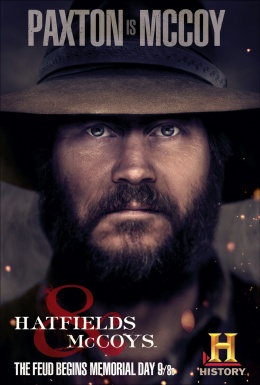
Bill Paxton brought all of his “Big Love” Godly smugness to his role as Randal McCoy.
The History Channel has aired its much-hyped “Hatfields & McCoys.” I’ve only watched two of the three parts. Thanks to the magic of Tivo, I’m hoping to finish it tonight.
I’m not a feud historian, but I’ve read a little bit about the dealings between Ole Ran’l and Devil Anse Hatfield. Being a McCoy, I have been asked many times if I am related to this famed feuding clan. While we don’t have any definitive genealogical proof, we do have some circumstantial evidence that points to the possibility.
There has been some family history done by one of my Dad’s cousins, and it appears that my family can trace its roots to Kentucky and West Virginia at about the time of the feud.
And then there’s the picture. Many years ago my uncle Larry McCoy found a picture of Randal McCoy. I wish I had a good picture of my Uncle Larry to show you. You’ll have to take my word for it: there is a resemblance.
That being said, watching the History Channel mini-series was a somewhat strange experience for me. I wasn’t just an objective observer. I guess you could say that I had a rooting interest. I remember as a kid when I heard about the McCoy-Hatfield feud, one of my first questions was, “Did we win?”
Me and my great-great-great-great uncle? I’m not sure, but the guy on the left is me, and the guy on the right is Ole Ran’l McCoy
Even now, as I watched the movie I found myself “rooting” for the McCoys. It was clear that Anderson Hatfield was a terrible person for deserting, and profiting while his brethren and friends suffered. It was clear that Old Ran’l was wronged when that thieving Hatfield stole his hog, then trumped up testimony in the trial. In the ruckus in the courtroom after the case, McCoy shouts, “This is a case of Godly right versus Damnation wrong!” And I was all, “Hell Yeah!”
I had to catch myself. It wasn’t about that at all. It was about pettiness and grudges. Eventually, McCoy’s godly self-righteousness started to grow tiresome. I couldn’t help but chuckle when later in the movie Hatfield tells Randall, “If you feel the need to bring up God one more time, and who’s side he sits on, you won’t be making the ride home.”
I won’t go through all of the details of the movie, or analyze any characters, because pretty quickly into the second episode it was clear that there were no good guys in this story. I haven’t seen how it ends, but I feel like the movie has done a great job of showing the feud as what it was – futile. There were no winners.
Stubbornness, false pride, hardened hearts, vindictiveness, and revenge fueled the feud. As a child I saw the world in black and white and just assumed that the McCoys were good, the Hatfields evil, and there must have been a clear winner. I’ve realized now that life is usually more about shades of gray. I’ve learned that revenge is never good fuel for a soul. As I watch the last episode, I’m hoping someone figures that out. Then I’ll know who won.
I recently wrote a guest column for rethinkchurch.org. If you want to read it, CLICK HERE. It’s a pretty good article, and a great website. I also preached a sermon on Mother’s Day around this topic. If you’re interested in a CD recording, please let me know in the comments. We can exchange information in a private email, and I’ll send you a CD.
Also, check out that picture of me next to the article. I’ve lost about 35 pounds since that picture was taken. I look a lot different now.
When I was a sophomore in high school I was kicked out of a football game for kicking someone. It was a stupid. I was near the bottom of a pile, and I felt like the guy on the other team that was on top of me was taking his sweet time in getting up. Instead of just waiting for the guy to get off, I got mad, and started kicking. I don’t think I actually kicked anyone. I wasn’t aiming at anyone in particular. I was just mad and reacted. Unfortunately the ref saw me and said “You, 62 – you’re out of here.” I couldn’t believe it. So I stormed off the field in anger and sulked on the sideline for the rest of the game. Strangely, none of the coaches even said anything to me.
After the game, none of the coaches said anything to me. When I was back at school, had changed and was ready to go home, none of the coaches had said anything to me. I was a little perplexed, but also pretty nervous. I knew I wasn’t going to escape punishment. They must be letting me stew. I figured that at the next practice I’d be running laps around the field for the duration. I started to walk home, despondent.
I didn’t get far when Mr. Selke pulled up and asked me, “Do you need a ride?” Mr. Selke was an intimidating guy. With his hair slicked back and suit on, he looked like he could have been cast as an associate of Joe Pesci. He didn’t give sophomore football players rides home. He was not a coach. He was the Athletic Director. I lived about a half mile from school. I didn’t really want a ride. I just wanted to sulk my way home. “No thanks,” I said. “No, let me give you a ride,” he said. I realized that this was an offer I couldn’t refuse.
I’d say we had an interesting conversation on the short ride to my house, but that would imply that I said something. He didn’t raise his voice. The power of his words did not need volume. “You will not do something like that again,” he said simply. “Your family is too good for that. Your Mom, Dad, brother, and sister have given you a good name. And you will not do anything like that again.”
I didn’t run laps at practice on Monday. None of my coaches ever said anything to me about it. It was like it never happened.
When I think of that interrupted walk home, I am reminded of another interrupted walk of shame. In Luke 24 we find the story known as “The Walk to Emmaus.” The walk to Emmaus was a walk of defeat. It was a walk of devastation, confusion, and anger. Two men were going home – back to Emmaus. They were leaving Jerusalem after a tumultuous week.
They were devastated, because the man that they thought was going to redeem Israel had been crucified. We don’t know how long they had been following Jesus. We don’t know how much they had given up, but we know that as the walked home, they were walking in shame. they were walking in confusion, despair, and anger. Their walk to Emmaus was a walk of shame. And then they were interrupted.
They were interrupted by the living Christ. They were interrupted in their despair, and at first, they were annoyed by this stranger that didn’t understand their pain. “Haven’t you been paying attention?” they ask him. “Have you been paying attention?” he responds. He does two things for them after their encounter. He allows them to tell their story, then he tells them his version. Their version went like this:
“Because of [Jesus’s] powerful deeds and words, he was recognized by God and all the people as a prophet. But our chief priests and our leaders handed him over to be sentenced to death, and they crucified him. We had hoped he was the one who would redeem Israel. All these things happened three days ago. But there’s more: Some women from our group have left us stunned. They went to the tomb early this morningand didn’t find his body. They came to us saying that they had even seen a vision of angels who told them he is alive. Some of those who were with us went to the tomb and found things just as the women said. They didn’t see him.” (Luke 24:19-24, Common English Bible)
It was a story of despair, loss, and confusion. Jesus responds by telling them the story again. This time he starts with Moses. He tells of God saving the people from slavery. He tells of the giving of the Law. He tells them about the Land that God provided the people. He tells them about the Prophets that spoke the truth to power. He reminded them about the God that saves.
Eventually it was time to eat. So they gathered at a table, and Jesus broke the bread. When they saw him break the bread, it all came together. They knew that were in the presence of Jesus. They knew that Jesus had risen. They knew everything had changed.
While they gathered at the table, their story was no longer one of despair and fear. Their walk was no longer a walk of shame. It was a walk of triumph. In the breaking of the bread, this act of friendship, companionship, and relationship, they knew that they were in the presence of the living God. He re-framed the story. He re-presented the bread. He re-newed their hearts.
Like Mr. Selke did for me during my walk of shame, Jesus reminded them of who and whose they were. All of us need that reminder every now and then. All of us take long walks of shame. We take a wrong turn. We veer off the path. We forget who and whose we are, and suddenly we find ourselves someplace we never intended to be. We find ourselves on a path of shame – somewhere God never intended us to be. It is in the midst of such walks that Jesus has a funny way of showing up. We may encounter Jesus on our path when we are least expecting him to show up.
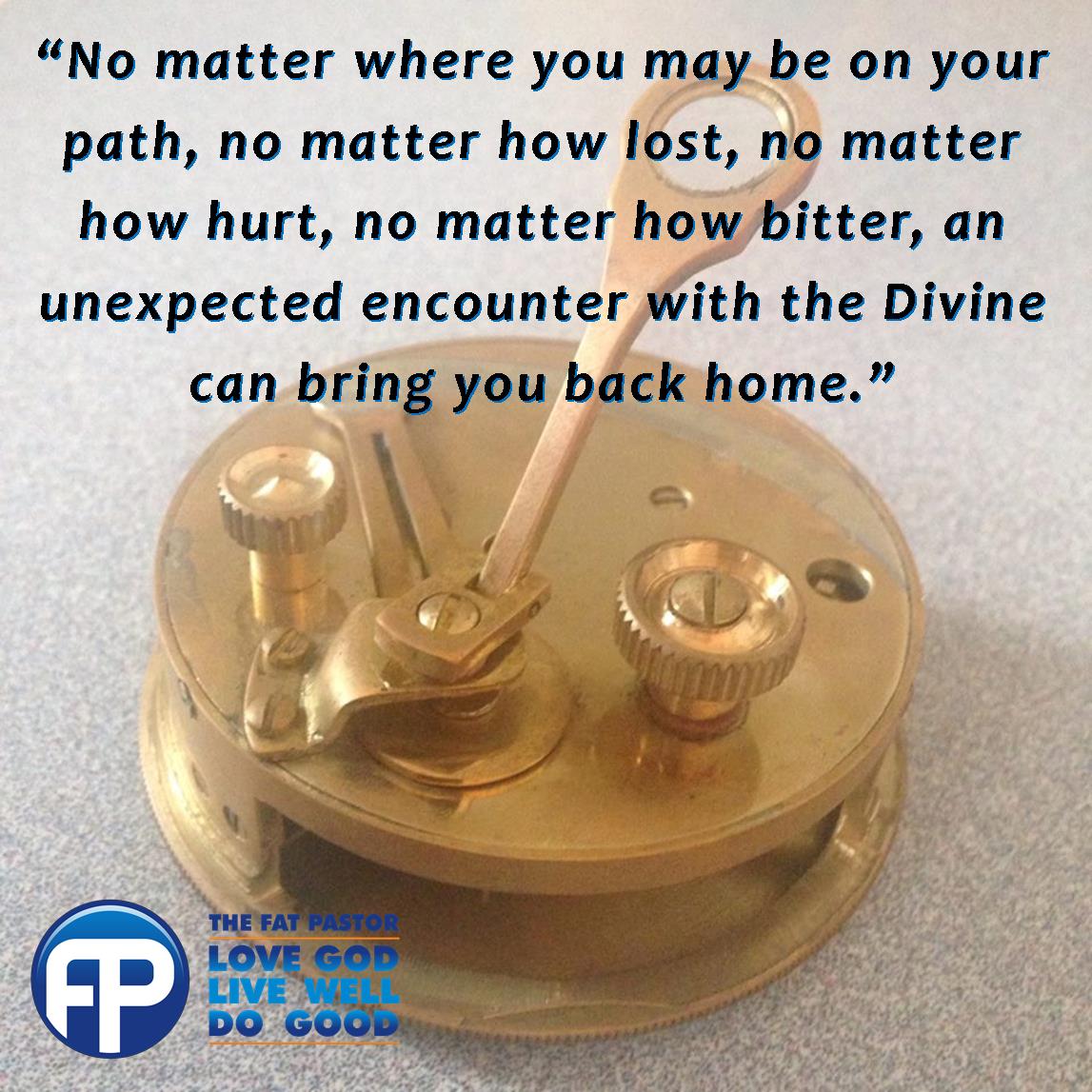
No matter where you may be on your path, no matter how lost, no matter how hurt, no matter how bitter, an unexpected encounter with the Divine can bring you back home. Be open to the Scriptures, and the story of God’s salvation. Be open to breaking bread with those that might surprise you. Be open and know that you never need walk this path alone. You never have to make a walk of shame again.
“Dinner’s Ready!” Man, did I love hearing those two words when I was a kid. My Mom is a great cook, and I loved dinner time. Most of the time I would drop everything to get to the table. There were times, however when I might not answer the call right away. There were two main questions that determined my reaction time: What was I doing at the time? What was for dinner?
There were times when I’d be playing a game on the computer, and I just needed to finish one more level. There were times I was watching TV, and just wanted to wait until the commercial. There were times my buddies and I were playing basketball in the yard, and we just had to finish this game.
If heaven has a smell, I think it is garlic browning lightly in olive oil.
If dinner was spaghetti, it didn’t really matter what I was doing. I don’t think I ever had to be called twice to come for spaghetti. Whenever Mom made spaghetti the aroma would fill the entire house. It took several hours to cook, creating a crescendo of anticipation as I waited for the moment I could twirl that first forkful of garlic bliss. On those days, “Dinner’s Ready!” were my two favorite words, and there was no delay.
There was one thing however, that I did not like to eat as a kid. I need to try it again because my pallet has probably matured, but when I was a kid there was nothing worse than navy bean soup. I’m sure my Mom made great navy bean soup. It just wasn’t my favorite. For me, navy bean soup meant one bowl doused in ketchup, and then peanut butter and jelly. When I knew that navy bean soup was coming, “Dinner’s Ready!” was not exactly a clarion call.
Now that I’m an adult, “Dinner’s Ready” remains two of my favorite words. Now I’m usually the one calling out to my family. It is no longer so much the quality of the food that gets me excited about calling out “Dinner’s Ready!” I get excited because I know that shortly after saying those two words, the most important people in my world are going to be coming. Shortly after calling out “Dinner’s Ready!” I will hear the toys being put away (or dropped randomly). I will hear the distinct pitter-patter of my 18 month old daughter, and the much louder stomps of my 5-year-old daughter running into the kitchen. I know that soon the four of us will sit down together and eat. We will pray together. We will talk about our day. We will tell jokes. We will correct the baby when she throws her cup. We will pick up spills. We will be nourished in mind, body and soul, and we will be drawn a little closer together. There are few things I enjoy more than sitting around the table with the people I love most in the world.
Today – right now – God is calling out to all of us, “Dinner’s Ready!” God wants desperately for us to come to the table, sit down and enjoy the feast. God yearns for a chance to draw us closer together – all of us. God wants us to laugh, talk, cry, pray, correct each other when needed, forgive each other when needed, and love each other always. God invites all to the table, but not everyone will come.
Jesus tells a story in the Gospel of Luke about the great banquet.
Jesus replied, “ A certain man hosted a large dinner and invited many people. When it was time for the dinner to begin, he sent his servant to tell the invited guests, ‘Come! The dinner is now ready.’ One by one, they all began to make excuses. The first one told him, ‘I bought a farm and must go and see it. Please excuse me.’ Another said, ‘I bought five teams of oxen, and I’m going to check on them. Please excuse me.’ Another said, ‘I just got married, so I can’t come.’ When he returned, the servant reported these excuses to his master. The master of the house became angry and said to his servant, ‘Go quickly to the city’s streets, the busy ones and the side streets, and bring the poor, crippled, blind, and lame.’ The servant said, ‘Master, your instructions have been followed and there is still room.’ The master said to the servant, ‘Go to the highways and back alleys and urge people to come in so that my house will be filled. I tell you, not one of those who were invited will taste my dinner.’ ” (Luke 14:16-24, Common English Bible)
This story tells us a lot about God and how desperate God is to have the table full. If we are honest with ourselves, it tells us a lot about us too. God is willing to go to any length to fill the table with God’s children. The banquet has been prepared, all God needs now is guests. When we deny the invitation, God might be frustrated, but God will keep sending servants to find someone to come.
We all deny God’s call at some point. I know that God has called me to the feast over and over again. There are times when I have responded, and I have tasted grace. I have tasted forgiveness. I have tasted reconciliation. I know what it is like to take a seat at the gospel feast and feel the love of God. I have had a taste of the power of the Holy Spirit. I also know that there are too many times when I have ignored the invitation.
I have come up with my list of excuses. Like a child not wanting to come have bean soup, I have decided I’d rather play another inning of wiffleball, or solve another Carmen San Diego case. I’ve used lots of excuses to ignore God’s call. Like the excuses of the men in Jesus’s parable, they all seemed legitimate at the time, but they were all empty. Who would buy a field or a yoke of oxen sight unseen? These two excuses are probably just outright lies. And a marriage? How does getting married prevent anyone from going to a banquet? The excuses seem good on the surface, yet a closer look at them reveal just how shallow they are.
Some people love navy bean soup. I'm just not one of them.
Aren’t most of our excuses? What are the reasons we tell ourselves we cannot answer God? We lack the time. We lack the training or talent. We think someone else can do it. How many excuses do we come up with, but all of them are foolish. I mean, we’re not talking about an invitation to choke down some liver and onions. We’re invited to the greatest banquet that has ever been spread. God is calling to you, “Dinner’s Ready!”
Maybe you’re invited to your first taste at the table. You are invited. You are invited even if you are blind, lame, sick, hurting, broken, shattered, worried, fearful, or poor. If you are human, you are invited. Maybe you’ve been to the table before, and God is calling you for more. Maybe God is calling you for greater service, deeper Bible study, healthier living, fuller prayer, or more passionate worship.
Wherever you are on the path of life, whatever you’ve done, no matter who you are, you are invited. The banquet is ready – and it is ready now. It’s not ready in some distant and unreachable future. It’s not ready by and by when we all go to heaven. It’s ready now. God is ready now. The dinner is ready. Come and get it.
This blog post is a condensed form of a sermon I preached at Riverside United Methodist Church on February 26, 2012. If you are interested in CD with the entire worship service, please let me know in the comments, and I will contact you in private email about mailing information.
“Some times you want to go, where everybody knows your name. And they’re always glad you came…”
The Rembrandts “I’ll Be There For You” was a number one hit in America in 1995.
“So no one told you life was going to be this way. Your job’s a joke, you’re broke, you’re love life’s D.O.A… I’ll be there for you (When the rain starts to pour)…”
What makes these great theme songs? First of all, they were attached to great shows. The theme song to Veronica’s Closet might have been a masterpiece, but no one is going to remember it. Secondly, they were truly “Theme” songs. Meaning, they set the theme for the rest of the show.
The Friend’s theme is upbeat and youthful. You can clap along to it, and identify with the emotion of starting off in the world. It captured what was so popular about the show. It’s lyrics about friendship and being there for each other make the same emotional claim on the viewer that the show was able to make. The Cheers theme is a beautiful song (ranked number one by that website) that speaks to what made the show great – the desire to be a part of a community. Lovers of Cheers felt intimately connected to Sam, Norm, Cliff, and Diane, and that connection began with the wistful “Making the way in the world today, takes everything you got. Taking a break from all your trouble, sure would help a lot.”
The United Methodist Church has a theme song too. And just like these great TV theme songs, it captures the heart of what the Methodist movement was, and should still be, all about. The United Methodist Church wasn’t always a church. In fact, its founders were never members. John and Charles Wesley were members of the Church of England, and never intended on creating a new church. Charles, in fact, was adamantly opposed to it. John saw it more as a pragmatic solution to the problem of a movement that grew too fast for the institution.
“O For a Thousand Tongues to Sing” is the unofficial theme song of the UMC, and it captures perfectly what our church once was, and what it could be again. It is a song that is about two things – the power of a redeeming God and our only proper response. Charles Wesley wrote this hymn on the anniversary of the day he found a personal relationship with Jesus Christ. He was deeply rooted in the Church of England, but for most of his life he felt no real connection to the loving, merciful, and gracious God that can transform lives.
The song is a reminder of that experience – the power of knowing a God that makes sorrows cease, makes the sinner clean, and restores us to new life. Wesley’s hymn captures the joy and excitement that is felt when a relationship with Jesus Christ becomes real and personal.
There are very few things that are more personal than a relationship with Jesus Christ through the Holy Spirit. My relationship with Jesus is intensely personal. It has had its ups and downs. We have had times when were were extremely close and times when I’ve alienated myself from him. Jesus knows the inner depths of my soul and can see the blackest parts of my heart. He has seen me stumble. He has seen me hide. He has seen me fall. He has seen me get knocked down. But every time I get knocked down he is right there. He puts his arm around me and whispers in my ear, “Get up, Robb.”
And those times when I have gotten back up, there is nothing that I can do but sing my praise to God. My only wish is that I had more than one mouth to do it with. I wish I had more than one tongue to sing my savior’s praise. O For a Thousand Tongues to Sing my great redeemer’s praise! You see, transformation in the Holy Spirit is an intensely personal experience, but it is not private. Authentic faith in Jesus Christ is a personal matter, but it must never be private.
This dual nature of faith as both intensely personal and never private is what our theme song is about. Knowing our redeeming God brings tremendous joy. I am convinced that others are in desperate need of this kind of joy. They are in need of a relationship with the God transforms lives, transforms communities, and transforms the world. People are looking for something that gives life meaning. I have found meaning in a relationship with Jesus and in involvement with the United Methodist Church, and if I am to live up to our theme song, then I must share this with others. It doesn’t mean that I am going to tell others that they are wrong. It doesn’t mean that I’m going to insert God into conversations where it isn’t warranted or welcomed. I’m a grown up with grown up social skills, but I’m also not going to hide from the opportunity to share with someone what God has done in my life and what life in the Church means to me.
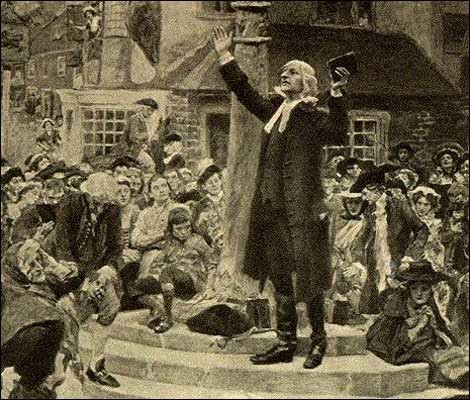
John Wesley preaching outside (because most churches wouldn’t let him inside). Notice: He’s using words
“O For a Thousand Tongues” is our theme song, and it captured what was great about the Methodist Church. It was written for a movement that was driven by the Holy Spirit. It was the song of a movement that captured the hearts of thousands. It was written for a movement of people that were willing to take risks – to go places others weren’t willing to go. It was written for those going into the prisons, for those preaching to the working poor that would never enter a church, for those that were meeting in their homes to have hard discussions about how God was working in their lives. It was written for a movement of people that were on fire with the Holy Spirit, and could not help but tell others. It doesn’t mean that they were pushy or judgmental or rude. It was written for a people that had found the good news of Jesus Christ and found that one tongue to share that good news just wasn’t enough.
In our world where we are inundated with bad news, couldn’t the world use a little bit of good news? Are people really going to think you’re a nut job if you tell them that you find meaning in worship, study, fellowship, prayer, or service?
Today, many Methodists like to quote Francis of Assisi’s “Preach the gospel at all times. Use words when necessary.” There’s a lot about that quote that I like. If it means “Make sure that your actions back up your words,” or “Don’t just talk the talk, but walk the walk,” I can get on board. For too many though, this quote is used as an excuse to not talk about their faith. Sometimes words are needed. Most of the time words are needed.
“O For a Thousand Tongues to Sing,” by Charles Wesley
O for a thousand tongues to sing,
My great Redeemer’s praise,
The glories of my God and King,
The triumphs of His grace!
My gracious Master and my God,
Assist me to proclaim,
To spread through all the earth abroad.
The honors of Thy name.
Jesus! the name that charms our fears,
That bids our sorrows cease;
’Tis music in the sinner’s ears,
’Tis life, and health, and peace.
He breaks the power of canceled sin,
He sets the prisoner free;
His blood can make the foulest clean,
His blood availed for me.
He speaks, and, listening to His voice,
New life the dead receive,
The mournful, broken hearts rejoice,
The humble poor believe.
Hear Him, ye deaf;
His praise, ye dumb,
Your loosened tongues employ;
Ye blind, behold your Savior come,
And leap, ye lame, for joy.
In Christ your Head, you then shall know,
Shall feel your sins forgiven;
Anticipate your heaven below,
And own that love is heaven.
This blog was written after I preached a sermon on this topic at Riverside United Methodist Church in Moline, Illinois. If you are interested in a CD of the worship service, please leave a comment below and I will contact you about a mailing address.
5K 36:00 (Race for the Cure, Jun. '12)
35:15 (Firecracker Run, Jul. '12)
33:47 (Crimestoppers, Aug. '12)
31:40 (Lagomarcino's, Oct. '12)
26:52 (CASI St. Patrick's Day, Mar. '13)
26:28 (Railroad Days, Jun. '13)* *2nd place in age division
26:40 (Casa Guanajuato, Nov. '13)
30:30 (Modern Woodmen Knockout Hunger, Sep '14)** **3rd place in age division
Debut on 10/02/2008
1,000 total views on 12/04/2008
100,000 total views on 11/30/2011
200,000 total views on 5/26/2012
300,000 total views on 9/7/2013
400,000 total views on 5/23/2014
500,000 total views on 8/22/2015
All of the writing on this, and all pages at fatpastor.wordpress.com, are the sole possession of Robb McCoy, and are in no way affiliated with the United Methodist Church, or with any local congregation of the United Methodist Church.
Permission to use the written material on this site is granted for non-profit use, as long as credit is given to Robb McCoy and a reference to https://fatpastor.wordpress.com is used.
Comments and discussion are encouraged. However, any comment that is degrading, profane, violent, vulgar, or offensive will be removed.
All opinions and ideas are my own, unless otherwise noted. All opinions and ideas are subject to change depending on my own social location, events of the day, or my mood (it's all about the context, man!)










 The Fat Pastor