Tag Archives: grace

Err on the Side of Grace

I’m a pretty safe driver.  I’m a safe driver for a lot of reasons.  One reason is that I hate the idea of getting a ticket.  I’ve gotten pulled over for speeding before, and it sucks.  It’s expensive.  It’s a pain.  You know that feeling you get when you drive past a squad car going a little over the speed limit, and then you look in your rear view mirror, hoping it doesn’t pull out?  I hate that feeling.  This, combined with the simple fact that I don’t want to die, is the reason I drive safely.  I get passed a lot on the interstate.
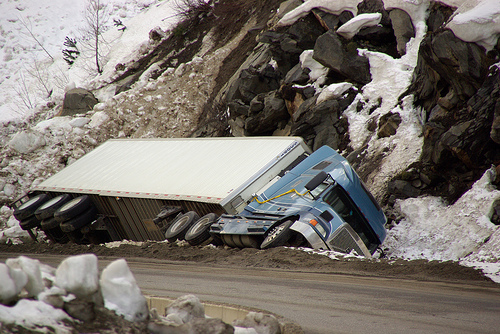
This photo is used with permission. It was taken by Dave King http://www.flickr.com/photos/djking/

I don’t go exactly the speed limit (partly because the way people drive, that in itself would be somewhat unsafe), but I’m never the lead car either.   I have realized that in the course of driving somewhere, I have to make many decisions.  Should I pass?  Should I wait behind this truck for the exit?  Should I change lanes now?  Each decision usually involves either speeding up or slowing down.  Whenever I’m driving, and I have a decision to make that can be boiled down to this, I almost always choose the option of slowing down.  Maybe it’s not always the best choice, but it seems like a good rule of thumb.

“I choose to err on the side of grace.”  A seminary professor of mine said that once in class.  He was not talking about driving.  He was talking about interpreting the Bible.

The Bible can be interpreted a lot of ways.  With any given issue, people of faith can go to the same Bible, pray to the same God, seek out the same Holy Spirit, and come up with very different answers.  Take any issue: homosexuality, immigration, the treatment of the poor, abortion, gender roles, warfare, capital punishment, gun rights, euthanasia, the environment, education, etc. and people of faith will come to very difficult conclusions.

Some try to group these things into neat little packages like liberal and conservative.  I’m not a fan of those labels, or of any labels really.  I think most people are more complicated than our labels.  I know that the world is.

That said, I think my seminary professor was right.  He taught a lot about grace and the Hebrew word hessed, which he translated as “God’s steadfast love.”  When asked once about God’s judgment he said (more or less), “For most issues, people lean either on God’s grace or on God’s judgment.  When I think about those two sides, I choose to err on the side of grace.”

It might not always be the right choice, but it seems like a good rule of thumb to me.  I choose to err on the side of grace.  Some may think that sounds wishy-washy.  Some may say that I am preaching “cheap grace.”  I understand if you think that, but I disagree.

I choose to err on the side of grace because I love and respect the Bible too much to narrowly focus on a few verses that do otherwise.  I choose to err on the side of grace even when it is inconvenient, unfair, or unsavory.  I choose to err on the side of grace because when I look at the Biblical story, that is what I see my God doing time and again.  Yes, there are moments of God’s judgment.  Surely there are warnings of dire consequences as a result of sin.   But I believe that the story of God’s redeeming love, mercy and forgiveness permeates the entire Bible.

The good news of Jesus Christ rests on the grace of God.  Above all, that is why I err on the side of grace – because that is what I believe Jesus did.  That is why he invited sinners to be his disciples.  That is why he ate with tax collectors and pharisees.  He healed gentiles and children and women.  He forgave the unforgiven and welcomed the unwelcome.  Time and again he leaned on the grace of God and for it he was betrayed, denied, abandoned and crucified.

So yes, I err on the side of grace.  It’s not always the easy choice, but it seems like a good rule of thumb to me.
Follow the Fat Pastor on Facebook

Follow on Twitter

14 Comments

Filed under Christianity

Gethsemane

The Garden of Gethsemane has always been one of my favorite passages of Scripture.  The most vivid description of it is found in the Gospel of Mark.

They went to a place called Gethsemane; and he said to his disciples, ‘Sit here while I pray.’ He took with him Peter and James and John, and began to be distressed and agitated. And he said to them, ‘I am deeply grieved, even to death; remain here, and keep awake.’ And going a little farther, he threw himself on the ground and prayed that, if it were possible, the hour might pass from him. He said, ‘Abba, Father, for you all things are possible; remove this cup from me; yet, not what I want, but what you want.’ He came and found them sleeping; and he said to Peter, ‘Simon, are you asleep? Could you not keep awake one hour? Keep awake and pray that you may not come into the time of trial; the spirit indeed is willing, but the flesh is weak.’ And again he went away and prayed, saying the same words. And once more he came and found them sleeping, for their eyes were very heavy; and they did not know what to say to him. He came a third time and said to them, ‘Are you still sleeping and taking your rest? Enough! The hour has come; the Son of Man is betrayed into the hands of sinners. Get up, let us be going. See, my betrayer is at hand.’

Immediately, while he was still speaking, Judas, one of the twelve, arrived; and with him there was a crowd with swords and clubs, from the chief priests, the scribes, and the elders. Now the betrayer had given them a sign, saying, ‘The one I will kiss is the man; arrest him and lead him away under guard.’ So when he came, he went up to him at once and said, ‘Rabbi!’ and kissed him. Then they laid hands on him and arrested him. But one of those who stood near drew his sword and struck the slave of the high priest, cutting off his ear. Then Jesus said to them, ‘Have you come out with swords and clubs to arrest me as though I were a bandit? Day after day I was with you in the temple teaching, and you did not arrest me. But let the scriptures be fulfilled.’ All of them deserted him and fled.

A certain young man was following him, wearing nothing but a linen cloth. They caught hold of him, but he left the linen cloth and ran off naked.

Mark 14:32-52 (New Revised Standard Version)

It is interesting to me that in later Gospels, this story gets truncated.  In Luke, which most scholars agree was written after Mark, Jesus’ experience in Gethsemane was much briefer, and the sorrow and agony he experienced was not as graphic.  The Gospel of John, which most scholars agree was the last of the four Biblical gospels, does not include the agony in Gethsemane at all.

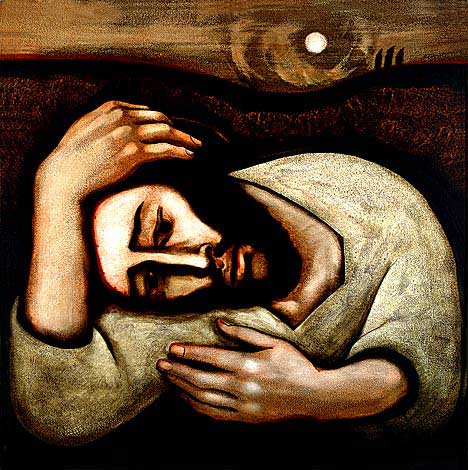
“Christ in Gethsemane” by Michael O’Brien. Go to http://www.studiobrien.com/ for more from the artist.

I think this reflects an emotional response that is still common to people when they first read about Jesus’ agony in Gethsemane.  Here we have Jesus tormented and upset.  We have him begging his Father to let him pass from the cross.  It makes us uneasy.  It seems strange to think of Jesus having fears and doubts.  It makes us wonder how close he was to turning.  What would have happened if Jesus decided, “Not your will, but mine,” and left.  What if there had been no cross for Jesus?  In this moment of Jesus in Gethsemane, we can imagine it for a moment.  We wonder, with bated breath, what he will do.  This is unsettling.

Yet at the same time, this story of Jesus in Gethsemane may be the most important passage in all of the gospels.  It is here that Jesus is most human.  It is here that Jesus is most vulnerable.  And it is here that Jesus is most courageous.  What makes this passage so powerful is the idea that it could have gone either way.  We have the luxury of reading the gospels knowing the end of the story.  We know his decision.  We know how the story ends, but if we allow ourselves to enter the drama of the moment, we can see Jesus making the decision to go forward.

Jesus spent his ministry teaching about love.  Through word and deed Jesus showed us how to love God and to love one another.  He fed the hungry.  He healed the sick.  He invited the women and the children and the tax collectors and the sinners to come to his table.  He broke bread with the least and the lost and shared the cup of redemption with them all.  He crossed boundaries of race, nationality, ethnicity, gender, and class.  He challenged religious authority, and he scoffed at the pomposity and self-absorbed granduer.  He called out the hypocrites.  He admonished the scribes and the pharisees for their hardened hearts.  He brought a simple message: Love God, and love one another.

And for all of that – for the criticism and the invitiation and the healing and the challenge he represented to the comfortable and powerful – he knew he was going to the cross.  He knew if he stood up for all that he lived for, for all that he believed, for all that he held dear, he would be killed.  He knew that if he followed God’s will it would lead to a cross.  Not because God needed him to die, but because men could not allow him to live.  We would not allow him to live.

So he sat there in Gethsemane and he prayed.  He prayed for another way out.  He prayed in anguish.  He prayed as a man who could feel pain, who would be hurt by betrayal, who would be scarred by the scourge, and would bleed when nails were driven into his arms and legs.  He prayed as a man who knew that if he would follow God’s will, he would be charged, convicted, mocked, humiliated, abandoned, and nailed to a cross.  Knowing all of this full well he prayed, “Not my will, but yours.”  Then he rose and stood up for all that he had lived for.

Stengthened by his prayer and with the power of the Holy Spirit he stood, and he went to the cross.  He did not go as a lamb to the slaughter, for a lamb knows not where it is going.  He went as a man who had decided to follow God.  He went as a man that would endure a punishment he did not deserve.  He went as a man that would heal and forgive and love even to the very end.

Gethsemane reminds us that Jesus chose his fate, but more importantly, it reminds us that we choose our own as well.  When we see Jesus in agony in the garden, we know that we will face our own Gethsemane, but we will never do so alone.  Every day we have the choice.

We can follow the way of the world – we can be selfish, we can look out for number one, we can work hard to get what we deserve, we can acquire more stuff, we can ignore the outcast, we can condemn the poor, we can tread on the orphan and the widow, we can judge the sinner, and we can build our nice comfy walls which no one will breach accept those we deem worthy.

Or we can follow Jesus.  We can pray to God, “Not my will, but yours,” and mean it.  We can fail from time to time, but we can know that we are always struggling, like Jesus in the Garden, to do God’s will.  And we can do it knowing that as we struggle, as we are mocked, as we are belittled, as we fail, as we triumph, as we suffer and as we celebrate, Jesus is with us.

Follow on Facebook

Follow on Twitter

6 Comments

Filed under Christianity, Sermons

And it was still hot

That's me up there.

That’s me up there.

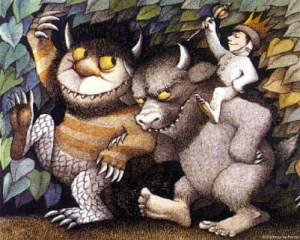
When I was a boy, I discovered a wonderful book.  It was a part of my school library, and I would check it out every chance I had.  It was the story of a boy who was sent to bed without his supper for misbehaving.  While in his room a “forest grew, and grew, and grew until his ceiling hung with vines and his walls became the world all around.”

I was Max.

I was the little boy that got into trouble.  Not so much for being a wild thing, but for other reasons.  I was the little boy that had a big imagination – one full of friends and heroes and enemies and a few wild things.  I was the boy, who after going on an adventure, even when he knew his mother might be angry with him, could depend on the fact that when he came home, his supper would be waiting for him.

“Where the Wild Things Are” is more than a book to me.  It is a story that captured me twenty five years ago and continues to hold me tight.  It is a story I now tell my daughter – word for word, without the book.  It is a story of adventure, imagination, friendship, love, loss, and grace.

“Where the Wild Things” opens in movie theaters tonight.  I have seen all the trailers.  Even with a resounding endorsement from Maurice Sendak, I am reluctant to see it.  I am reluctant because its not his story anymore.  And its not Spike Jonze’s story either.  Its mine.

“Where the Wild Things Are” is MY story.  It is MY adventure.  I was there when they roared their terrible roars and gnashed their terrible teeth and rolled their terrible eyes and showed their terrible claws.  I was on that ship – dozens of times.  It is MY wild rumpus, complete with the beating drums in the background that I still make when I read the story.  I was the king of the Wild Things.

I am Max.

And it was MY mother who had dinner waiting for me when I returned.

I will probably go see the movie, but to be honest I’m not sure if I want to.  I’m not exactly sure what I’m afraid of.  I know that the story will always be mine.  When I was a kid it was important to know that no matter how wild I was, no matter how far I strayed, no matter how long I was gone, my supper would always be waiting for me.

As an adult I have a deeper understanding of grace.  Max and his mother helped teach me that.  So now maybe its okay to let go of my story – a little.  The story of grace is one that needs to be told over and over to as many people as possible.

Someday soon my daughter will come home from the library (her favorite place in the world) carrying the story of Max and his wild friends.  She will read it and I pray that she will know that no matter how wild she is, no matter how far she strays, no matter how long she is gone, her supper will always be waiting for her.

And it will still be hot.

Follow the Fat Pastor on Facebook

Follow on Twitter

7 Comments

Filed under Christianity, Media