Tag Archives: kingdom of god

Why Church?

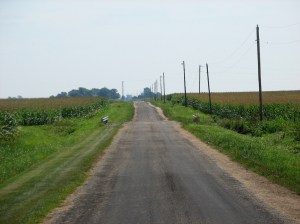
An Illinois country road. Photo by DeWayne Neeley. Click on the picture to go to his Flickr site.

A long time ago I wrote a sermon about a bike ride through the cornfields of central Illinois.  It was one of my favorite things to do when I lived in Chenoa.  I would turn left out of our driveway and just keep going.  It wouldn’t take long before I was on a road that looked a lot like the one pictured. 

When the corn was high, riding a bike down a narrow road like this was a slighltly harrowing experience because I couldn’t really see where I was.  When you’re in the middle of one of these corn canyons, you can see where the road leads – at least until the next hill – and that’s about it.  When the corn is high, you can’t really see anything but corn and sky.

That is partly why I loved those bike rides so much.  It was so peaceful and so calm.  I spent a lot of time in prayer on those country roads.  The reason I said it was harrowing, however, is because I could be riding along with cornfields on boths sides for quite some time.  And while country roads were usually straight, they were not always a dependable grid.  Some were deadends.  Some veered in directions I didn’t really mean to go.  Some took me to the highway (and if you ever want a lesson in white-knuckled prayer, ride your bike on a busy country highway – with semi trucks passing you at 60 miles and hour).

It could be really easy to get turned around amidst all the fields and right angles.  Yet no matter where I rode, I always knew that I could see the water tower.  As long as I could see the water tower, I knew I could get back home.  The water tower is the tallest thing poking out of the grove of trees that is Chenoa.  Whenever I rode – I knew I could make it home if I could see the water tower.  That is why those moments in the corn canyons were a little unsettling.

In life, we can go down a lot of roads.  Sometimes were are heading away from home.  Sometimes we are meandering around aimlessly.  Sometimes we hit dead ends, or go on courses we didn’t intend.  Sometimes we get turned around.  Sometimes we hold on white-knuckled just praying that things will be okay.  That is why it is so important to have that water tower – raising over it all, showing us the way home.

To me, that is church.  It is the place to which I can always turn.  It is not perfect.  The church has made mistakes – some historic, some personal.  The church has hurt people, hurt families, hurt nations.  Yet as far as I’m concerned, it is our best hope.  It is the best hope we have of finding our way.  It is the beacon that calls us home. 

At its best the church is a place of love.  If the church is being what Christ intended it to be, the church is a place of forgiveness, grace, invitation and mission.  It is a place to be fed, empowered and sent out.  It is the oasis of the Kingdom of God.  When I think of the churches I have been a part of, I don’t think of buildings or decor. I don’ t think of great sermons or well-organized Bible study.  I don’t think of perfect liturgy or music.  I think of love.

I think of people that cared for me as a child.  I think of people that loved me as an adult.  I think of people that helped guide me into ministry, that picked me up when I failed and allowed me to grow.  I think of people that loved me like parents and were grandparents to my daughters.  When I think of when the church has hurt me I do not think of wrong theology, or boring sermons, or bad music.  When the church has hurt me it has been when people failed to live up to the commandment Christ has given us – love one another as Christ has loved us.  Yet before I let the anger, resentment and hurt feelings get the better of me, I remember that I have failed to love as well.  I am in need of forgiveness for my carelessness, my thoughtlessness and my selfishness.

Through it all, I have found love in the church.  My heart breaks for those that have been wronged by the church.  My heart yearns for those that seek and do not find.  I don’t know where you are on your journey.  I don’t presume to know the path you need to take.  All I know is what I have found.  I have found a place to hold onto.  I have found a water tower in the bike ride of my life – showing me the way to get back home.  I pray you find your way home too.
 

3 Comments

Filed under Christianity, Sermons

Come to the Feast

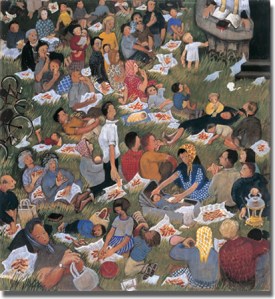
“The Five Thousand” by Eularia Clark, 1962. Click on the image to be taken to the Methodist Church Collection of Modern Christian Art.

As an athlete, one of my favorite times was the few moments before a game.  I loved the anticipation of getting ready – putting on the uniform just right, lacing up the shoes, sharing eye contact with a teammate communicating a sense of common purpose in nothing more than a nod.  I loved getting ready with music playing.  It was like I was in my own movie, and the song I chose was my soundtrack.

Come to the Feast, by Christopher Grundy

Today I go through a similar ritual before worship.  I get myself ready.  I breathe a little deeper.  My adrenaline starts to flow.  I sit in my office for a few moments, and sometimes I crank up the music.  Often it is the same song: Come to the Feast, by Christopher Grundy (Grundy is professor at Eden Theological Seminary and a great musician. You should go to the link and listen to and buy his music).

“Come to the Feast” speaks to the heart of the gospel.  “Come to the feast.  There’s always room for one more and there’s all you can eat.  Come and take some to go. Gather all you can hold and then go.  Go spread the feast.”  We are a people of the feast.  We are a people of the Table.

At the heart of everything we do as Christians is the table of Jesus Christ.  How we think about the table informs how we think about everything else.  Where does the pastor stand?  Behind the table in a gesture of welcome and inclusion, not with her back to the congregation.

What do we serve?  Bread and grape juice as a sign of hospitality to those that cannot have alcohol.

Who is invited?  Everyone.  Children?  Yes.  They may not understand what is going, but then again, are we kidding ourselves if we think we do understand?

Unbaptized?  Yes.  The moment of communion is so powerful that it can be a moment of conversion and transformation.

Democrats and Republicans? Yes. We don’t bar you for voting a certain way.

Rich and Poor? Yes – and they each get the same amount.

Black and White?  Yes, although we repent for times when this wasn’t true.

Gay and Straight? Yes, for God created all and said it is “good.”

The Lord’s Table is a table for all.  On it holds the feast which has transformed lives.  On it rests the bread that has been broken for us all.  Jesus broke the bread and told us to “do this in remembrance of me.”  It was not simply to remember that Jesus’ body was broken.  It was remember that his body held life.  When we break the bread we are to remember that Jesus was more than a sacrificial lamb led to the slaugher.

When we hear “Do this in remembrance of me,” we should hear Jesus saying: “When we got together in the home of tax collectors and sinners – Remember that.  When the women came to me and broke free from their man-made roles of servitude – Remember that.  When you guys tried to keep the children from getting to me, and I said ‘let them come’ – Remember that.  When we sat in the crowd of 5,000 people and all we had were five loaves and two fish and you all thought there was no way that we would have enough, and then everyone ate – Remember that.”

“Remember when the Pharisees tried to use the Law to put up barriers between who is in and who is out – Remember that I broke those barriers as easily as I break this bread.  When they used the Law to condemn and tried to trap me in legal issues –   Remember when they asked me what was the greatest commandment, hoping that I would trip on my words – Remember what I told them?”

“And things aren’t looking good right now.  The Romans and the leaders are coming.  They are going to beat me and crucify me.  After that happens I want you to remember me at this table saying to you, my body is broken for you.  And when I come back, maybe then you will get it.  Maybe then you will finally see.  Maybe then you understand all the things I did and said and showed you.  I break the bread so that you may have life.”

When we come to the Table of Christ we are invited to a feast.  We are invited to a table of plenty.  We are invited without merit.  We are invited without deed.  We are simply invited to come and be loved.

But when we are invited to come to the feast, it is imperative to remember that we are also sent.  We are not invited to get full and go home fat and satisfied.  We are invited to be fed so that we may feed. We are invited to forgiveness so that we may forgive. We are invited to be empowered so that we may go out and empower.  So, as the words of the song so elegantly say, “Come and then go. Go spread the feast.”

“Come to the Feast” is (c) by Hand and Soil Music.  Visit www.christophergrundy.com to listen to more music.

2 Comments

Filed under Christianity, Sermons

Engaging in ministry with the poor

The most important part of this area of focus is the word “with.” Too often, we think of ministry “for” the poor, as if it is our job, as those have means, to do things for those that don’t. As a church, we need to be engaged in ministry with the poor. It is not about giving away money. It is about building relationships with our neighbors.

I have said before that “the Kingdom of God exists where the needs of a community intersect with the resources of a loving congregation.”

For a church to be engaged in bringing about the Kingdom of God, it must:
1. Be loving.
2. Know its resources.
3. Know the needs of the community.

The first two seem easy. The first is about motivation. Does the congregation want to make a difference in the world? Many churches are actually more interested in maintaining a building so that they have a place to be buried and married then they are interested in making disciples of Jesus Christ. Yet once a congregation decides they want to transform the world, they must figure out what they are good at. Every Christian has gifts and passions that can be used to serve others. Every Church is made up of gifted Christians that have something to share.

Some churches have great quilting circles. They can create blankets for babies in need. They can sell quilts to raise money for the food pantry. Some churches have a lot of gardners. They can host a Garden Surplus Day, and share the bounty of their harvest with those in need. What are you good at? What do you love to do? Once you figure that out, then it takes time to figure out No. 3.

The third one takes time. It takes energy. It takes building relationships. It means that people in the congregation must be in the community. Where are the poor in your community? Are they in your church? Are they at Wal Mart, MacDonald’s, the community food pantry, the park, school, the tavern? Ask yourself, where are poor people in your community, and how can we work together to make the community better.

Engaging in ministry with the poor was an important part of Jesus’ mission. It must be a part of our mission as a church as well. If you’re wondering how to start, just ask these questions:

1. Are you loving? Do you want to transform the world, or at least the life of one person?
2. What are you good at? What are your passions?
3. How can you use that to help someone else?

1 Comment

Filed under Christianity

Jesus, Pilate, Barabbas, and centuries of violence

As we approach Easter, my church continues to work through Adam Hamilton’s 24 Hours that Changed the World.  This Sunday, we will be looking at Jesus before Pilate.  As found in the gospel of Mark, the story goes like this:

As soon as it was morning, the chief priests held a consultation with the elders and scribes and the whole council. They bound Jesus, led him away, and handed him over to Pilate. Pilate asked him, ‘Are you the King of the Jews?’ He answered him, ‘You say so.’ Then the chief priests accused him of many things. Pilate asked him again, ‘Have you no answer? See how many charges they bring against you.’ But Jesus made no further reply, so that Pilate was amazed.

Now at the festival he used to release a prisoner for them, anyone for whom they asked. Now a man called Barabbas was in prison with the rebels who had committed murder during the insurrection. So the crowd came and began to ask Pilate to do for them according to his custom. Then he answered them, ‘Do you want me to release for you the King of the Jews?’ For he realized that it was out of jealousy that the chief priests had handed him over. But the chief priests stirred up the crowd to have him release Barabbas for them instead. Pilate spoke to them again, ‘Then what do you wish me to do with the man you call the King of the Jews?’ They shouted back, ‘Crucify him!’ Pilate asked them, ‘Why, what evil has he done?’ But they shouted all the more, ‘Crucify him!’ So Pilate, wishing to satisfy the crowd, released Barabbas for them; and after flogging Jesus, he handed him over to be crucified.

Gospel of Mark 15:1-15 New Revised Standard Version

Here we have an incredibly powerful narrative of Jesus, Pilate and Barabbas.  If used properly, this story can be a mirror to our own souls – forcing the reader to ask the question, “What do you wish me to do with the man?”  In this dramatic scene, the people are given a choice.  The Gospel of Mark presents this choice in clear and uncertain terms.  Barabbas is describes as a rebel who murdered someone during an insurrection.  He was an enemy of the state – and he used violence to achieve his goal.

Barabbas was resentful of Roman rule and wanted, like so many Judeans at the time, to be free of Roman rule.  For centuries Judea had been under the thumb of one world superpower or another.  Rome was just another in a long line of foreign rulers.  The people longed to be free of oppression.  Barabbas had followed one path toward freedom.  We don’t know if he lead a great uprising, or if he was just a part of a troublesome skirmish, but the details of his crime are not important.  He is presented as a symbol.  He is the path of liberation through violence.

More than this though, he is the way of the world.  His path is the same path as the Romans.  Though he had the goal of overthrowing Roman rule, his means were the same that Rome used.  His path of violence was, in many ways, the only one that people knew.  It was the way of the world – it was the way of “might makes right.”  He wanted to make a new Kingdom, based on God’s law and God’s people, but he used the tactics upon which the Kingdom of Rome was built.  They were the same tactics on which the Kingdom of Perisa was built, and the Kingdom of the Babylonians, and the Kingdom of the Pharoah.

Jesus presents a different option. He was trying to build the Kingdom of God, which can only be built with peace, grace, humility and self-sacrifice.  Jesus told his disciples to love their enemies, to sell their possessions, to leave their families and their status and their well-being and their comfort.   Barabbas said, “Pick up your weapon and follow me.”  Jesus said, “Pick up your cross and follow me.”

As we read the Gospel account of the people choosing to set Barabbas free, we must remember that the choice is ours.  Everyday we stand in that crowd.  Everyday we hear the chief priests – the pompous, the powerful, the comfortable, the talking-heads, the radio hosts, our friends, our co-workers, our neighbors – egging us on to set Barabbas free.  Everyday we must choose between the way of the world and the way of God.

We work either to build kingdoms of men, or the Kingdom of God.  Every time we choose to work for the good of others, every time we seek out a closer relationship with the outcast, every time we sacrifice our comfort or status for the sake of love, we reverse the decision that was made that day.  When we pay a little more for fair trade coffee, when we make an effort to recycle our trash, when we pick up our Bible and spend some time with God, when we ask a friend if it’s okay to pray for them, when we go to worship instead of sleeping in, when we witness to our faith through word and deed, we reverse the decision that was made that day.

Don’t let evil ones tell you that the decision was made by the Jewish crowds.  Don’t let them get away with pawning off this decision on them, because we are there making the same decision everyday.  Don’t let Pilate off because he tried to “wash his hands of this.”  It’s not that easy.  Jesus’ blood isn’t washed away with water and a towel.

This text has been misused to justify violence against millions for centuries.  It has been misused by people who want to avoid the question, “What do you want me to do with this man?”  Don’t let Mel Gibson’s movie tell you that it was the Jews that killed Jesus.  Don’t believe the lies.  Too often, depictions of the gospels in drama – called passion plays – get lazy.  They allow and sometimes encourage the viewer to side with Pilate, the reluctant Roman, and denounce the actions of the Jewish mob.

Don’t forget that the road from Oberammergau to Dachau is only a short drive in a car, and throughout history has been shorter than that in the hearts of those looking for someone to blame.  Read about the history of Oberammergau.  Read about Hitler’s visit in 1934.  Read about the changes they have made since 2000, and wonder why it took so long.  I live close to the longest running passion play in America, and yet its website is conspiculously free of anything about the link between violence against Jews and passion plays.

There are those that have deeply emotional responses to passion plays.  Part of my faith development includes a powerful experience with a passion play.  They are designed to emit emotional response.  There is a basic human response to the suffering of an innocent that should invoke emotional response.  All I am saying is, be careful.

If you see a passion play this year, do so with your eyes wide open.  Be honest with your own feelings.  Those emotions you feel – are they about the sin you see in yourself?  Do you have a contrite and broken heart because you see yourself in the crowd?  Do you see yourself in Pilate, trying to wash your hands of a something that you had the power to stop?  Or are you angry with those that killed Jesus?  Are you quick to blame others for sin in which we all participate?

Leave a comment

Filed under Christianity

Advent Poem

I wrote and posted this poem last year, but only a few people were following this site back then.  It has a sort of Dr. Seuss rhythm that works better in some stanzas then others, but here’s my first try at poetry in over ten years:

“Established, Unfinished”
by Robb McCoy

Established, unfinished; at hand, yet to be.
For the Kingdom of God, we are waiting to see.

Where’s the Prince of Peace in the midst of such war?
Made the image of God, yet corrupt to core.
It is peace that we seek, for peace do we yearn.
While cities and buildings and children still burn.

Dividing walls built in hearts and with brick,
By people who hold onto Bibles so thick.
Telling us who we can and cannot love,
Like Pharisees all, they strangle the dove.

Through the darkness does break a beacon of hope.
In midst of rough waters a life-saving rope.
Lo a child is born in a manger so rough,
Letting us know that, YES, love is enough.

Love your neighbor, Love God, there is nothing more.
And at once the seams of the curtain, they tore.
In the midst of fighting and chaos and doom,
We know our Creator is saving a room.

The Kingdom of God is still unfulfilled,
We continue to struggle for what God has willed.
Love mercy, do justice, walk humbly with God.
Eat dinner with sinners, the poor and the odd.

Though sometimes the Kingdom comes painfully slow,
Together we struggle, together we go,
to the Kingdom of God, our victory won
Established, unfinished, our stuggle not done.

Another poem.  This one is called “Invitation (or Evangelism)”

8 Comments

Filed under Christianity

Etablished, Unfulfilled

It’s a little cheesy, and you can tell that I have been reading some Dr. Seuss with my daughter, but here’s my first try at poetry in over ten years:

Established, unfulfilled, here and yet to be.
People of God, unwilling to see.

Where’s the Prince of Peace in the midst of such war?
We’re in the image of God, yet corrupt to core.
Peace that we seek, for peace do we yearn.
While cities and buildings and children still burn.

Dividing walls built in hearts and with brick
By people who hold onto Bibles so thick.
Telling us who we can and cannot love,
Pharisees all try to strangle the dove.

Through the darkness does break a beacon of hope.
In midst of rough waters a life-saving rope.
Lo a child is born in a manger so rough,
Letting us know that, YES, love is enough.

Love your neighbor, Love God, there is nothing more.
And suddenly the seams of the curtain, they tore.
In the midst of fighting and chaos and doom,
We know that our Creator is saving a room.

The Kingdom of God is still unfulfilled,
We continue to struggle for what God has willed.
Love mercy, do justice, walk humbly with God.
Eat dinner with sinners, the poor and the odd.

Though sometimes the Kingdom comes painfully slow,
Together we struggle, together we go,
to the Kingdom of God, our victory won
Established, unfulfilled, our stuggle not done.

Leave a comment

Filed under Christianity