Category Archives: Christianity

Jesus, Pilate, Barabbas, and centuries of violence

As we approach Easter, my church continues to work through Adam Hamilton’s 24 Hours that Changed the World.  This Sunday, we will be looking at Jesus before Pilate.  As found in the gospel of Mark, the story goes like this:

As soon as it was morning, the chief priests held a consultation with the elders and scribes and the whole council. They bound Jesus, led him away, and handed him over to Pilate. Pilate asked him, ‘Are you the King of the Jews?’ He answered him, ‘You say so.’ Then the chief priests accused him of many things. Pilate asked him again, ‘Have you no answer? See how many charges they bring against you.’ But Jesus made no further reply, so that Pilate was amazed.

Now at the festival he used to release a prisoner for them, anyone for whom they asked. Now a man called Barabbas was in prison with the rebels who had committed murder during the insurrection. So the crowd came and began to ask Pilate to do for them according to his custom. Then he answered them, ‘Do you want me to release for you the King of the Jews?’ For he realized that it was out of jealousy that the chief priests had handed him over. But the chief priests stirred up the crowd to have him release Barabbas for them instead. Pilate spoke to them again, ‘Then what do you wish me to do with the man you call the King of the Jews?’ They shouted back, ‘Crucify him!’ Pilate asked them, ‘Why, what evil has he done?’ But they shouted all the more, ‘Crucify him!’ So Pilate, wishing to satisfy the crowd, released Barabbas for them; and after flogging Jesus, he handed him over to be crucified.

Gospel of Mark 15:1-15 New Revised Standard Version

Here we have an incredibly powerful narrative of Jesus, Pilate and Barabbas.  If used properly, this story can be a mirror to our own souls – forcing the reader to ask the question, “What do you wish me to do with the man?”  In this dramatic scene, the people are given a choice.  The Gospel of Mark presents this choice in clear and uncertain terms.  Barabbas is describes as a rebel who murdered someone during an insurrection.  He was an enemy of the state – and he used violence to achieve his goal.

Barabbas was resentful of Roman rule and wanted, like so many Judeans at the time, to be free of Roman rule.  For centuries Judea had been under the thumb of one world superpower or another.  Rome was just another in a long line of foreign rulers.  The people longed to be free of oppression.  Barabbas had followed one path toward freedom.  We don’t know if he lead a great uprising, or if he was just a part of a troublesome skirmish, but the details of his crime are not important.  He is presented as a symbol.  He is the path of liberation through violence.

More than this though, he is the way of the world.  His path is the same path as the Romans.  Though he had the goal of overthrowing Roman rule, his means were the same that Rome used.  His path of violence was, in many ways, the only one that people knew.  It was the way of the world – it was the way of “might makes right.”  He wanted to make a new Kingdom, based on God’s law and God’s people, but he used the tactics upon which the Kingdom of Rome was built.  They were the same tactics on which the Kingdom of Perisa was built, and the Kingdom of the Babylonians, and the Kingdom of the Pharoah.

Jesus presents a different option. He was trying to build the Kingdom of God, which can only be built with peace, grace, humility and self-sacrifice.  Jesus told his disciples to love their enemies, to sell their possessions, to leave their families and their status and their well-being and their comfort.   Barabbas said, “Pick up your weapon and follow me.”  Jesus said, “Pick up your cross and follow me.”

As we read the Gospel account of the people choosing to set Barabbas free, we must remember that the choice is ours.  Everyday we stand in that crowd.  Everyday we hear the chief priests – the pompous, the powerful, the comfortable, the talking-heads, the radio hosts, our friends, our co-workers, our neighbors – egging us on to set Barabbas free.  Everyday we must choose between the way of the world and the way of God.

We work either to build kingdoms of men, or the Kingdom of God.  Every time we choose to work for the good of others, every time we seek out a closer relationship with the outcast, every time we sacrifice our comfort or status for the sake of love, we reverse the decision that was made that day.  When we pay a little more for fair trade coffee, when we make an effort to recycle our trash, when we pick up our Bible and spend some time with God, when we ask a friend if it’s okay to pray for them, when we go to worship instead of sleeping in, when we witness to our faith through word and deed, we reverse the decision that was made that day.

Don’t let evil ones tell you that the decision was made by the Jewish crowds.  Don’t let them get away with pawning off this decision on them, because we are there making the same decision everyday.  Don’t let Pilate off because he tried to “wash his hands of this.”  It’s not that easy.  Jesus’ blood isn’t washed away with water and a towel.

This text has been misused to justify violence against millions for centuries.  It has been misused by people who want to avoid the question, “What do you want me to do with this man?”  Don’t let Mel Gibson’s movie tell you that it was the Jews that killed Jesus.  Don’t believe the lies.  Too often, depictions of the gospels in drama – called passion plays – get lazy.  They allow and sometimes encourage the viewer to side with Pilate, the reluctant Roman, and denounce the actions of the Jewish mob.

Don’t forget that the road from Oberammergau to Dachau is only a short drive in a car, and throughout history has been shorter than that in the hearts of those looking for someone to blame.  Read about the history of Oberammergau.  Read about Hitler’s visit in 1934.  Read about the changes they have made since 2000, and wonder why it took so long.  I live close to the longest running passion play in America, and yet its website is conspiculously free of anything about the link between violence against Jews and passion plays.

There are those that have deeply emotional responses to passion plays.  Part of my faith development includes a powerful experience with a passion play.  They are designed to emit emotional response.  There is a basic human response to the suffering of an innocent that should invoke emotional response.  All I am saying is, be careful.

If you see a passion play this year, do so with your eyes wide open.  Be honest with your own feelings.  Those emotions you feel – are they about the sin you see in yourself?  Do you have a contrite and broken heart because you see yourself in the crowd?  Do you see yourself in Pilate, trying to wash your hands of a something that you had the power to stop?  Or are you angry with those that killed Jesus?  Are you quick to blame others for sin in which we all participate?
Leave a comment

Filed under Christianity

Three year old theologian

My daughter has a little Bible that she loves to “read.”  It is a little copy of New Testament and Psalms that is about four inches long.  She was sitting on my wifes lap the other day “reading” from her Bible, and said this:

“On the way to the cross, Jesus saw his disciples and said come with me to die and have peace.”

I thought that was pretty good.  Actually, I was pretty much blown away by what she said, but then she read from another passage.  I wrote it down as she was speaking, so this is what she said, word for word:

“Jesus went to the cross and died.  But he came back, and he was happy.  And they were all happy.  And the nails were gone and his tummy was fine.  And his body was awesome.  And he didn’t whine.  He was happy.”

This is where I am tempted to add my reflection, but I have a feeling that I couldn’t possibly be as poignant as her.

3 Comments

Filed under Christianity

Gethsemane

The Garden of Gethsemane has always been one of my favorite passages of Scripture.  The most vivid description of it is found in the Gospel of Mark.

They went to a place called Gethsemane; and he said to his disciples, ‘Sit here while I pray.’ He took with him Peter and James and John, and began to be distressed and agitated. And he said to them, ‘I am deeply grieved, even to death; remain here, and keep awake.’ And going a little farther, he threw himself on the ground and prayed that, if it were possible, the hour might pass from him. He said, ‘Abba, Father, for you all things are possible; remove this cup from me; yet, not what I want, but what you want.’ He came and found them sleeping; and he said to Peter, ‘Simon, are you asleep? Could you not keep awake one hour? Keep awake and pray that you may not come into the time of trial; the spirit indeed is willing, but the flesh is weak.’ And again he went away and prayed, saying the same words. And once more he came and found them sleeping, for their eyes were very heavy; and they did not know what to say to him. He came a third time and said to them, ‘Are you still sleeping and taking your rest? Enough! The hour has come; the Son of Man is betrayed into the hands of sinners. Get up, let us be going. See, my betrayer is at hand.’

Immediately, while he was still speaking, Judas, one of the twelve, arrived; and with him there was a crowd with swords and clubs, from the chief priests, the scribes, and the elders. Now the betrayer had given them a sign, saying, ‘The one I will kiss is the man; arrest him and lead him away under guard.’ So when he came, he went up to him at once and said, ‘Rabbi!’ and kissed him. Then they laid hands on him and arrested him. But one of those who stood near drew his sword and struck the slave of the high priest, cutting off his ear. Then Jesus said to them, ‘Have you come out with swords and clubs to arrest me as though I were a bandit? Day after day I was with you in the temple teaching, and you did not arrest me. But let the scriptures be fulfilled.’ All of them deserted him and fled.

A certain young man was following him, wearing nothing but a linen cloth. They caught hold of him, but he left the linen cloth and ran off naked.

Mark 14:32-52 (New Revised Standard Version)

It is interesting to me that in later Gospels, this story gets truncated.  In Luke, which most scholars agree was written after Mark, Jesus’ experience in Gethsemane was much briefer, and the sorrow and agony he experienced was not as graphic.  The Gospel of John, which most scholars agree was the last of the four Biblical gospels, does not include the agony in Gethsemane at all.

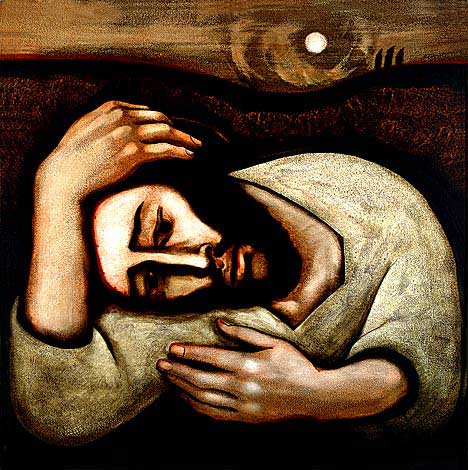
“Christ in Gethsemane” by Michael O’Brien. Go to http://www.studiobrien.com/ for more from the artist.

I think this reflects an emotional response that is still common to people when they first read about Jesus’ agony in Gethsemane.  Here we have Jesus tormented and upset.  We have him begging his Father to let him pass from the cross.  It makes us uneasy.  It seems strange to think of Jesus having fears and doubts.  It makes us wonder how close he was to turning.  What would have happened if Jesus decided, “Not your will, but mine,” and left.  What if there had been no cross for Jesus?  In this moment of Jesus in Gethsemane, we can imagine it for a moment.  We wonder, with bated breath, what he will do.  This is unsettling.

Yet at the same time, this story of Jesus in Gethsemane may be the most important passage in all of the gospels.  It is here that Jesus is most human.  It is here that Jesus is most vulnerable.  And it is here that Jesus is most courageous.  What makes this passage so powerful is the idea that it could have gone either way.  We have the luxury of reading the gospels knowing the end of the story.  We know his decision.  We know how the story ends, but if we allow ourselves to enter the drama of the moment, we can see Jesus making the decision to go forward.

Jesus spent his ministry teaching about love.  Through word and deed Jesus showed us how to love God and to love one another.  He fed the hungry.  He healed the sick.  He invited the women and the children and the tax collectors and the sinners to come to his table.  He broke bread with the least and the lost and shared the cup of redemption with them all.  He crossed boundaries of race, nationality, ethnicity, gender, and class.  He challenged religious authority, and he scoffed at the pomposity and self-absorbed granduer.  He called out the hypocrites.  He admonished the scribes and the pharisees for their hardened hearts.  He brought a simple message: Love God, and love one another.

And for all of that – for the criticism and the invitiation and the healing and the challenge he represented to the comfortable and powerful – he knew he was going to the cross.  He knew if he stood up for all that he lived for, for all that he believed, for all that he held dear, he would be killed.  He knew that if he followed God’s will it would lead to a cross.  Not because God needed him to die, but because men could not allow him to live.  We would not allow him to live.

So he sat there in Gethsemane and he prayed.  He prayed for another way out.  He prayed in anguish.  He prayed as a man who could feel pain, who would be hurt by betrayal, who would be scarred by the scourge, and would bleed when nails were driven into his arms and legs.  He prayed as a man who knew that if he would follow God’s will, he would be charged, convicted, mocked, humiliated, abandoned, and nailed to a cross.  Knowing all of this full well he prayed, “Not my will, but yours.”  Then he rose and stood up for all that he had lived for.

Stengthened by his prayer and with the power of the Holy Spirit he stood, and he went to the cross.  He did not go as a lamb to the slaughter, for a lamb knows not where it is going.  He went as a man who had decided to follow God.  He went as a man that would endure a punishment he did not deserve.  He went as a man that would heal and forgive and love even to the very end.

Gethsemane reminds us that Jesus chose his fate, but more importantly, it reminds us that we choose our own as well.  When we see Jesus in agony in the garden, we know that we will face our own Gethsemane, but we will never do so alone.  Every day we have the choice.

We can follow the way of the world – we can be selfish, we can look out for number one, we can work hard to get what we deserve, we can acquire more stuff, we can ignore the outcast, we can condemn the poor, we can tread on the orphan and the widow, we can judge the sinner, and we can build our nice comfy walls which no one will breach accept those we deem worthy.

Or we can follow Jesus.  We can pray to God, “Not my will, but yours,” and mean it.  We can fail from time to time, but we can know that we are always struggling, like Jesus in the Garden, to do God’s will.  And we can do it knowing that as we struggle, as we are mocked, as we are belittled, as we fail, as we triumph, as we suffer and as we celebrate, Jesus is with us.

Follow on Facebook

Follow on Twitter

6 Comments

Filed under Christianity, Sermons

Invoking the name of God

We have spent most of the week hearing the images and reading the stories of thousands of people devastated by the earthquakes in Haiti.  There are many reactions to such a tragedy, but the only Christian response is action.  It is action through prayer, giving, and volunteering.  Today we can only do two of those things.

Unfortunately, some that call themselves Christian made another response. Last week I preached in my church about the danger of grouping people into “us” and “them,” because the next step is dehumanization, and the next is violence.  Today though, I feel that I need to call out evil when I see it.

On the TV show the 700 Club, Pat Robertson connected the earthquake and 200 years of poverty with a pact that Haitians made with the devil.  This statement is historically inaccurate.  It is theologically disturbing and it is morally reprehensible.  I could go into the details about why this is the case, but others have done so with more vigor and tenacity then I have the energy to do.

I have been preaching and blogging about religious violence and the evil in the world that is done in the name of God.  To claim that this earthquake was the wrath of God as punishment for a mythical deal from 200 years ago is an act of religious violence.  It is not physical violence, but it is emotional abuse.  To claim this tragedy in the name of God is shameful.

Instead of invoking the name of God as a cause of the earthquake for some unknown political or monetary gain, let us instead invoke the name of God as the inspiration of our mercy.  Let us invoke the name of God as the source of hope in the midst of chaos and despair.  Let us invoke the name of God as people are dug out of the rubble, as food is delivered to a newly orphaned child, and as we hold a crying mother in our arms.

Leave a comment

Filed under Christianity

Part 3 – 1979

This is part 3 of my blog series based on the lecture of Dr. Martin Marty.  His lecture was titled, “Religion and Violence and the global searches for peace.”  He gave this lecture at Wesley United Methodist Church in Urbana.  Part 1 was called, “Why talk about it?”.  Part 2 was called, “What is religious violence?”

There are certain years that just hold a certain amount of power.  People recognize them as turning points.  American history has a few, like 1492, 1776, 1849, 1865, 1929, 1941, and 1963 (in order, Columbus landing in the “new” world, the signing of the Declaration of Independence, the California gold rush, the end of the Civil War, the stock market crash, the bombing of Pearl Harbor, and the assassination of JFK).  On lists like this, few outside of Pittsburgh would include 1979 (the Pirates win the World Series to the soundtrack of “We Are Family).

Yet one event in 1979 began a new era of religion and violence.  After decades of feeling as if the last war to be waged was the one against godless Communism, America was introduced to a new enemy that had their very own god.

The Iranian Revolution sent shockwaves across the world.  Until 1979, there was a general concept in society that, by and large, religion was becoming less and less important.  This was actually seen as a trend since the Enlightenment.  When science and logic ushered in the modern era, most thinkers believed that religion – and all the violence that came with it – was going to slowly die.  The theory of secularization was that society would grow in secularization, and religious fervor and phanaticism would lose its influence.

The Iranian revolution proved the theory of secularization wrong.  In fact, it proved that the exact opposite was actually taking place.  While secularization coninued through much of the world, the result was not the deadening of the extremes, but a push toward the extremes.  Secularization took people out of the middle-of-the-road religion.  Mainstream churches started to die, moderation became a sign of weakness.

At the same time, the extremes started to close rank.  They drew their lines, and more clearly defined themselves.  Taking up the name “Fundamentalists,” they made lists of what is the right way of believing and acting, and anyone outside these definitions were deemed “non-believers,” or “heathen,” or “infidels.”  This was not unique to any one religion.  Fundamentalism took hold in Christianity, Islam, Judaism, and Hinduism. 

So instead of dulling the edges, secularization actually sharpened them.  This created a turbulent environment across the world.  In the United States, this battle was fought largely in the 1960s during battles over race and sexuality.  While some would argue that the Civil Rights Movement and the sexual revolution had nothing to do with Religion, I would beg to differ.  Both of these issues were deeply rooted in religion, the image of God, interpretation of the Bible, a sense of the holy, and the nature of humankind.

In Iran, it culminated in the rise of Islamic fascism.  The revolution showed that religious phanatacism was, in fact, an important aspect of geo-politics and national security.

According to Marty, most experts in national security in the 60s and 70s were interested in Communismand the nuclear arms race.  Religious skirmishes in places like Ireland, Bosnia, and even the Middle East, were seen as regional affairs that had little affect on United States national security. According to Dr. Marty, 1979 was the year that the CIA “got religion.”

2 Comments

Filed under Christianity

Longest Night

On Thursday night churches everywhere will be filled with happy people.  The lights will be on, the poinsettias arranged, the sweaters will be bright, the smiles will be wide.  People will gather in the pews and sing the traditional carols, hear the Christmas story as told by the Gospels of Luke and Matthew, and light candles.  Millions on Thursday night will rise and sing “Joy to the World.”

Many of those same people that will rise and sing on Thursday night will go to bed on Monday and face the longest night of the year in despair.  There will be many that lie down wondering, “Where is the joy?” 

The bills have not been paid, the credit debt is mounting, and work is hard to come by.  The night is so very long.

My mother died at this time of the year.  Christmas won’t be the same.  I miss her smile.  I miss her words of wisdom.  I miss her so much, and the night is so very long.

For the last 53 Christmases I have been with my husband.  He held me in his arms as we watched the children, then the grandhcildren, open their presents.  He made hot cocoa every Christmas morning.  I do not even know the recipe, and the night is so very long.

The onesies I got for Christmas last year are put in a box in the attic.  Never worn.  Never held.  I miss my child and I never held him in my arms, and the night is so very long.

The night can be so very long.  The night can be so very dark and cold. 

Some say that everything happens for a reason.  God is in control, and has a plan.  But what kind of God could plan such things?  Is this the God that I am supposd to celebrate?  Is this the God that I am supposed to worship?  How can I sing “Joy to the World,” when there is none in my own heart?

Christmas does not mean everything is okay.  Christmas did not end the sadness, the pain or the despair.  For those that are hurting at Christmas, I hope you know that you are not alone.  I do not offer you simple platitudes.  I do not offer you easy answers.  All I can offer you is my love.

I don’t think that everything happens for a reason.  I think there are terrible things that happen everyday that God did not plan. I also think that God gives us the power and the grace to overcome even the worst that can happen.  God gives us the chance to heal and be healed; to feed and be fed; to love and be loved.

The longest night can be so very long.  Christmas does not end the night, but it gives us hope for the dawn.

If you are in the midst of the longest night, I invite you to come to Chenoa United Methodist Church on Monday, December 21 at 4 p.m.  The service will end just before sunset of the longest night of the year, and hopefully it will help you to know that you are not alone this Christmas.

5 Comments

Filed under Christianity

Signs

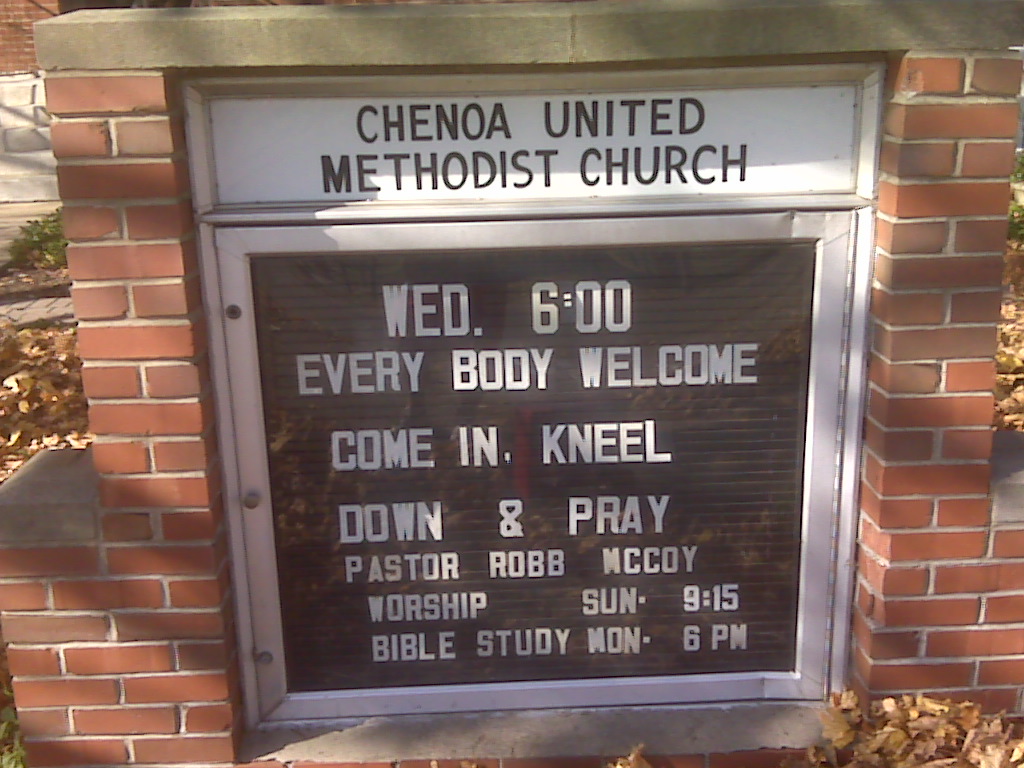
“And the sign said, “Everybody welcome, come in, kneel down, and pray.”

I had a religious experience with Tesla, a couple of buddies and a couch.  I had never heard of Tesla when we sat down there that night.  I had never heard this song, but we listened to it on repeat about a dozen times.  I didn’t know it then, but that moment was informing the rest of my ministry.

At the time I had no plans on being a pastor.  I had no inkling of going to seminary or studying about John Wesley.  To be honest, I probably didn’t know what a  seminary was.  Yet listening to this song shaped the way I felt about church.

I never had long hair, and never felt compelled to trespass on someone’s property.  I never belonged to any club with membership cards.  Yet I understood what it meant to be unaccepted.  I understood what it meant for people to build walls that God would not want built.  The song claimed a piece of my heart, and it is still with me.

Once I became a pastor I decided it would be really cool to put that on the church sign.  Now I’ve got my fancy seminary education and I can tell you all about John Wesley and ecclesiology and neo-orthodoxy.  I have studied the New Testament and the Hebrew Bible.  I have analyzed Jesus’ parables, and I’ve written Bible studies and sermons.   All of it still leads me to this song.  I still think it summarizes what  church should be about.

It is about invitation to all.  It is about opening hearts, minds, and doors so that all are welcome.  It is about offering the grace of Jesus Christ to the least, last and lost.  It is about tearing down those walls that humans are so good at building.  I’m not sure why it has taken me so long, but here it is:

"And the sign said, 'Everybody welcome.  Come in, kneel down, and pray'"

When I was done putting up this sign, I got chills. I think the next one will read, "Thank you Lord for thinking 'bout me, I'm alive and doing fine."

5 Comments

Filed under Christianity

Keep Christ in Christmas

This is the time of year when people start to talk about the war on Christmas. It is a popular slogan to “Keep Christ in Christmas.” There is nothing wrong with that sentiment, unfortunately for many the battleground for the war on Christmas is in slogans, names and semantics. It’s just a matter of time before someone targets a store to boycott because they have the atheistic gall to put up signs that say “Happy Holidays.”

Keeping Christ in Christmas is about more than how you greet someone or what the sign at JC Penny’s reads, or what you call the decorated tree on the lawn at City Hall.

If you want to keep Christ in Christmas, do something that Christ would actually care about. Feed the hungry, cure the sick, share the good news of Jesus Christ, invite someone to church, pray for others, read your Bible. Those are the things that we can do to keep Christ in Christmas.

Here’s one way Chenoa UMC is trying to keep Christ in Christmas: by giving food to kids over Christmas break. We are trying something new at our church. It was an idea that started in a small group Bible study. Inspired by the call to Risk-Taking Mission, the group decided to try and make Christmas Lunch Boxes for elementary school students that would not have lunch over Christmas Break.

So they started collecting food, and telling others. In a matter of a few days a few hundred dollars and a table full of food has been donated. The principal of Chenoa Elementary was contacted, and a letter is going to go out to every student inviting parents to either make a donation or to call the church to get a Christmas Lunch Box.

We don’t know what is going to happen next, but we feel the power of the Holy Spirit in this mission. We know that there is going to be a child that wakes up on Christmas morning, and might not know a thing about Jesus or the Bible, but they will also not know hunger. That child will sit down at a table and eat a sandwich and Christ will be there – right smack dab in the middle of Christmas.

(If you would like to help with the Christmas Lunch-Box program, please call 815-945-7155, or send checks payable to Chenoa United Methodist Church, and mark them “Lunch Box.”)

2 Comments

Filed under Christianity

Advent Poem

I wrote and posted this poem last year, but only a few people were following this site back then.  It has a sort of Dr. Seuss rhythm that works better in some stanzas then others, but here’s my first try at poetry in over ten years:

“Established, Unfinished”
by Robb McCoy

Established, unfinished; at hand, yet to be.
For the Kingdom of God, we are waiting to see.

Where’s the Prince of Peace in the midst of such war?
Made the image of God, yet corrupt to core.
It is peace that we seek, for peace do we yearn.
While cities and buildings and children still burn.

Dividing walls built in hearts and with brick,
By people who hold onto Bibles so thick.
Telling us who we can and cannot love,
Like Pharisees all, they strangle the dove.

Through the darkness does break a beacon of hope.
In midst of rough waters a life-saving rope.
Lo a child is born in a manger so rough,
Letting us know that, YES, love is enough.

Love your neighbor, Love God, there is nothing more.
And at once the seams of the curtain, they tore.
In the midst of fighting and chaos and doom,
We know our Creator is saving a room.

The Kingdom of God is still unfulfilled,
We continue to struggle for what God has willed.
Love mercy, do justice, walk humbly with God.
Eat dinner with sinners, the poor and the odd.

Though sometimes the Kingdom comes painfully slow,
Together we struggle, together we go,
to the Kingdom of God, our victory won
Established, unfinished, our stuggle not done.

Another poem.  This one is called “Invitation (or Evangelism)”

8 Comments

Filed under Christianity

Veterans’ Day

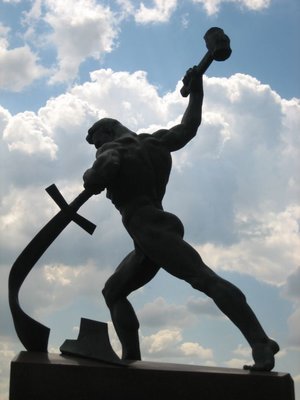
Let Us Beat Swords into Plowshares, a sculpture by Evgeniy Vuchetich in the United Nations Art Collection

Thankful For Veterans. Praying for peace.

Litany for Veterans

One: God of love, peace and justice, it is your will for the world that we may live together in peace. You have promised through the prophet Isaiah that one day the swords will be beaten into ploughshares. Yet we live in a broken world, and there are times that war seems inevitable. Let us recognize with humility and sadness the tragic loss of life that comes in war. Even so, as we gather here free from persecution, we may give thanks for those that have served with courage and honor.

Please Rise: Those that are in our presence that are either in active duty or reserve duty, and the fathers, mothers, siblings, spouses and grandparents of those that are currently serving.

All: God, we praise you for those that are willing to serve. Let all Soldiers, Marines, Sailors, Airmen and Coast Guardsmen serve with honor, pride, and compassion. Do not let their hearts be hardened by the actions they must take. Strengthen their families. Keep them surrounded in your love and peace.

Please Rise: Those that are in our presence that have served in the military in the past.

All: God, we praise you for those that have served in the military. We thank you for those that put the welfare of others ahead of their own safety. Let us all be inspired by their self-sacrifice in service to those who needed protection.

Please Rise: Those that are in our presence who have lost a loved one in war.

All: God, we praise you for those that have made the ultimate sacrifice. We ask that you comfort those that still feel the pain of their loss. Keep us mindful that you have promised to comfort those that mourn.

Please Rise: Those who have gathered in your name in safety because of the sacrifices of others.

All: God, we praise you for granting us these freedoms. Let us honor those who have served by working for peace. Let us never forget those that have served, and let us never let go of your promise of peace.

I also wrote this short Memorial Day liturgy.

A reflection for Memorial Day. Sometimes “Thank you” seems inadequate.

This litany was written by Robb McCoy. It is free to print or display for use in worship. Please attribute: “Permission to publish is granted by Robb McCoy, http://fatpastor.me.”  If you use this in worship, I would love for you to let me know in the comments.

Follow the Fat Pastor on Facebook

Follow on Twitter

69 Comments

Filed under Christianity