The greatest sync since The Dark Side of Oz

A lot of awesome stuff happened in 1989.  The Berlin Wall fell.  The USSR ended their war in Afghanistan.  A brave man stood in front of a tank in Tienanmen Square, inspiring millions in the hopes of democracy.  The Velvet Revolution produced free elections in Czechoslovakia.   The Boys of Zimmer won the NL East.  Montana to Taylor won Superbowl XXIII.   Taylor Swift was born, and there was a National Aerobics Championships.

Tonight, my daughters and I enjoyed a spirited dance party to Taylor Swift’s “Shake it Off” in our kitchen.  After finding this video, my only question is, “how did they get a camera in our kitchen?”

Seriously though, this video is truly amazing.  It was posted on my Facebook as a link from Huffington Post.

Unfortunately the Huffington Post article, and the maker of the video incorrectly identify this aerobics championship as the 1989 season.  This is actually the 1988 championship.  It was hosted by Alan Thicke, and apparently, this happened too:

Follow the Fat Pastor on Facebook
Follow @FatPastor on Twitter

Leave a comment

Filed under Media

The Open Table

Click on the picture to see a part of Amy's house concert.

Click on the picture to see a part of Amy’s house concert.

It was a nearly perfect night.  Ever since, I’ve been thinking, “Can we do that again?”

We gathered in at our home.  It was the first cool night of autumn, and we started the night with some chili and hot apple cider around a fire pit.  Then we came inside.  There were 15 friends sitting in couches and chairs around our living room.  Amy Cox, a talented singer-songwriter with a heart for Jesus and a passion for justice, brought her guitar, a mic, and a small speaker.

She sang.  She told stories.  The kids came and went as they pleased.  The older ones stayed upstairs, listened to the music and whispered to each other in their own little world. The younger ones came and went, going from the floor to the basement to play when they felt like being more rambunctious.  The littlest ones stayed in laps and arms – not necessarily the laps and arms of their own parents.  At one point I looked around at this group of people, all of whom I care for deeply, and my heart was warmed.

“This,” I thought, “is church.”

It was a holy moment, one which I want to re-create.  My wife and I have talked since.  “Do you think we could do that again?”  And time and again our answer is, “I don’t know if we can, but we need to try.”  Unfortunately, Amy Cox isn’t available.  She’s busy planting a church in Virginia, and I wish her success.  She was able to come through the Quad Cities on a cross-country trip to San Diego, and I’m so glad she was able share a night with us.

Luckily, I have some friends with some musical talent, and I’m hoping we can create something together.  Picture this:

It’s a Thursday night.  People come to our house at 6:30.  Hopefully everybody’s had dinner, but we’ll have some small snacks, wine, coffee, and we’ll just chat for a little while as everyone arrives.  Eventually, we’ll write down something for which we would like prayer, and throw it in a basket.  All are invited to share if they’d like, but don’t have to.  We share a brief time of prayer and silence.  Someone with a guitar leads sings a couple of songs.  Some sing along.  Some of the kids stick around for the music.  Some have gone down to the basement to play.  Someone reads a passage of Scripture.  I talk about it for ten minutes or so.  It’s not really a sermon – more like a guided discussion.  We wrap up the discussion, then we talk about a mission or ministry – local or global – and take an offering for it.  Sometimes instead of an offering, we might put do some kind of hands-on mission.  Then I get a nice loaf of bread and grape juice, and we share in Communion.  We sing another song or two, and go home.  Before we leave, everyone takes one of the prayers that was written down at the beginning of the night and we promise to be in prayer for whatever we draw over the course of the week.

This is my vision.  It is kind of scary to put it out there like this, but I do so because I wonder, does anyone out there have a similar experience?  What kind of worship have you experienced outside of church walls?  What is the value of gathering in homes?  What are the pitfalls?  I’d love to hear from you.

Follow The Fat Pastor on Facebook
Follow @FatPastor on Twitter

Follow Amy Cox on Facebook
Follow @AmyECox on Twitter

Leave a comment

Filed under Christianity

The Great Cloud of Witnesses

Hebrews 12:1-2: So then let’s also run the race that is laid out in front of us, since we have such a great cloud of witnesses surrounding us.  Let’s throw off any extra baggage, get rid of the sin that trips us up, and fix our eyes on Jesus, faith’s pioneer and perfecter.  He endured the cross, ignoring the shame, for the sake of the joy that was laid out in front of him, and sat down at the right side of God’s throne.

harvested fieldIn churches around the world, on All Saints’ Sunday, the names of the dead are read.  Bells are tolled.  Portraits are shown.  Years of birth and death are printed.  Candles are lit.  Songs are sung.  This is the day that all saints are remembered.  The saints of the Church are remembered, and their names are spoken.

At the eve of winter, before the Advent season has begun, as the leaves are dried and fallen, and the fields lay bare, we celebrate all the saints.  At the eve of winter, when the wind feels a little stronger, and the grass starts each morning with a glistening sheet of frost, we look into the face of death.  The winter is coming.  The temperature will continue to drop.  The night will get longer.  In the midst of this changing season, we pause.  We stand.  We face the cold winter wind and in defiance, we speak the names of those we have lost.

We stand and face the coming reality.  In the midst of life, we are surrounded by death.  We stand together facing the twin realities that we have all lost someone, and that we all face the same end.

In a culture hungry for immortality, we come together on All Saints Day and proclaim the good news that all will die.  Everywhere you look, there are those avoiding death.  Vampire and Zombie stories are insanely popular.  What is their common theme?  They revolve around the ability to cheat death.  All around, there are schemes – plans, pills, and procedures – to avoid aging.  Is there any stranger relationship we have in our culture than we have with aging? I cannot think of anything people try so hard to at the same time do and avoid.  So we mock a celebrity for getting saggy arms, or wrinkles on their face; and then we mock them for having plastic surgery.

On All Saints’ Day we can come together and acknowledge our own mortality.  And we name those we mourn. We say the words, and there is a physical response.  There is a release when we speak the name of those that have died.  So often, we hold in our memories and emotions.  We keep them bottled up, and often forgotten.  We’ve been told over the last year – or longer – that we should be “over it.”  It is doubtful anyone actually said the words, “get over it,” to someone who is mourning.  We hear it nonetheless.  We hear it from life that goes on.  We hear it from routines that settle back in.  We hear it in empty chairs that are never filled, phones that no longer ring, and arms that no longer embrace.  And so we get over it.  We move on, but never quite the same again.  When we speak the name, it is a chance to stop pretending.  Stop pretending that we have “gotten over it.”

Speaking the name is a chance look at death and say, “I will not forget.  She will not die.”  Death is no less a reality when we speak the name of those that we mourn, but when we gather for worship in the midst of death, we know that it does not have the final say.  We continue to run the race that is laid out in front of us because we know we are surrounded by a great cloud of witnesses.  The death of a mortal body that falls to the ground is no more the end of  life than the death of a seed that falls from a tree.

So we gather, surrounded by the great cloud of witnesses.  We gather, surrounded by the saints of Christ.  We gather, singing the songs of the ages and reading the words of hope and healing.  We gather, praying to the Spirit that lives in us all, surrounds us, strengthens us, and empowers us.  We gather in the midst of life, and yet surrounded by death.  We gather and face the cold wind, and we are warmed by the hope of resurrection.  We are warmed by love that is eternal.  We are warmed by the assurance that nothing may separate us from the love we share in Christ.

Follow The Fat Pastor on Facebook

Follow @FatPastor on Twitter

Leave a comment

Filed under Christianity

Five Reasons I celebrate Halloween

trick or treat jesus

Jesus doesn’t want pencils or Smarties either.

1. It is fun. Candy. Decorations. Costumes. What’s not to love? Why do we search for eggs on Easter?  Why do we watch fireworks on the Fourth of July? Why do we hang stockings on Christmas? It’s fun. Yes, there are pagan roots behind a lot of these traditions. That doesn’t make them evil. Halloween is a day to celebrate with friends, family, and neighbors. Kids love to play pretend.  They love to dress up as superheroes, cartoon characters, magical creatures, and yes – even monsters. Today I picked up my daughter from school, and you know what I saw?  Elsas. So many Elsas. And storm troopers, clowns, ninjas, jesters, Harry Potters, minecraft guys, princesses, and batmen. More than this though, I saw smiles. I saw kids running and playing and laughing.  I saw Dads holding little hands, asking “did you have fun?” and an exuberant, “Yes” in response. I saw teachers giving hugs and kids sharing candy. Halloween is fun, and in a world that is full of plenty of real-life monsters, a little bit of fun is a good thing.

2. It builds community. On my block, Halloween is a great community building experience. All the families come out and enjoy the evening together. We bring food. We have bonfires. The kids play, the adults talk. We get to know each other. The neighborhood I live in now is the first place I’ve lived since where I grew up that I know the names of everyone on my block. A big reason for that is that the neighborhood embraces Halloween.

Secret Reason #6 - Strangely warmed pumpkins. I carved this bad boy by hand at youth group.

Secret Reason #6 – Strangely warmed pumpkins. I carved this bad boy by hand at youth group.

3. It is a chance to mock death and evil, not celebrate it. OK, so now I’ll get a little deeper. At every graveside service I have ever officiated, I have read these words, “Death has been swallowed up in victory. Where, o death, is your victory? Where, o death, is your sting? But thanks be to God, who gives us victory through our Lord Jesus Christ.” I could make the argument that Halloween, or All Hallow’s Eve, is an important Christian holiday. It comes on the eve of winter, when death is impending. Yet it is only through this death that we have a harvest. It is “when a grain of wheat falls into the earth and dies, it remains just a single grain; but if it dies, it bears much fruit.” Death is something that is universally feared. Halloween is a chance to look straight into that death and laugh. It is on the brink of death, just as we enter the valley, that we can stand in the assurance that we shall fear no evil.

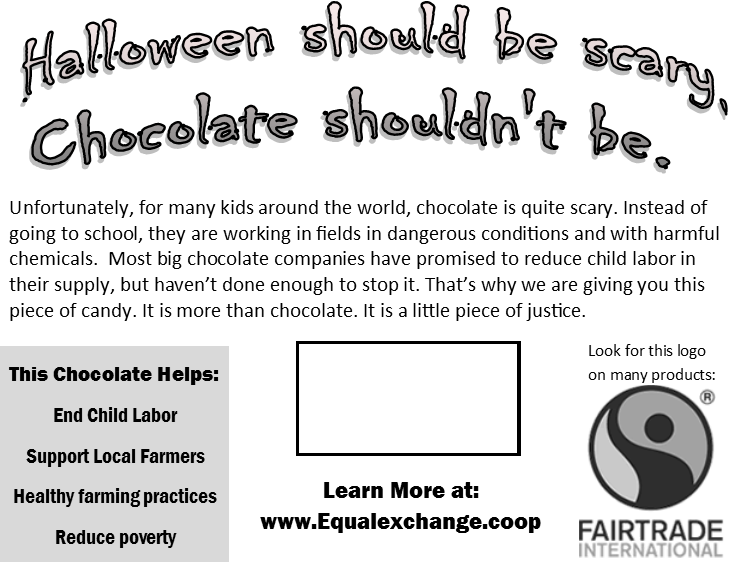
4. Reverse Trick or Treating. Halloween is a chance to raise awareness about fair trade chocolate. If you want to be upset about Halloween, then be upset about the part of it that really matters. Get upset that it is the most popular season for buying chocolate, and that most of the chocolate bought on Halloween is made by child slaves. I’ve written a lot about Fair Trade Chocolate. Every Halloween, I try to use it as a chance to teach people about the value of fair trade chocolate. We glue little chocolates from Equal Exchange to postcards explaining some bullet-points about the chocolate market, and hand them out to people as we go trick or treating. It is a small thing, but it is a way to connect a fun event to a real issue. and hopefully, some people learn something along the way.

Download this and use it as a quarter of a piece of paper. Print it on card stock, glue a piece of Equal Exchange candy to it, and you are ready to spread some justice this Halloween. Put some stuff about your church on the other side, and you're doing evangelism too.

Download this and use it as a quarter of a piece of paper. Print it on card stock, glue a piece of Equal Exchange candy to it, and you are ready to spread some justice this Halloween. Put some stuff about your church on the other side, and you’re doing evangelism too.

5. Jesus said, “Lighten up.” Ok, so he might not have said that, but stay with me for a second. In the Old Testament, God and the prophets tells the people over and over again to “fear the Lord.” Most modern readers of these texts bristle at the idea of a fearful God. They, and I count myself among them, remind people that biblical fear is more about reverence. “Revere and respect the Lord,” is fine translation.  Now, jump ahead to Jesus, who went around saying “fear not” or “don’t be afraid,” a lot.  If we look at the OT understanding of fear as reverence, is it possible that Jesus was saying, “Be irreverent.” In other words, “lighten up,” or “have a sense of humor.” So, maybe this is a stretch. I don’t have time to do the proper word study, but I do believe that Jesus appreciated life. He wants us to have it abundantly, and sometimes that means having a great time with friends, family, and even strangers.  So, Happy Halloween everybody.

Follow The Fat Pastor on Facebook

Follow @FatPastor on Twitter.

1 Comment

Filed under Christianity

Help me invite Amy Poehler to be on my podcast #AmyOnPulpitFiction

amy poehler

Dear Amy Poehler: You are amazing. Please come on our podcast. #AmyOnPulpitFiction

Yesterday I read this story from a website called Deadline.  It is painfully short, so I’ll sum it up for you: The greatest TV show ever is coming.  OK, so that’s not exactly what it says, and I don’t know if Amy Poehler’s newest project will live up to my expectations, but I am excited about the possibilities.

My wife and I love Parks and Recreation. It is smart, funny, poignant, and touching.  It is full of lovable, flawed, believable, and honest characters.  I could go on and on about how much I love that show.  You can bet that every episode of its upcoming final season will be appointment television for my wife and I.  And now Amy Poehler is in production of a show for NBC with a similar style that is set in a church.  Imagine it: Nick Offerman as a member of the trustees.  Aziz Ansari as the youth pastor.  Aubrey Plaza as the secretary. Rob Lowe as the District Superintendent. Adam Scott as the finance chair.  Chris Pratt as the leader of the praise band (Church Rat).  

So here’s the part where I ask you for some help.  If you are as excited about this as I am, then do me a solid.  Go on twitter and use the hashtag #AmyOnPulpitFiction.  You may or not be aware of the fact that I co-host a podcast called Pulpit Fiction. It’s a weekly discussion between my friend Eric Fistler and me. We talk each week about the Bible, pop culture, sermon writing, the church, and other fun stuff.  We’re just two good friends who are pastors talking about the Bible.  In addition to our weekly podcast, we do periodic Thursday Night Specials.

During these Thursday Night Specials we interview authors, musicians, and other awesome people.  We’ve had some great conversations with Adam Hamilton, Rachel Held Evans, Nadia Bolz Weber, and Jennifer Knapp.  We want to talk to Amy Poehler about this new show.  It would be incredible.  It’s a long shot, but it would probably be the coolest thing I’ve ever done in my life.  I’m not sure if Amy is on twitter.  The closest thing to a personal twitter account she has is @smrtgrls.  Her partner in producing the show is Aisha Muharrar.  Her twitter handle is @eeshmu.  Today I sent a letter to 3Arts Entertainment in hopes that it would somehow get to Amy.  Any help you can give us in getting noticed would be greatly appreciated.

So please, right now, go to Twitter and ask Amy and/or Aisha to be on Pulpit Fiction.  Tweet something like “@Smrtgrls and @eeshmu So excited about your new project, please go on @pulpitfpodcast to talk about it #AmyOnPulpitFiction”

Follow @FatPastor on Twitter

Follow The Pulpit Fiction Podcast on Twitter

Leave a comment

Filed under Christianity, Media

Dr. Seuss Tells the Sermon on the Mount, Part 4: The Zax

Zax_in_prax

The north-going Zax and the south-going Zax cross paths in the prairie of Prax.

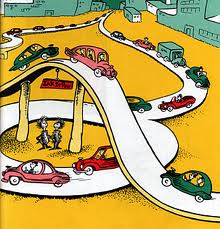
The Zax are lesser-known Seuss creations.  Found in one of the smaller stories within the Sneetches book, they are two creatures full of certainty.  Their paths intersect one day in an open field.  One is going north.  The other south.  They run into each other, and refuse to yield.  Each Zax is certain of his path.  He is certain that there is no other way to go.  There is no room for east or west.  Both dig in, ready for a wait, ready to hold fast to their certainty for as long as it takes.  As they stand there at a face off, a funny things happens.  The world around them goes on.   The story ends with the north-going Zax and the south-going Zax standing face to face, with the world all around them changed.  There are buildings and roads, even a bridge that goes over them.  All around them is progress, leaving behind the Zax and their certainty.

zax standoffAssurance is a virtue.  I’m not sure certainty is.  Certainty is built on the promise that I am right.  It inspires us to dig deeper trenches, and defend certainty at all costs.  Certainty regards new facts with suspicion.  It does not adapt well to change.  Assurance is built on the promise that I am loved. It is a source of hope and inspires confidence.  Assurance allows freedom for challenge and growth.  I think the world could use more blessed assurance and less religious certainty.

Jesus closes his Sermon on the Mount with a warning.  “Not everybody who says to me, ‘Lord, Lord,’ will get into the kingdom of heaven,” he says (Matthew 7:21).  Faith is not about checking a box.  Faith is not about making your claim, saying a formulaic prayer, and thinking that your ticket has been punched.  “Only those who do the will of my Father will enter,” he continues.  He closes this long sermon, one in which he told them some pretty radical stuff, with a reminder that nodding their heads in agreement, even shouting a few ‘amens’ wouldn’t be enough.  I can imagine after this sermon, the people filing by Jesus, shaking his hand warmly and saying, “Good sermon, teacher.”  The Kingdom of Heaven is about more than knowing what is right.  It is about living each day as if the things Jesus taught actually matter.

The Christian life is not easily defined, and it is not easily lived.  It starts not with having all the answers, but with having the courage to ask the questions.  Religious certainty is built on having all the answers.  It is about picking the right Bible verses to memorize, and standing firm on the right side.  It is built, above all, on being right.  Yet Jesus himself called out those who wanted to draw such clear lines.  To those who memorized all the right Bible verses, he declared “You have heard it said… But I say to you.”  He threw doubt upon all that their institutions and religious righteousness had been built on.

Instead he called people to struggle with real problems.  He called people to fix upon the spirit of love that transcended the letter of the Law.  Instead of offering certainty, he offered assurance.  Assurance that the entirety of the Bible could be summed up with a commandment to love.  Assurance that the sinner is welcome at the table.  Assurance that treating one another with love was more important than being right.

Blessed assurance gives me the strength to love.  It gives me the confidence to be vulnerable.  It gives me the safety to adventure into uncharted territory.  Assurance inspires me to go to new places, meet new people, and try to find new ways to encounter what transcends all things: God’s love.

Jesus closes his Sermon on the Mount with a simple metaphor.  “Everybody who hears these words of mine and puts them into practice is like the wise builder who built a house on bedrock.  The rain fell, the floods came, and the wind blew and beat against that house.  It didn’t fall…  But everybody who hears these words and doesn’t put them into practice will be like a fool who built his house on sand.  The rain fell, the floods came, and the wind blew against that house.  It fell and was completely destroyed” (Matthew 7:24-27)

Certainty is built upon the promise that I am right.  It does not respond well to shifting winds or changing times.  Assurance is built upon the promise that I am loved.  With that foundation, I can stand against any storm.

3 Comments

Filed under Christianity, Sermons

Dr. Seuss Tells the Sermon on the Mount, Part 3: The Sneetches

sneetchesThe Sneetches are such silly creatures, aren’t they?  Two groups of yellow bird-like creatures lived on a beautiful beach.  Some have little green stars on their bellies.  Some don’t.  That’s when the trouble begins.  The star-bellied Sneetches believe that the star upon their belly makes them “the best Sneetches on the beaches.”  They enjoy much fun and frivolity, but don’t let their plain-bellied-brethren join in their reindeer games.  Enter Sylvester McMonkey McBean.  He has just the contraption that will solve all the problems of the plain-bellied Sneetches.  The plain-bellied Sneetches pay just three dollars to enter the machine, and come out the other end with stars upon thars.

This is only a momentary victory, as natural-starred-Sneetches maintain that they are still the better Sneetches.  Sylvester comes in again and offers some help.  For only ten dollars per Sneetch, they can enter the machine and have that pesky star removed.  Chaos ensues.  The Sneetches get so caught up in adding or removing their stars to keep up with the trends that eventually even they cannot keep up.  Eventually, Sylvester leaves, his pockets properly lined.  In the end, “all the Sneetches forgot about stars, and whether they had one, or not, upon thars.”

It would be easier to dismiss the Sneetches as silly, superficial creatures if we didn’t see ourselves so clearly in them.  Once again, Dr. Seuss presents us with a fun-house mirror.  Bent to stretch out the image to absurd proportions, but mirror-enough to recognize ourselves.  The Sneetches remind us of the absurdity of our divisions.  They remind us of the stars for which we long.  They remind us of the anxieties with which we wake every day.  The anxieties that sit in the pit of our stomachs.  The anxieties that keep us awake, that diminish our appetites, that affect our relationships, and cripple us with fear for of what we don’t have.

The Sneetches worried about whether or not they had stars upon thars.  And we can look out those silly Sneetches and laugh, until we start noticing the stars upon others that we wish we had.  I see the Corvette parked in our neighbor’s garage.  I see the parents whose children are always so well-behaved.  I see the blogger who is selling advertising and the podcasts in the top 100.  I see the churches with the talented praise bands and the powerful music, and the preachers biggering their churches.  I look down at my own belly, and there is no star.  And to boot, it’s a little too big.  Look at those guys at the gym who have six-packs, not stars, upon thars.

And then I hear Jesus.

“Therefore I say to you, don’t worry about your life,” and the needle on the record player amplifying my anxieties gets lifted off with a terrible screech.

Before he can finish the sentence, I want to scream.  Don’t worry about your life? What is that supposed to mean?  My worries are valid.  My worries are righteous.  Shouldn’t I be in better shape?  Shouldn’t I want a bigger church?  Shouldn’t I want more readers, more listeners?  Don’t I deserve to do some biggering of my own?  And then I hear myself.  And I pause long enough to let Jesus finish.

“Don’t worry about what you’ll eat or what you’ll drink, or about your body, what you’ll wear.  Isn’t life more than food and the body more than clothes?” (Isn’t there more to you than the whether or not you have a star upon yars?)  “Look at the birds in the sky.  They don’t sow seed or harvest grain or gather crops into barns.  Yet your heavenly Father feeds them.  Aren’t you worth much more than they are?” (Matthew 6:25-27)

“I guess”, I think.  But still, that seems absurd.  God is the one who gave us the ability to think about the future.  And with the ability to think about the future comes the ability to worry about it.  So am I supposed to stop saving money?  Should I spend my pension?  Should I get rid of my refrigerator?  How far am I supposed to take this?

“Who among you by worrying can add a single moment to your life?” (Matthew 6:28) Maybe there is a difference between preparing for the future and worrying about the future.  Being a good steward of what has been entrusted to me is different than wrangling out every last penny so as to hoard my blessings.  It seems possible to have a pension without being a slave to it.  There is still room for generosity, kindness, and contentment even in the midst of preparing for a rainy day.  If I can let Jesus’ words seep into my crippling anxiety, I can realize that biggering is not what life is all about.

The Sermon on the Mount is Jesus’ long explanation of the Kingdom of Heaven.  This Kingdom that Jesus describes defies simple explanation.  Yet at the same time it seems to come back to one thing: love.  “No one can serve two masters.  Either you will hate the one and love the other, or you will be loyal to the one have have contempt for the other.  You cannot serve God and wealth” (Matthew 6:24)  What do you love?  Do you love God, and seek first God’s kingdom?  Or do you love status, or money, or power?  When we operate out of anxiety, we let our fears rule, so we serve whatever quick fix might offer us an illusion of security.  But when we operate out of love, and truly let Jesus be our Lord, we learn that security lies not in the fragile, decaying, dying things of this world.  When we operate out of love, we can stop worrying about the stars we don’t have.  Perhaps more importantly, we can stop guarding the places where we have stars. We can loosen our grip on the stars upon ours.  When security rests only in the eternal, life-giving, resurrected Christ, generosity, justice, and peace start to seep in.

The Sneetches were convinced that having a star upon thars was all that mattered.  They knew that if they could only have what the others didn’t then they’d be okay.  So they gave everything they had to the one who offered them security.  He offered them a quick fix, a walk through a machine, and a star upon thars.  Eventually though, they learned.  They learned that the security they sought in the mark on their belly was empty.

The question remains, will we?  Can we learn to stop searching for easy answers?  Can we learn to let go of our anxiety over what is or isn’t on our bellies, in our garages, in our pews, or in our bank accounts?  Can we learn to stop putting our trust in a false sense of security?

Can I?

Can I learn to love God first, and let all else come later?  Can I learn to seek first the Kingdom of God, and then my pension?  Can I learn to let go, loosen my grip, and let God’s grace fill in the gaps?

Follow The Fat Pastor on Facebook

Follow @FatPastor on Twitter

Get a Love God. Live Well. Do Good. sticker


Leave a comment

Filed under Christianity, Sermons

Dr. Seuss Tells the Sermon on the Mount, Part 2: The Lorax

Theodore Geisel, the man millions know simply as Dr. Seuss, was not a religious man.  That doesn’t mean that his work didn’t have deeply religious themes.  I’m currently working on a sermon series called “Dr. Seuss Tells the Sermon on the Mount.”  It is a five-part series where I go through Jesus’ most important teaching, as found in the Gospel of Matthew, and relate the texts to different Dr. Seuss classics.

truffula treesThe Lorax is a cautionary tale.  It opens in a land that is gray and foresaken.  There are stumps littering the countryside and smog fills the sky.  There is a city off in the distance, but the only remnant of life in the desolate land is a tower.  A boy ventures out into this wilderness in hopes of hearing the story of how it all came to be.  Once he gets to the tower, a man named Once-ler tells the story.

One day long ago, Once-ler happened upon a beautiful land full of trees, animals, birds, and fish.  The trees, he finds, can be harvested to produce something he calls a “thneed,” and a “thneed is a something that everyone needs.”  Immediately upon chopping down one of the truffula trees, a little orange mustachioed creature appears, “I am the Lorax,” he declares. “I speak for the trees.”  The tale that is spun is a familiar one.  While the Once-ler “biggers and biggers” his operations, and “biggers and biggers” his profits, there are unintended side effects.  The animals have no place to play.  The fish have no place to swim, and the birds have no place to fly as the waste from the Thneed factory lays waste to the land.  Despite the Lorax’s loud protestations, the Onceler keeps going, with employees to feed, he needs to make thneeds, and cares for little else.  Finally, the last truffula tree is chopped down.  The Lorax lifts himself out of the place, and the Once-ler’s tale seems to come to an end.

UnlessBack at the “present day,” the business-tycoon-turned-hermit puzzles over the little monument that the Lorax left behind.  It is a small pile of rocks with one word, “Unless.”  Finally, Once-ler seems to understand the Lorax’s cryptic message.  “Unless someone like you cares a whole awful lot, nothing’s going to get better.  It’s not,” the Once-ler tells the boy.  With that, he throws down to the boy a seed.  The very last truffula seed.

Dr. Suess is famous for open-endings.  So often he allows the reader to finish the story.  Here, the reader is thrust into the role of the boy hearing from the Once-ler.  After finishing the book, I feel like if I shake loose the pages a seed might fall out.  Surrounded by desolation and despair, a small monument stands as a shrine to hope.  This book is a clear warning about economic growth at the expense of ecologic disaster.  Whole sermons can be preached on the stewardship of the earth, and the importance of protecting the brown barbaloots and the humming fish.  Instead, I focus the two worlds that Seuss once again presents.

Last time we looked at Yertle the Turtle, and were reminded that in the Kindgom of God, even the burp of a lowly turtle name Mack matters.  Seuss showed clearly two ways of understanding the world.  One was to climb to the top by any means necessary.  The other was to care about those on the bottom of the pile.

In The Lorax, Seuss presents us with two ways of understanding the world.  There is the way of the Once-ler, whose primary goal is to bigger his profits.  He cares nothing about the future implications of his actions.  Even his name reveals what he values – using something once.  In the end, he winds up separated from the community, with nothing but disaster surrounding him.  Then there is the way of the Lorax.  The Lorax understands community.  He values the interconnection of all things, and speaks up for those who have no voice.  Once there is no community, the Lorax can no longer exist in that place.  Two value systems.  You might say, two kingdoms.  One where once rules.  Another  where community matters.

When Jesus came to preach about the Sermon on the Mount, he did so in community.  He gathered with the crowds, and told them something they may not have been expecting.  Surrounded by crowds who were desperate for healing, he spoke these words, “You are the salt of the earth… You are the light of the world…” (Matthew 5:13-16).

The Kingdom of God is one where the community matters.  It is where the voiceless are given a say.  It is where the sick are healed, the blind are made to see, and the lame are made to walk.  It is where those at dis-ease are made whole again.  “The Kingdom of God is at hand, and you are light of the world.”  Those that were gathered were not valued because of what they could perform, or what they could provide.  They had no standing or status.  They were not a part of the Roman system of tribute, hierarchy, and patronage. They were valued for more than what they could make once.

Jesus came to teach us and show us what the Kindgom of God was all about.  So he gathered with the crowds and told them that it was up them.  “Let your light shine before the people, so they can see the good things you do and praise your Father who is in heave,” Jesus declared.  He reminded the people that the Kingdom of God is at hand because of their very presence, not in spite of it.  “Unless,” he might as well have said, “Unless people like you, you who are the salt and light of the world, care a whole awful lot…”

Follow The Fat Pastor on Facebook

Follow @FatPastor on Twitter

Get a Love God. Live Well. Do Good. sticker

1 Comment

Filed under Christianity, Sermons

Dr. Seuss Tells the Sermon on the Mount, Part 1: Yertle the Turtle

Theodore Geisel, the man millions know simply as Dr. Seuss, was not a religious man.  That doesn’t mean that his work didn’t have deeply religious themes.  I’m currently working on a sermon series called “Dr. Seuss Tells the Sermon on the Mount.”  It is a five-part series where I go through Jesus’ most important teaching, as found in the Gospel of Matthew, and relate the texts to different Dr. Seuss classics.  

yertleYertle the Turtle was a king.  He was the king over all he saw, but he was dissatisfied.  He wanted a bigger kingdom, so he decided he needed a higher throne.  From the higher throne, he would be able to see farther, and rule over more territory.  To satisfy his need for a higher throne, he order a few turtles to be stacked upon each other.  From atop this throne of turtles, he could expand his kingdom.  Over the course of increasing his reign an insignificant turtle on the bottom of the throne named Mack asked for some relief.  He was granted none.  Higher and higher the turtles were stacked, and yet Yertle was never satisfied.  Eyeing his vast empire, he noted he wasn’t the highest creature in the sky.  Perturbed by the presence of the moon, her ordered a thousand more turtles for his thone.  All the while poor Mack on the bottom of the stack was aching with a sore back.  Finally, Mack cracked.  Actually, he burped.  And the tower of turtles came toppling down.  Yertle fell into a puddle of mud, where he reigned all that he could see, which wasn’t very far.

Yertle understood the power of a kingdom.  He understood only one thing that matters: more.  More turtles, more land, more power.  He didn’t care how he achieved more, and he paid no heed to some poor turtle named Mack.

Jesus lived in a time when the power of kingship was clear.  The stack of turtles under the King was high indeed.  So high that the King named Caesar called himself the son of God.  All the people that gathered on that mountain understood that kind of kingdom.  They understood what it felt like to be on the bottom of the stack.  It was a crowd of Macks that gathered that day.

Then Jesus stood in front of the crowd and told them about another sort of Kingdom.  He told them about who was blessed and who wasn’t, and it was different from anything they had known.  In the Kingdom they were used to, it was easy to tell who was blessed and who wasn’t.  Yertle was blesssed.  Mack wasn’t.  Then Jesus stood up and said “You who are poor…  You who mourn… You who hunger and thirst… are blessed.”

“You, Mack.  You are blessed.  You who have been piled on.  You with sore backs.  You who are neglected, mistreated, and set aside.  You are blessed.  You who see that the world is broken and want to speak up.  You who are left heartbroken by the pain of others.  You who long to be in community.  You who want to know the heart of God, and strive for something greater than the letter of the law.  You are blessed.”

Jesus declared that the Kingdom of God was at hand, and in the Kingdom of God, even the burp of a lowly turtle on the bottom of the pile matters.

Follow the Fat Pastor on Facebook

Get a “Love God. Live Well. Do Good.” sticker

Follow @FatPastor on twitter

2 Comments

Filed under Uncategorized

Find your voice for mothers

Healthy Families Healthy Planet

Click on the logo to apply for a Healthy Families Healthy Planet training seminar in Peoria, Ill. on Sept 6.

There are two little girls that I pick up out of bed almost every morning.  One of them is sitting in my office, cradling a stuffed turtle in her arms.  She is giving it kisses and singing it to sleep.  Now she has another little toy that her imagination has transformed into a bottle.  She wants to be a Mommy.

It may happen someday, and when that time comes, I will be a worried, emotional, joyful, wreck.  I pray that for her, like her mother, the decision to become a Mom will be completely hers.  I pray that she becomes a mother at a mature age, with a loving partner, and has access to health care during and after her pregnancy.  I hope that when she gives birth, it will be in a clean environment, surrounded by experts, and access to emergency treatments.  I know that giving birth is one of the most dangerous things a woman can do, and I will never take for granted the loving care with which she will be surrounded.

I won’t take it for granted, because I know that there are millions of women worldwide that do not have such care.  They do not have control over when they will be married, or when they will become pregnant.  They are valued for little more than the children they can produce.  They are forced into pregnancy too young, and once they have a child, their only option is to become pregnant again.  They are misinformed about how to avoid and delay pregnancies, and once they do become pregnant, they have little guidance about how to have a healthy child.

Giving better education and access to maternal health and family planning is a moral imperative.  This is from the Bill and Melinda Gates Foundation’s page about maternal health: 

Every year, complications from pregnancy and childbirth claim the lives of nearly 300,000 women and permanently disable many more, mostly in developing countries. Mothers suffer primarily from hemorrhage, sepsis, obstructed labor, and disorders caused by high blood pressure.

In addition, more than 2.6 million babies are stillborn, another 2.9 million die before they are a month old, and many suffer neurodevelopmental disabilities and impairments. Most neonatal deaths are caused by preterm birth, asphyxia during birth, and infections such as sepsis, pneumonia, and meningitis.

Effective, low-cost interventions are available, but they are not reaching all of the women and babies who need them. In developing countries, many women deliver at home and rarely see a trained healthcare provider before or after the baby’s birth. Skilled providers in poor countries often lack access to current tools or do not use them. Families may not seek care or follow medical advice.

This is why I am an ambassador for the Healthy Families Healthy Planet project.  HFHP is a partnership between the United Methodist Church and the United Nations Foundation.  The mission of Healthy Families Healthy Planet is to give mothers a voice.  Far too many women have no voice.  They have no advocate.  HFHP is trying to change that.  Two years ago I went to a training in Ohio.  I sat in awe of the powerful women that I met.  I wondered at that meeting if there was a place for me in this project.  

When I thought of my girls, my wife, my sisters, my friends who have given birth and never once wished they had a plastic sheet to lay across their dirt floor as they went into labor, I found my voice.  As I learned about complications that women I know and love faced and survived that would mean certain death in other parts of the world, I found my voice.  As I practiced my elevator speech, learned addresses of Congressional offices, watched documentaries, and met with Congressional staffs, I found my voice.

I am one father, and I have big dreams for my daughters.  As I realized that my dreams were not just for them, but for the daughters of the world, I found my voice. I am one father.  I am one voice.  I invite you – father, mother, brother, sister, son, or daughter – to find yours. 

On September 6, there is a Healthy Families Healthy Planet training seminar in Peoria, Illinois.  Follow the link below (or linked to the logo above) to read a little bit more about the training, and apply to come.  There is no cost for the training.  It starts at 9 a.m. with breakfast and ends at 6 p.m. with dinner.  Come and pray.  Come and learn.  Come and share stories.  Come, and find your voice.

Apply here for the training in Peoria on September 6.

Follow Healthy Families Healthy Planet on Facebook

Follow The Fat Pastor on Facebook.

Follow @FatPastor on Twitter.

Leave a comment

Filed under Christianity