Category Archives: Christianity

A journal entry from 12 years ago gave me goosebumps

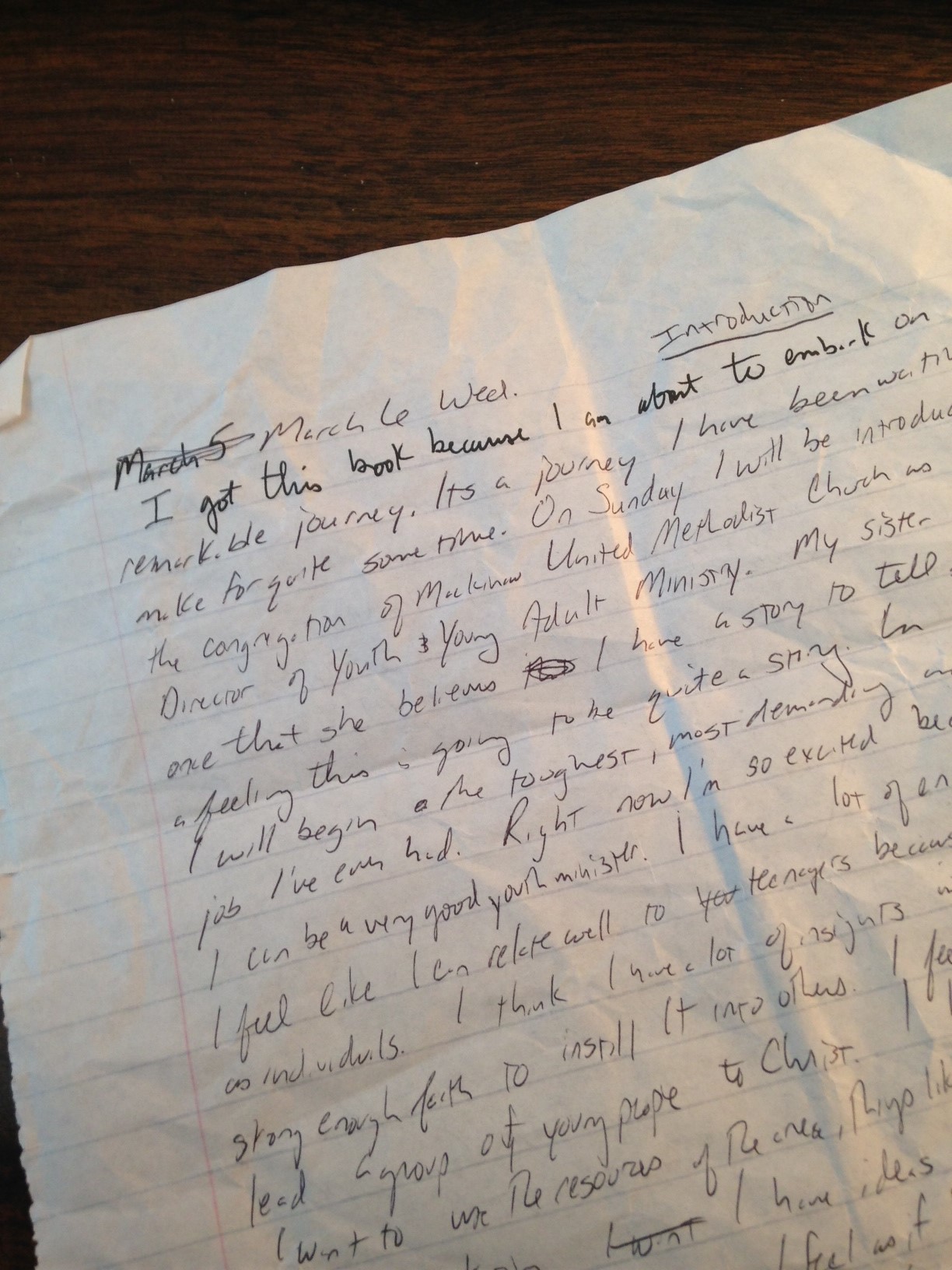
photoWhile packing up my house last month I came across a notebook I had not seen in many years.  I didn’t recognize it at first.  When I opened it up, a torn page fell out.  On it was an entry into a journal that I started to keep in 2002.  At the time, I was 24 years old.  I was living with my wife of eight months in a two-bedroom apartment in Peoria.  I was working my first full-time job as the head of the Children’s Book section at Barnes and Noble.  It was a great job, but I had felt frustrated.  I first heard the calling into ministry at age 15.  It was my Mom’s idea, and try as I might, it was an idea I couldn’t ignore.

My wife and I had found a church which we kind of liked, but it was difficult to get involved more than an occasional Sunday worship.  Working retail hours made it difficult to plan more than a couple of weeks out.  It was nearly impossible to join a Sunday school class, or the choir, or any of the regular things that help get acclimated into the life of a church.  So I started to pray.  I prayed that God would help me find a new job that would make it easier to get involved in church again.

Shortly thereafter I found a four-line ad in the Peoria Journal.  A small church about 30 minutes away was hiring a part-time Director of Youth and Young Adult Ministries.  I applied.  “I have no experience.  No training.  No qualifications,” I told the interview team.  “There is no reason you should hire me, except that I think this is what I’m supposed to be doing.  And I think I’d be pretty good at it.”  They believed me.  They took a chance on me, and hired me.  Here’s the first page of my journal before starting at Mackinaw United Methodist Church.

March 6, 2002

I bought this book because I am about to embark on a remarkable journey.  It is a journey I have been waiting to make for quite some time.  On sunday I will be introduced to the congregation of Mackinaw United Methodist Church as the new Director of Youth and Young Adult Ministries.  My sister once told me that she believes I have a story to tell.  I have a feeling this is going to be quite a story.

In a few days I will begin the toughest, most demanding, and most important job I’ve ever had.  Right now I’m excited because I think I can be a very good youth minister.  I have a lot of energy and enthusiasm.  I feel like I can relate well to teenagers because I will respect them as individuals.  I think I have a lot of insights into the Bible and a strong-enough faith to instill it into others.  I feel like I will be able to lead a group of young people to Christ.  I have a lot of good ideas.  Right now I feel as if I’m ready to dive in and start shaping lives.

At the same time I’m terrified.  I’ve never really done anything like this.  I don’t know the Bible that well, and I have no idea how to teach others about it.  I have no idea how I’m going to answer tough questions.  I still have questions myself.  Is homosexuality a sin?  Can you be gay and be saved? Are all Muslims going to hell?  What about the people who have never heard of Jesus, where do they go? Are we near the end times?  What if they see through me and realize I’m just a big impostor?  What if they see I have no idea what I’m doing?

On the job training is one thing, but we’re talking about souls here, not putting a book on the wrong shelf.  This is the most important job I’ve ever had, by a long shot.  I mean, second place isn’t even close.  Since I was 15 years old I’ve known that this was my path.  I’ve always felt it was a part of God’s plan for my life, but it was always somewhere in the future.  Well, it’s still in the future, about four days into the future.

Like I said, I’m about to embark on a journey.  Tomorrow I will meet with Rev. Dan to start figuring out some details of my job.  I have a feeling I’ll be figuring out the details of this job for some time to come.  “The first year as a youth minister for a totally untrained young man.”  It could be an interesting story.  I’m looking forward to writing it.

Those Mackinaw kids will forever hold a special place in my heart.  They’re all grown up now.  College, jobs, marriages, kids.  They were an amazing collection of young people, and Sarah and I have stayed in touch with many of them.  We were in Mackinaw for a year and a half before we decided to go to seminary.  Saying goodbye to those kids and that church was a difficult time.  Yet we left with so much joy at the time we shared, and so much hope for what was to come.  I’m now serving in my fourth church since Mackinaw.  Each goodbye was difficult.  Every hello has been a blessing.

12 years later.  Joy and hope.  Goodbyes and hellos.  A few questions answered. A few lessons learned. I’ve started as the Pastor of Two Rivers Church in Rock Island.  I’m still figuring out the details of this job, but I’m having a blast writing the story…

Like the Fat Pastor on Facebook
Follow @FatPastor on Twitter


4 Comments

Filed under Christianity

Prayer for Illumination

I’ve long said that the motto of the United Methodist Church is best read as a call to action.  It is not a descriptor so much as a call to action.  I take the word “open” to be a verb.  It is a call to action to do all that I can to open hearts, doors, and minds.  Including my own.

A prayer for illumination, to be read responsively in worship before the reading of the Scripture.

One: Open our hearts

All: That the Holy Spirit may move through the reading of the Word.

One: Open our minds.

All: That we may hear again the story of salvation.

One: Open our doors

All: That all may know the love and grace of Christ.

Follow The Fat Pastor on Facebook

Follow @FatPastor on twitter

Leave a comment

Filed under Christianity

We are left to finish the story

easter

1 Comment

April 20, 2014 · 7:44 am

Guest Blogger: Beautiful Child of God #ShapedByGod

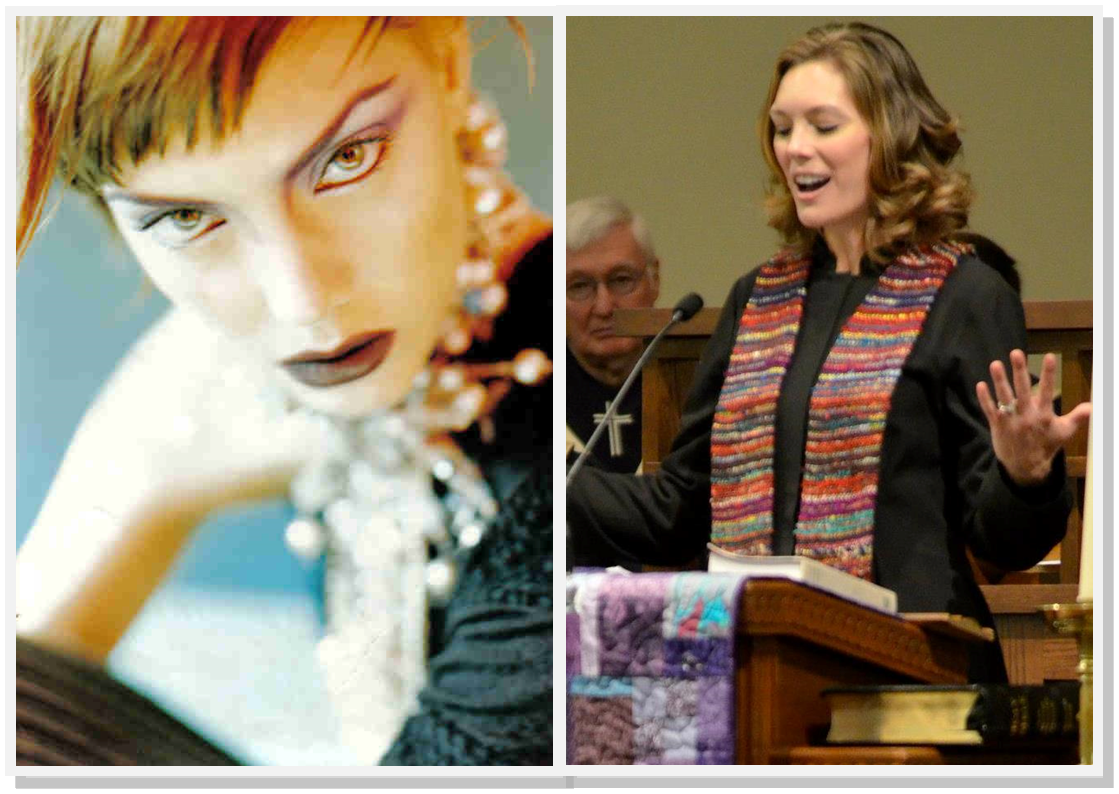
Rev. Sarah Renfro, former fashion model. Now preaching the good news of your body.

Rev. Sarah Renfro, former fashion model. Now preaching the good news of your body.

I discovered Rev. Sarah Renfro’s blog after she quoted a part of The Pulpit Fiction Podcast in a post.  I read her post because she quoted me, but was quickly drawn into her story.  Her blog is called Embodying the Divine: Body Image, Media, and Faith.  Sarah is a former fashion model, who is now a pastor preaching the good news of your body.  In her blog, she not only goes to phenomenal resources, but she expresses her struggles and joys as a pastor, woman of faith, Mom, wife, and Beautiful Child of God.  Her website also describes “body image workshops that dispel the myths of media and ‘ideal beauty’ in fashion magazines, and empower participants to claim their diverse and wonderful inner beauty given by God.”  

I love her holistic approach to faith.  As a father of two young girls, I am deeply invested in Sarah’s message.  I want to share it with others, and encourage everyone to check out her blog, schedule her for a workshop, and like her facebook page.  That’s enough of my words about her.  Here’s her story: 

I was born and raised in the Christian Church (Disciples of Christ).  I was active in youth group and worship.  After high school, I left Kentucky to pursue modeling full-time, living in Tokyo, New York, Los Angeles, and Europe for a bit.  I had the opportunity to see the world, but at the same time, the fashion industry is competitive and harsh.  I struggled with disordered eating and depression after constantly being told that I wasn’t good enough just as I was.  I wasn’t thin enough or blond enough or big-busted enough or . . . I was the one of one percent of the population who is in the magazines and catalogs and on billboards and in commercials; yet, I had low self-esteem and a negative body image.

During my travels, I did not maintain a faith community.  Oh sure, I attended on Easter and came home for Christmas, but that was about it.  I was not grounded in a church that reminded me that I was a child of God.  But deep down I knew.  So when I retired at age 21, I moved home, attended the University of Kentucky, and went to church.

I became a youth group sponsor and loved it!  I was invited to share my story from the fashion world for the first time, and I realized that I just might have something to say to young people about body image.

Fast-forward a few years, a failed marriage, and another stint in LA, and I came back home, finished college, and continued to work with the church.  I received my call to ministry soon thereafter.  At no time had I envisioned God calling a former Hollywood-type to the share the Word.  But alas.  Here I am.

So now I am a former model, ordained minister, married-again (to a minister), and mom to Miriam (almost three-years-old).  My passions about body image have only increased as I continue to lead workshops and retreats with youth and women.

Media reinforces over and over and over again that we are not okay just as we are.  That we are to subscribe to some “ideal beauty,” which is impossible to achieve and devalues the diversity of God’s creation.  There are many passages from the Bible on which I base the title of my website and workshops “Beautiful Child of God: Embodying the Divine.”  Perhaps, my favorite is how God created humankind in God’s own image (imago Dei), and called us not just good, but very good.

Most of us, women and men, young and old, of all colors and ethnicities, struggle with the reflection in the mirror.  Media has much to do with our dissatisfaction.  In my talks, I seek to expose the myths that reinforce negativity for capitalist gain, and I attempt to enforce the Truth that we are created beings, body and spirit, incarnated, imprinted with the Divine.

Robb asked how I came to use #ShapedByGod.  That was an idea by a friend and colleague, Rev. Sarah Taylor Peck, who mentioned it as Lenten discipline.  I immediately asked to join in her journey, because I believe we were molded out of the soil of the earth to be exactly who God shaped us to be.  Some tall and thin, most not so.  Some light skinned, most not.

When we look in the mirror, it is God whom we reflect.  It is the Divine spark that shines from our eyes and in our bodily actions and spirit-filled prayers.  We are shaped by God to be God’s hands and feet and ears and voice in the world.  We are not supposed to all have the same shape (tall and thin for women, “manly” and muscly for men), but we are to love the bodies that we were given, take care of them, and use them to bring about the Kin-dom of God.

There’s your sermon for the day, but I realize that this is easier said (or typed) than done.  I still struggle.  Fifteen years removed from modeling full-time, I can still pick my body apart if I let myself, even though I eat well and exercise.  But I try not to.  I try to love my whole self because I lead workshops about this type of thing (duh), I am mom to a daughter whom I desperately wish maintains the love of her belly, the good foods she eats, the exercise she gets, the joy she has in her body and spirit, and I am a child of God.  A beautiful child of God.  And so are you!

Thanks for letting me share a bit of my story.

Follow Sarah Renfro on Facebook

Follow @revRenfro on Twitter

Follow The Fat Pastor on Facebook

Leave a comment

Filed under Christianity

The difference between seeing and sight.

visionNeurologist Oliver Sacks tells a fascinating story about Virgil, a man who received sight at age 50 after spending 45 years totally blind.  His book An Anthropologist on Mars tells a tragic tale about a man who struggled to adapt to his new-found sense.  On the surface, it seems like such a story would be a wonderful, heartwarming story of triumph and celebration.  In reality, Virgil’s story is fraught with confusion, loss of identity, and even health.

At first marveling at the light that he was able to perceive, Virgil was quickly overwhelmed by the confusion of so much light, color, shapes, and movement.  What people born with vision take for granted became difficult, even terrifying.  A bird flying by, even at a distance (for distance was meaningless to him), was more than a little startling.  Making connections between flat shapes and 3D objects was almost impossible (a circle and a sphere were totally unrelated).  The story of Virgil is heartbreaking. His tactile world, that was ordered and in which he was thriving, was shattered.  His identity was lost as he realized he was neither blind nor sighted.  After making some improvements, he suffered a setback when an unrelated illness caused him to nearly lose the ability to breathe.  He almost died, and in the process he lost his job, his home, and eventually his sight again.

It is one thing to have physical ability to perceive light hitting your retina.  It is another process to interpret that light in the midst of the world.  Virgil was never able to fully incorporate the light which was in front of him.  He was never able to distinguish the shapes, colors, movements, and flashes into a coherent vision of the world.  He spent fifty years in world of touch.  He was able to spend a few months in a world of vision, and when the two worlds collided, the result was not pretty.  It almost indirectly cost him his life.  Would he have been able to adapt if given more time? Perhaps.  Was the stress of the two worlds colliding too much for him to take? Did it hasten the progress of his sickness? That certainly seems reasonable.

Virgil’s story illustrates that being able to see is different from having sight.  There is a story in the Bible about sight and blindness.  It is told in the ninth chapter of John.

In this story the man born blind has  no such difficulty adapting.  Instead, it is the Pharisees who cannot cope.  They had a very ordered world.  It was their role in society to keep the order.  They used the Biblical Law to understand what was clean and unclean, what was righteous and sinful, what was in order and what was out of order.  A man born blind was clearly out of order.  Sin is punished with curse.  Righteousness is rewarded with prosperity.

This is how the story begins.  Even the disciples understand the world in this way.  Sin is the only explanation for blindness.  The only question is, who’s sin? So they ask Jesus to clear things up.  “Who sinned that he was born blind, this man or his parents?”  Jesus turns the order upside down immediately.  He gives an answer that is completely out of their expected order, “This happened so that God’s mighty works might be displayed in him.”

After the healing, there is much confusion.  The people do not know what to make of this healing, so they take him to the ones whose job it is to answer questions about order.  The Pharisees are baffled.  They are split.  They investigate.  In the end, they cannot understand this new order that Jesus is proposing.  Jesus does not fit into their order.  He healed, which must be of God. He worked on the Sabbath, which is a sin.  These two facts are so starkly in contrast, they cannot make sense of them.  The world of Jesus collides with their world, and the result is not pretty.

When you read Virgil’s story, it is easy to feel compassion for him.  In receiving sight, he was changed so drastically that it was difficult to cope.  It wasn’t just laziness, or stubbornness.  There were physical, emotional, and neurological hurdles that were enormous.  That he didn’t “make it” as a sighted person does not make him weak.

Perhaps we can take a similar amount of compassion to the Pharisees.  Their world was being turned upside down.  They knew what they were seeing, but they couldn’t interpret it in the midst of their world.  They were not able to incorporate the light which was in front of them.  They were able to see, but they never possessed the sight needed to understand what they were seeing.  It is easy to condemn the Pharisees, put black hats on them, and call them the bad guys.

Demonizing is tricky business.  Were they at fault? Sure.  It would be wise to remember though, that Jesus cast out the demons, he didn’t cast “demonhood” on others.  Neither should we.

I think we’d do well to remember that there’s a difference between seeing Jesus, and having vision.  When Jesus comes off of the page, out of the two-dimensional world we so often like to keep him, disruptive things can happen.  When we incorporate Jesus into the world, there can be collision that is discomforting.  Catching a vision of the Kingdom of God knocks us out of our daily existence.  It challenges our preconceived notions.  It breaks our routine.  It shatters prejudices.  Suddenly we’re supposed to be loving our neighbor.  Suddenly we’re supposed to forgive as we are forgiven.  Suddenly all of our instincts of survival and self-hood are replaced by Kingdom instincts of abundant life through selflessness.

It’s a struggle, and it’s a process. We may experience a flash of euphoria when the weight of sin and shame is lifted.  Usually there is more to it though.  It is rare for the scales to be removed, and all understanding to come at once.  Even the man in the Biblical story, though he could see, took time to process what had happened to him.  Even he didn’t open his eyes and praise Jesus, the Son of God.

It’s no wonder that for so many, the vision doesn’t stick.  It becomes easier to be blind, to shuffle through life slowly, methodically, unchallenged by the light.  Turn a blind eye on the suffering.  Turn a blind eye on our own sin.  Turn a blind eye on the injustice, on the first remaining first, and the last being pushed farther and farther down the line.  It’s no wonder so many cannot see

Jesus healed the blind man so that God’s mighty acts may be displayed in him. There’s a difference between seeing and having sight. We are called to do more than see.  We are called to have God vision, to catch the vision of Christ, and see the Kingdom of God.  For if we can see it, we can live into it.  There is a difference between seeing Jesus in a Bible, or in stained glass, or in a movie, and catching onto this vision for the world. When see Jesus, I mean really see Jesus, it changes the way we look at the world. It changes how we look at our neighbor. It changes how we look at a stranger. It changes how we look at suffering. It should also change the way we see ourselves. See the world with Christ’s vision so that God’s mighty acts may be displayed in you.

Follow The Fat Pastor on Facebook

Follow @FatPastor on Twitter


2 Comments

Filed under Christianity, Sermons

Raiders of the Lost Cabinet

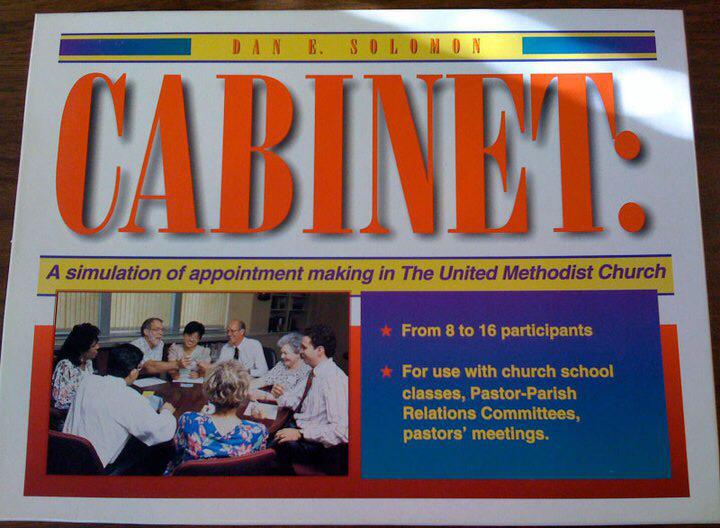
Cabinet, the board game.

Cabinet, the board game.

So it appears I have set off a fury.  From Nashville to Savannah, the people called Methodists are searching for Cabinet.  I discovered it when a friend shared this picture on his Facebook timeline.  I thought it was outrageous, and decided I would write about it.

Clearly my entrepreneurial skills are lacking.  I should have done the work of finding this precious artifact first, then written the blog post.  There seems to be a growing demand across the connection, and I probably could have cashed in.  Oh well, lesson learned.

raiders_of_the_lost_ark_end

The stacks at MTSO’s library (I think).

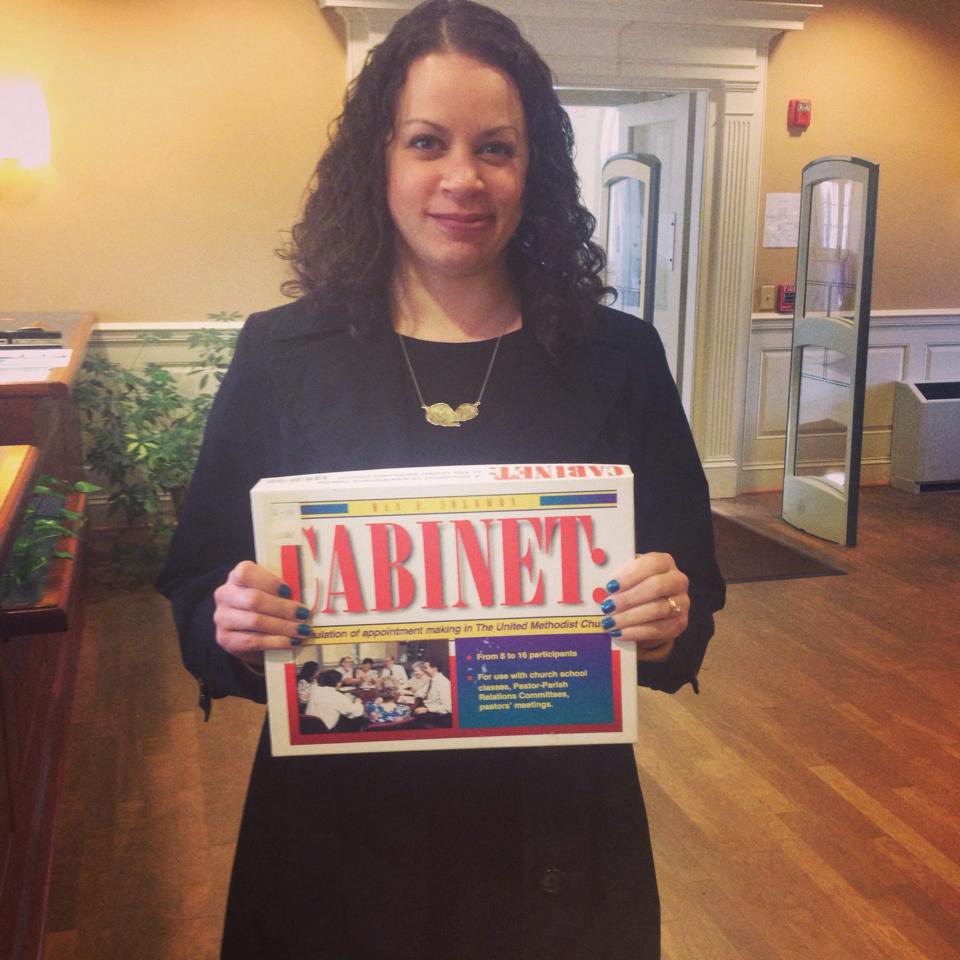
Upon not being able to find the game through normal outlets, i.e. Amazon, Cokesbury, Ebay, I was afraid it was lost somewhere in a warehouse in Nashville.  In my research though, I found a copy of the game at the Methodist Theological School in Ohio’s library.  Through the magic of Facebook, this picture was shared with me yesterday.  I’m pretty sure that the game was guarded by the ghost of Francis Asbury.  She had to prove that her heart was pure, or at least moving onward toward purity (or some-such thing).

cabinet game found

April Casperson, Director of Enrollment Management and Scholarship Development at Methodist School of Theology in Ohio.

As you can see, her face is a perfect mix of bemusement and mild disgust.  I can only assume the she is afraid of opening the box, lest her face get melted.  That would be a shame.  She seems to be a perfectly pleasant person, and I would hate for her to end up like this.

In the meantime, there seems to be a groundswell of Methonerd support to find copies of this game.  My friend Melissa Meyers  has promised to bring the game to the attention of someone at United Methodist Publishing.  If it gets re-published, I only have one request: Please let me be a part of the group having a grand ol’ time playing it on the box cover art.

I’m having fun with this. I have chosen to laugh when I see this game, but there is another reaction that I could have.  I have dedicated myself to a system that all-too-often feels like a game.  The only way I can remain sane in the itinerant system is to believe that the members of my conference’s cabinet understand that they are not playing with Pokemon cards, but with peoples’ actual lives.  I believe this is the case. I do.  Every year in appointment season I reaffirm in my own heart and mind the covenant I made with the United Methodist Church, and I submit to the will of my Bishop. I submit my family to the whim of a few people in an a room a few hundred miles away, and trust that they are guided by the Holy Spirit.  That is a huge amount of trust, and the fact that someone that was once given that kind of trust decided to turn that process into a game makes me boil over with rage.  Then I take a deep breath, realize I’m probably taking it all too seriously, and realize it probably is a good teaching tool.  Appointments are a wildly complicated thing to figure out, and this could help people realize how difficult it is.  So I make a joke.

So keep searching, Methodists.  If anyone finds and plays this game, please share your experiences here.

Check out the Pulpit Fiction Podcast, two local pastors talk about the lectionary readings for the week.

Follow the Fat Pastor on Facebook

Follow @FatPastor on twitter


4 Comments

Filed under Blogging, Christianity

I just added this to my bucket list (and I don’t even have a bucket list)

Cabinet, the board game.

Cabinet, the board game.

My friend and United Methodist colleague Gavin Lance Presley introduced me to this game, and my life will be incomplete until I play it.  It was created by Bishop Dan Solomon, I can only imagine his train of thought before creating this game.

“I’m so sick of people calling me to complain about the appointments I’ve made,” he thought. “If only I could show them how hard it is.” And in a flash of light, the greatest board game since Monopoly was created.  Though some might think that this game must be the parting gift of the worst TV game show ever, I feel like I have to play it.  Cabinet can actually be found at the library of Methodist Theology School in Ohio.  All I could think of is, “ROAD TRIP!”  I’m packing 7-15 of my favorite Methodists in a van and going.  Tomorrow.

According to the online catalog description, this game includes “1 director’s manual, 16 participant’s manuals, 2 lay advocate’s guides, 2 clergy advocate’s guides, 50 declension and data sheets, 16 name tags with 16 plastic holders, 10 envelopes for superintendents (2 sets of 5), 4 sets of color-coded file cards ; in box 24 x 31 x 4 cm.”

This is a game that is so beautifully Methodist, I’m almost in tears.  This is a game with not one but two different manuals, two kinds of guides, (my heart is aflutter) 50 declension sheets, and FOUR SETS OF COLOR CODED FILE CARDS.  I don’t even know what a declension sheet is, but I know I want one.  I’m guessing it is sort of like a Pastor’s pokemon card, with all of their stats and hit points on it.  I think mine would be ATTACK 68, DEFENSE 78, PREACHING 87, TEACHING 92, ADMINISTERING SACRAMENTS 87, ORDERING LIFE OF THE CHURCH 33.

I have to find this game for sale somewhere.  I think I would probably pay dozens of dollars for it.

The saga to find Cabinet has been updated

Check out the Pulpit Fiction Podcast for a weekly conversation about the Bible.

Follow The Fat Pastor on Facebook

Follow @FatPastor on Twitter

5 Comments

Filed under Blogging, Christianity

Six reasons I share Communion with kids

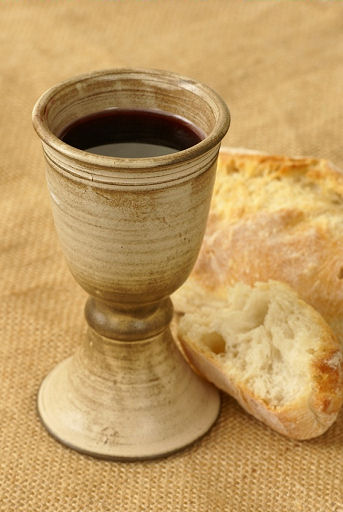
wine and breadCommunion is one of my favorite things about worship.  It is a ritual ripe with meaning and power.  People ask me sometimes about Communion and children.  I have been giving my daughters Communion since they could take solid food.  Some wonder if their kids are allowed to take Communion, so I offer this as my answer.  As far as I’m concerned, children are always welcome at the table, but I also respect the wishes of the parents.  If there is a new family coming forward, and they have a little one, I always say something like, “Your child is welcome to partake, if you are okay with it. If not, I’d be happy to give her a blessing.”   In that moment, it is difficult to go into all the details of why I invite that child to share in the bread and the cup.  So now I give you these reasons why any child (or any other person for that matter) will always be welcome to Communion at a table over which I preside.

  1. Communion is a means of Grace.  I believe that Communion is a powerful act.  I believe that God is present in the bread and the cup.  In that holy moment of eating and drinking, one can feel the presence of God.  This is at the foundation of my Communion theology, and everything follows from this precept.  God meets people in Communion, so why would I do anything to get in the way of that meeting?
  2. It’s not my table.  One of my favorite things to say during the course of any service is, “This is not my table.  This is not a Methodist table.  This is Christ’s table, and all are welcome.  Come, for all is ready.”  If it is Christ’s table, who am I to guess his guest list?  If Christ wants to meet someone at his table, that’s his call, not mine.  Jesus told a story about inviting guests to a banquet, and one of the most important lessons of that story is that we don’t make the guest list.
  3. There’s no kiddie table.  I’ve always thought of Communion as the family meal, and there’s no kiddie table.  If we consider kids to be a part of the family of God, why would we exclude them from the family meal?  Even at family gatherings where there is a special table for the kids, we always bring food to them too.
  4. No one fully understands what’s going on at this table.  People say to me, “We don’t bring our kids until they know what’s going on.”   My first reaction is to ask that person to explain to me their theology of atonement to make sure that they understand.  No it’s not.  That would be stupid.  We don’t have to pass some comprehension test to be invited to Christ’s table.  My actual first reaction is, “I’m not sure I fully understand what’s going on.”  Yes, I can write about the incarnation.  I can tell you what a Sacrament with a capital S is.  I can tell you about forgiveness, the body of Christ, and sacrifice, but I don’t think I can tell you with any real certainty what happens in Communion.  I believe God is present in the bread and the cup, but there is an element of mystery in the act that is unknowable.  That doesn’t mean we let kids think it’s snack time.  We teach them as we go.  Kids understand the difference between play time and serious time.  They know when something is important, if we tell them that it is.  When I hand a child a piece of bread and a cup of grape juice, I don’t say “this is the body and blood of Christ.”  I tell them, “Jesus wants you to have this so you remember how much God loves you.”  That’s all they need to know.  Sometimes that’s all any of us need to know.
  5. Children might not understand what’s going on, but they have a sharp understanding of what it means to be left out.  That is a feeling I want no child to feel in any church I am called pastor.
  6. Children are a vital part of the Body of Christ right now, as they are, not for what they might become.  I’ve heard many people say that “Children are the future of the church.”  I understand the sentiment, but I vehemently disagree.  Children are the right now of the church.  They are the church just as much as anyone else.  If we only value children for what they might become, or who they might bring with them (get the kids, and the parents follow), then we are not valuing children.  I want to be a pastor of a church that values real kids, not just the idea of kids.  I want a church that loves kids who are loud at the wrong time, who don’t sit still, who make messes when they eat, and ask rude questions sometimes.  Does this mean we don’t provide guidance, or boundaries, or expect good behavior?  Of course not.  It means that we love them as they are, and try to model for them behavior that is life-giving.  We don’t chastise or shame them.  We embrace them for all of their kid-ness.  Children are a vital part of the body of Christ, and I do not believe in treating them as anything less.

So there you have it.  These are six of the reasons why I share Communion with kids in worship.  I always leave the final decision up to the parent, but hopefully all the parents at my church know that when they come, all are welcome.

Follow The Fat Pastor on Facebook

Follow @FatPastor on Twitter

43 Comments

Filed under Christianity

I give up

We still get a daily newspaper, and sometimes the only page I touch in the whole thing is the crossword.  I love doing crossword puzzles, especially if they’re not too hard. I can’t even touch the Sunday New York Times crossword.

I like the one in our newspaper because on most days I can fill most of it up.  My favorite part of doing the crossword is when I tackle one big blank part of the puzzle at once after feeling blocked.  In one flash of brilliance the dam is lifted, and a tidal wave of right answers comes pouring out.  Whole sections of the puzzle that were once blocked can quickly come alive once I remember that an artichoke is an edible flower, and that acme is a four-letter word for peak.   Eventually though, I hit another block.

I seldom finish the whole thing.  It seems like there is always some intersection of an obscure town in India and the first name of an actress from the thirties that I just can’t figure out.  I try as hard as I can to finish the whole thing, but almost inevitably, I have to seek help.  But first I have to declare to myself, “I give up.”

“I give up” are three powerful words.  On Ash Wednesday, Christians of many stripes feel compelled to give something up.  Most people give up some vice or bad habit.  The practice of self-denial is an ancient spiritual discipline.  Others, and myself in the past, have poo-poohed the idea giving up of things for Lent.  Many writers have warned against the dangers of going through the motions during Lent, or giving up something superficial that won’t really get to the heart of the matter.

While I agree that the sacrifice that the Lord requires is not superficial, I’m giving up judging others’ discipline.  If you want to give up chocolate, who I am to tell you that you shouldn’t do that?  I know what the Lord requires of me.  Nowhere in mercy, justice, and walking humbly with God does it include commenting on your spiritual discipline.

I haven’t decided if I am going to fast for Lent.  In the past I’ve given up chocolate.  I’ve also done daylight food fasts.  For a couple years in a row I didn’t eat any solid foods between 6 a.m. and 6 p.m.  Every year I contemplate doing that again, but haven’t attempted it in years.  Last year I tried to write a note to someone for every day of Lent.  I wish I could tell you I actually wrote 40 notes in 40 days.  I can tell you though, that it was a very rewarding experience.

This year I feel ready to give up.  Giving up is an easy thing to do sometimes.

I feel weary, and I don’t think I’m alone.  I feel weary of a world torn by violence in Central Africa, Syria and Venezuela.  I feel weary of impending war in Ukraine.  I feel weary of divisive politics.  I feel weary of debating.  I feel weary of a long and brutal winter that just won’t relent.  I feel weary of social media, being bombarded every day by this post, this article, this meme.  I feel weary of my to-do list, which seems to be growing faster than I can check things off.  I feel weary of reacting harshly at my daughters when they don’t deserve my ire.  I feel weary of the  laundry pile in my basement, the paper pile on my desk, and the snow piles on the street.  Pile after pile seem to come in wave after wave.

And now Lent comes and I’m supposed to give something up, and I can’t pick just one thing.  So I give up.

Pass me the ashes, I give up.

I give up my plan.

I give up my power.

I give up my ability to affect change.

I rub ashes on my head, and mark myself “given up.”  Weary. Tired. Defeated.

I remember that out of dust I was formed. To dust I will return.

I give up.  I confess my failures. I examine my shortcomings.  I reflect on the ways that I cannot do it all.  I resign myself to God’s will, not my own.  I remember that I will die, and pain and suffering will remain, but I will have lived.  I will live without the need to be right every time.  I will live without the need to follow my plan, without the need to check every box, without the need to fix everything.  Out of dust I was formed, and to dust I will return, but in between I am going live.

I am going to live.

I fall on my knees and cry out to God, “I give up.”  God smiles, embraces me and says, “Finally.  Now, allow me…”

And suddenly the dam is lifted, and a tidal wave of grace comes pouring out.

The fast I choose is justice, mercy, and kindness.  Not because my actions will solve the world’s problems, but simply because God is.  God is justice.  God is mercy. God is kindness. God is love.  This same God took a pile of dust and breathed life into me, so how else can I live?

I can’t solve the world’s problems.  I can barely finish my laundry.  These ashes are a reminder of my own mortality.  These ashes are a reminder of my own shortcomings.  These ashes are a reminder that God took ashes and formed something that I could never form.  God provides answers I could never know.  God provides paths I could never find.

I give up. I get up with God, and I feel fine.

Follow The Fat Pastor on Facebook

Follow @FatPastor on Twitter

ash wednesday meme

3 Comments

Filed under Christianity, Sermons

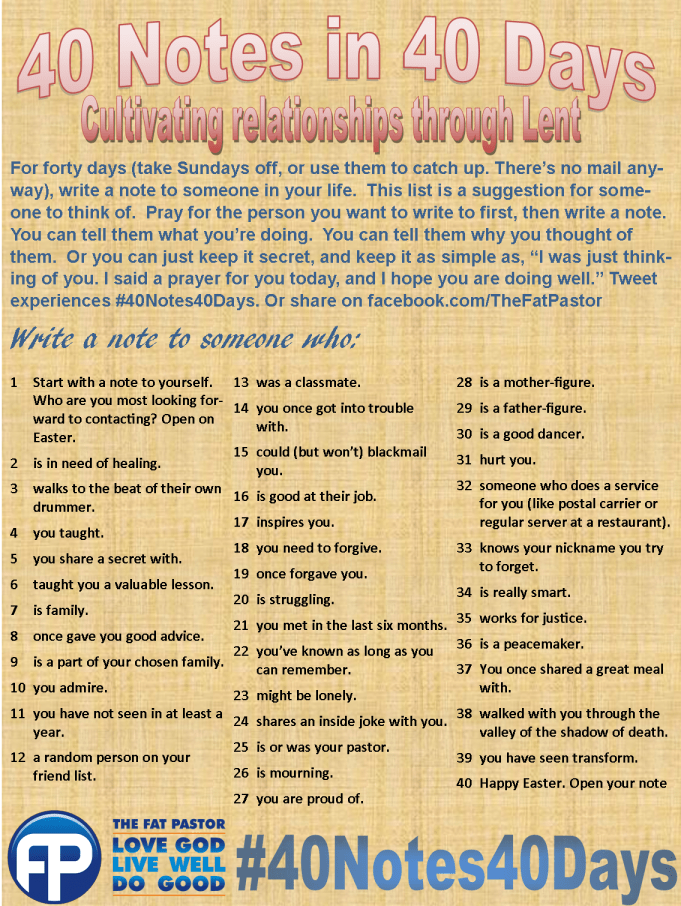
40 Notes in 40 Days, 2.0

Read my blog about taking up ashes to begin Lent. “I Give Up.”
40 Notes in 40 Days, 2.0

Last year I introduced this idea for Lent. It was a powerful experience for many who tried it. The point of this exercise is not to get overwhelmed by another thing on your to-do list. The idea is start thinking about relationships. Think about real, past, new, old, strong, strained relationships. As you write your notes, if something cool, unexpected, fun, or funny happens, let me know. Tweet it out using #40Notes40Days.

Read my blog about taking up ashes to begin Lent. “I Give Up.”

Follow The Fat Pastor on Facebook

Follow @FatPastor on Twitter

6 Comments

March 5, 2014 · 12:17 am