Someone posed this question to me – “Why do you call yourself the Fat Pastor?” Well, I have a few reasons.
First of all, because I am a pastor. A lot of what I do on this blog is write about God and the Church. I offer my thoughts, or what I have called “my nebulous theology.” As a pastor, I am interested in sharing God’s message of love, redemption and grace. I think there is a lot of noise out there that contributes to a lot of confused people. I try to offer my view of God because, in my boldness, I think it might be helpful.
Since starting this blog, I have been given much encouragement from people that have received gifts from my words to know that I indeed have something to offer. I’ve had about 40,000 views, and get about 50-100 a day. This is not a huge site, but some people tell me they like it. So right away, in the title of my blog, people know that I am coming from a pastoral perspective. I am, and always will be, a pastor.
I am many other things too, and I write about the many things I enjoy. But one thing I am is overweight. It’s a fact that I cannot ignore. Every time I try to put on a tie, every time I tie my shoes, every time I get out of breath after light exertion, I am reminded of this fact. I am 6′ 2″, and at my last weigh-in, I’m 320 pounds. That’s grossly overweight. I named this blog in 2008 when I was shocked to find out my weight had topped 300 pounds, and it has generally gone the wrong way ever since. I’ve always been big. I was never the “fat kid” growing up, but I don’t think anyone has ever described me as skinny. I’m athletic, and actually healthy in a lot of ways, but my belly is certainly bigger than it should be.
I call myself the Fat Pastor on this blog first and foremost because its true. But I also use the word “Fat” to try and breathe a little brevity into what I am doing. I have always had a self-depricating sense of humor. People tend to think of pastors in one of two ways. Some have an automatic sense of distrust. This is something that we, as pastors, have earned well. There are far too many of us that abuse our authority, and misuse the trust we are given. There are also people that tend to think of pastors as almost otherworldly. By calling myself the Fat Pastor, I am attempting to diffuse either extreme.
I’m just a regular guy. I have struggles. I sin. I have a sense of humor. I like sports – perhaps too much. I like eating – definately way too much. I like beer and wine and scotch, but not in excess. I like some vulgar music and raunchy comedies and dirty jokes. I am not perfect. I’m fat. I don’t want to be, but I am. I don’t work out nearly as much as I should, and I eat way more than I ought. It doesn’t make me a bad person. Does it make me a hypocrite? Some would say so. But I am who I am. I want to be better, and I’m striving to live well and do good in the world.
I am gifted. I have failures. I am a sinner. I am a saint. It’s who I am. And I would bet it is who you are too.
I am the Fat Pastor. This is my blog. I hope you like it. If you do, share it with others. If you don’t, I’ll love you anyway.
From Jacqueline Shuler, the artist: “Classic Irish Blessing with tenth century Celtic hand lettering.The capitals in the title are decorated with authentic “zoomorphs”. These are animal images interwoven with the letters. I drew the interweaving border which has no beginning or end, in the tradition of Celtic decoration. I placed a trefoil, symbol of the Trinity, along the bottom border. I focus on making my designs authentic by using the letters and designs embedded in the culture–in this case, Ireland in the tenth century”
I love St. Patrick’s Day. I love my Irish heritage, and love trying to spread a little knowledge about St. Patrick. The McCoy family never sends out Christmas cards. We send out St. Patrick’s Day cards, and I love looking up a good Irish blessing, or a prayer of St. Patrick to put in it.
The McCoy name is Irish, but it is not easily traced because it has many different roots. It may be Scotch-Irish. While my Dad and I were in Ireland, we found out that the McCoys (or simply Coys or MacCaugheys) moved from Ireland to Scotland before coming to America.
Every St. Patrick’s Day I think back to the time my Dad and I spent in Ireland. It was honestly one of the best weeks of my life. We listened to music in Dublin, and held our breath on the Cliffs of Moher. We marveled at the hillsides that looked as if God had laid down a quilt of green. We kissed the Blarney stone. We danced. We sang. We drank some Harp (I hadn’t yet acquired the taste for Guinness), and talked to kind, hospitable people wherever we went. My Irish heritage might be less than pure, but Ireland has claimed a piece of my heart.
Today, there are few things I enjoy more than sitting down with a Guinness and some friends and listening to some good Irish music. So today, everyone is Irish.
Okay – that sounds nice, but how many people really stop and think about what that means?
If by saying “Today I’m Irish,” you mean that you want to drink Budweiser with blue food coloring in it; act like an fool; start a fight; and wear some silly, vulgar, green t-shirt; then frankly, I’d prefer if you just stayed German (or Polish or Swedish or African American or English or whatever you are) and act like a fool because you are a fool, not in the name of ‘being Irish.’
If, however, by saying “Today I’m Irish” you mean that you respect Irish culture, want to enjoy a good evening with friends with some good music and a pint or two, then yes, you are Irish. If it means that you are going to Mass or said a prayer for the Irish people, then yes, today you are Irish. If it means that you stand in solidarity with a people that suffered centuries of famine, subjugation, attempted genocide at home, and racism and violence that greeted them when they got to America, then yes, today you are Irish.
Indeed, today we may all be Irish, and I leave you with this, “The Breastplate of Saint Patrick,” as found on the website prayerfoundation.org.
I bind unto myself today The strong Name of the Trinity, By invocation of the same, The Three in One and One in Three.
I bind this day to me for ever. By power of faith, Christ’s incarnation; His baptism in the Jordan river; His death on Cross for my salvation; His bursting from the spicèd tomb; His riding up the heavenly way; His coming at the day of doom; I bind unto myself today.
I bind unto myself the power Of the great love of the cherubim; The sweet ‘well done’ in judgment hour, The service of the seraphim, Confessors’ faith, Apostles’ word, The Patriarchs’ prayers, the Prophets’ scrolls, All good deeds done unto the Lord, And purity of virgin souls.
I bind unto myself today The virtues of the starlit heaven, The glorious sun’s life-giving ray, The whiteness of the moon at even, The flashing of the lightning free, The whirling wind’s tempestuous shocks, The stable earth, the deep salt sea, Around the old eternal rocks.
I bind unto myself today The power of God to hold and lead, His eye to watch, His might to stay, His ear to hearken to my need. The wisdom of my God to teach, His hand to guide, His shield to ward, The word of God to give me speech, His heavenly host to be my guard.
Against the demon snares of sin, The vice that gives temptation force, The natural lusts that war within, The hostile men that mar my course; Or few or many, far or nigh, In every place and in all hours, Against their fierce hostility, I bind to me these holy powers.
Against all Satan’s spells and wiles, Against false words of heresy, Against the knowledge that defiles, Against the heart’s idolatry, Against the wizard’s evil craft, Against the death wound and the burning, The choking wave and the poisoned shaft, Protect me, Christ, till Thy returning.
Christ be with me, Christ within me, Christ behind me, Christ before me, Christ beside me, Christ to win me, Christ to comfort and restore me. Christ beneath me, Christ above me, Christ in quiet, Christ in danger, Christ in hearts of all that love me, Christ in mouth of friend and stranger.
I bind unto myself the Name, The strong Name of the Trinity; By invocation of the same. The Three in One, and One in Three, Of Whom all nature hath creation, Eternal Father, Spirit, Word: Praise to the Lord of my salvation, Salvation is of Christ the Lord.
It is now time for the third annual mascot bracket. Tired of losing every year with my own basketball knowledge, I decided to divise a very scientific method of picking the NCAA tournament. It all revolves around this question:
Which mascot would win in a fight? For schools that have different nicknames than mascots, I defer to the meaning of the nickname. For example, last year I determined that a Blue Devil is not a supernatural being. The Blue Devils were a fighting squadron from World War I. With nicknames that are ambiguous – especially about whether or not they are armed, I might defer to the logo or mascot.
Last year, I entered the Mascot Bracket into a yahoo public group. There were about 30 entries, including the picks of Joe Lunardi, President Barack Obama, My three-year-old daughter, all the top seeds, and me. The Mascot Bracket won, and finished in the 84th percentile. Also, all mascots are treated as individuals unless they are specifically plural.
The rules:
There are a few rules to follow:
Inanimate objects, e.g. colors and plants, always lose to animate objects.
Predators beat non-predators and unarmed humans.
Humans beat non-predators.
Humans with weapons beat predators.
Humans with weapons beat humans without weapons.
Humans with superior weapons/fighter training win.
Supernatural beings and killer weather systems are tough to beat.
Ties go to the high seed.
Prepositions lose to everything.
PLAY-IN GAMES
Alabama State Hornets def. UT San Antonio Road Runners. The hornet can sting multiple times. The road runner has no discernable offense. It might take awhile, but the hornet wins. Things are looking good for the Hornets, who have the luck of taking on a plant next.
Alabama-Birmingham Blazers def. Clemson Tigers. I thought this would be tougher, expecting that, like the former Portland basketball team, the blazers was short for trailblazers. I was wrong. Apparantly, the Blazers are a bad-ass dragon with blazing fire out its mouth. They are going to be tough to beat.Southern California Trojans def. Virginia Commonwealth Rams. Armed human over animal (Rule 4).
Arkansas Little Rock Trojans def. North Carolina Ashville Bulldogs. A Trojan will beat a bulldog even easier than he would beat a Ram.
EAST
(16) Alabama State Hornets def. (1) Ohio State Buckeyes. The Ohio State University kills me every year. The 16-seed hornet takes out the buckeye, as per Rule #1.
(8) George Mason Patriots def. Villanova Wildcats. Armed human shoots the wildcat.
(12) UAB Blazers def. (5) West Virginia Mountaineers. Usually the armed man defeats the predatory animal. But usually the predatory animal isn’t a GIANT FIRE BREATHING DRAGON!!! I’ve seen Harry Potter, and no hillbilly with a shotgun is going to take out an Hungarian Horntail.
(13) Princeton Tigers def. Kentucky Wildcats. A big mean, predatory cat devours the much smaller, mean, predatory cat.
(3) Syracuse Orange def. Indiana State Sycamores. Seriously, when I saw this draw I laughed out loud. Every year Syracuse is an early exit from the Mascot Bracket. They finally found a matchup they could win. The color versus the tree would undoubtedly be the least entertaining of all of these matchups. This has to defer to RULE #8 – ties go to the higher seed.
(6) Xavier Musketeers def. (11) Marquette Golden Eagles. Muskets aren’t the most accurate gun ever invented, but all it would take is one shot, unless of course the Golden Eagle is made of actual gold. But then it wouldn’t really be able to mount much of an offense
(7) Washington Huskies def. (10) Georgia Bulldogs. In a (excuse the pun) dog-eat-dog matchup, I’d have to go with the Husky. And this youtube video proves it. It is of an actual bulldog and a husky pit against each other in fierce competition. In the end, the Husky clearly comes out on top (just watch it).
(2) North Carolina Tar Heels def. (15) Long Island Blackbirds. The Tar Heel name is the stuff of legend, but according to the UNC website, it started during the Civil War and refers either to the North Carolina soldiers’ stubborn ability to stand and fight, as if they had tar on their heels; or was a slur used to make fun of the poor and dirty soldiers that made tar. For the purposes of the Mascot Bracket, I’m going with civil war soldier.
ROUND THREE
(8) George Mason Patriots def. Alabama State Hornets. No weapon needed, just a hand or rolled up copy of “Common Sense”
(12) UAB Blazers def. Princeton Tigers. “Princeton yells for Tigers, and Wisonsin for Varsity,” but the Blazers would eat roast cat.(6) Xavier Musketeers def. Syracuse Orange. RULE #1
(2) North Carolina Tar Heels def. Huskies. RULE #4
REGIONALS
Blazers def. Patriots
Tar Heels def. Musketeers RULE #6
Tar Heels def. Blazers. Okay, so you might be asking, would a civil war soldier be able to beat a dragon? Would a Tar Heel be able to do what a Mountaineer, Tiger, and Patriot failed to do? Well, the Tar Heel just shot a Musketeer and a Huskie without a challenge. The Dragon has been shot at by two different people and taken some nasty tiger bites. I’m saying the dragon is more weakened by the previous three rounds than the tar heel. If you think I’m wrong, make your own mascot bracket. Besides, its RULE #4.
SOUTHWEST
I say. I say, I say, what is a Jayhawk, boy?
(1) Kansas Jayhawks def. (16) Boston Terriers. The Jayhawks present quite a problem. The mascot itself resembles foghorn leghorn. According to some research, it is actually supposed to be a cross between a Blue Jay (because its annoying) and a Sparrow Hawk (because it is a stealthy hunter). If you go by this, then it is not particularly intimidating. Granted, neither is a boston terrier, but I’d still pick the terrier over an annoying bird. However, I have a tradition of going back to the meaning of the mascot. According to the school website, the Jayhawk refered to pioneers in Kansas that bugged other pioneers, notably from Nebraska. As Kansas moved toward statehood, there was quite a public debate over whether Kansas would be a free or a slave state. Ruffians on both sides of this battle were dubbed “Jayhawkers” and were known to rob, vandalize, sack, set fire to, and steal horses from the other side. In time, the Jayhawks referred mainly to the free-staters. So, that is a very long-winded way to determine that the true meaning of Jayhawk is not a stupid little bird, but a 1850s thug that was against slavery. In other words, RULE #4.
(8) Illinois Fighting Illini def. (9) UNLV Runnin’ Rebels . This is another tough one. Neither the Rebel nor the Illini is intrinsically armed. the Rebel seems to be a Civil War era rebel, but the school was really called the rebels because they rebelled against the University of Nevada. I’m going with the Illini because of the adjective. In the Mascot Bracket, it helps to fight instead of run.
(5) Vanderbilt Commodores def. (12) Richmond Spiders. Unless the Commodore has a severe case of arachnophobia.
(13) Morehead State Eagles def. (4) Louisville Cardinals. RULE #2
(3) Purdue Boilermakers def. (14) St. Peter’s Peacocks. Seriously, its a big dude with a hammer against a non-flight bird. It’s a pretty gruesome image.
(11) USC Trojans def. (6) Georgetown Hoyas. What’s a hoya? Well, that is a question that Georgetown opponents have been chanting for decades. Wikipedia gives us the answer – it appears to have come from a chant, “Roxa Hoya,” which is loosely translated from Latin to “such rocks.” Hoya is basically Latin for “Such as.” Long story short: Prepositions lose.
(10) Florida State Seminoles def. (7) Texas A&M Aggies. You would think an Aggie is someone involved in agriculture. Look up Texas A & M Aggie. Apparantly their mascot is a collie. Lassie doesn’t stand a chance against the guy with the flaming spear riding a horse.
(2) Notre Dame Fighting Irish def. (15) Akron Zips. For some reason the Zips use a kangaroo as their mascot. This boxing kangaroo notwithstanding, I think a good drunken Irishman would whip a kangaroo.
(5) Vanderbilt Commodores def. (13) Morehead St. Eagles
(11) USC Trojans def. (3) Purdue Boilermakers. The Trojans have swords and armor and stuff. The Boilermaker has a hammer.
REGIONALS
Commodores def. Jayhawks. A Commodore is a naval officer, a jayhawk is some rabble rouser with a pitchfork.
Seminoles def. Trojans. I really didn’t know who would win this one, so I did a little more searching. The first google image of a seminole is a guy with a huge shotgun. Screw the flaming spear, Seminoles win big.
Seminoles def. Commodores. Again, this is a really tough one. I think the Seminole would be able to beat the naval officer, because most officers are older and have seen their battles in years past.
SOUTHEAST
(16) Arkansas Little Rock Trojans def. (1) Pittsburgh Panthers. Here’s another big upset. I was expecting the Buckeyes to go down in the first round. I’m not too crazy about losing the Panthers.
(9) Old Dominion Monarchs def. (8) Butler Bulldogs. I’m assuming that a monarch would have some access to a weapon of some kind, but if you go by the mascot they use, a lion, that wins too.
The Utah State Aggie is apparanrly a bull. The Texas A & M Aggie is a collie.
(12) Utah State Aggies def. (5) Kansas State Wildcats. Whether the Utah State Aggie is a farmer or the bull on the left, it would beat a wildcat. Wildcats are really not that big.
(13) Belmont Bruins def. (4) Wisconsin Badgers. A badger is a mean little bastard, but a bruin is a bear. A bear. This little part of the bracket is all upsets.
(3) BYU Cougars def. (14) Wofford Terriers. If Wofford were the pit bull terriers, it might be interesting. They’re not. They are boston terriers. A nice snack for a cougar.
(6) St. John’s Red Storm def. (11) Gonzaga Bulldogs. Another dog goes down. I suppose by drowning, or maybe lightning strike. The fact that the Storm is red doesn’t add to its ferocity, but most dogs are total cowards in storms. I know mine is.
(10) Michigan State Spartans def. (7) UCLA Bruins. This is something right out of a Charlton Heston movie. It would be a great fight, but according to RULE #4, Sparty wins.
(15) UC Santa Barbara Gauchos def. (2) Florida Gators. Much like the last matchup, this might be fun to watch, that is, until the Gaucho pulls out his six-shooter.
THIRD ROUND
(16) Ark-LR Trojans def. ODU Monarchs. The ODU Monarch is a lion. The Trojan against the Lion would be an intersting fight, but I’m going with RULE #4. (I’m not expecting many points out of this part of the bracket).
(13) Belmont Bruins def. (12) Utah State Aggies. That bull looks pretty tough, but not up against a bear.
(6) St. John’s Red Storm def. (3) BYU Cougars. RULE #7.
REGIONALS
Trojans def. Bruins
Red Storm def. Bruins (tough day for Bruins)
Red Storm def. Trojans.
WEST
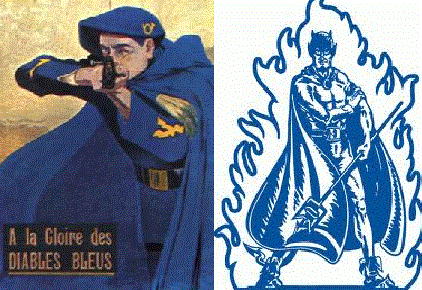
The Blue Devil on the left if the historic root of the mascot – a French fighting force in WWI. The Blue Devil on the right is lame.
(1) Duke Blue Devils def. (16) Hampton Pirates. Duke was named for a French squadron in World War I, and if you are thinking, “How tough can they be if they were French?” then you are betraying your ignorance about world history. The French were long known as one of the greatest armies of the world – and they were especially tough during World War I.
(12) Memphis Tigers def. (5) Arizona Wildcat. The second matchup between a Tiger and a Wildcat. Again, the tigers win.
(13) Oakland Grizzlies def. (4) Texas Longhorns. Again, Grizzlies are big, bad bears. Not sure many land mammals could take out a Grizzlie, except Baxter from Anhorman.
(14) Bucknell Bison def. (3) UConn Huskies. A bison would trample a huskie.
(11) Missouri Tiger def. (6) Cininnati Bearcat. A bearcat vs a badger would be a tough call. A bearcat vs a tiger is not.
(7) Temple Owls def. (10) Penn State Nittany Lions. A Nittany Lion is really just a wildcat from Pennsylvannia. It isn’t real big or vicious, and I think an owl would wear it down.
(2) San Diego State Aztecs def. (15) Northern Colorado Bears. The armed human defeats the bear.
ROUND THREE
(1) Duke Blue Devils def. (9) Tennessee Volunteers. Volunteers were named after fighters in the war of 1812. This is RULE #6.
(13) Oakland Grizzlies def. (12) Memphis Tigers. This might the best matchup of the entire tournament. My first instinct is to go with the bear, but a tiger is a bad dude. Not sure who to pick, I went to the “expert” at Wild Animal Fight Club. The writer seemed to know more about animals than me, and he picked the Tiger. I’ll go with Memphis.
(11) Missouri Tigers def. (14) Bucknell Bisons. The Bison has no offense. The tiger naturally takes down animals like yaks and elk.
(2) San Diego State Aztecs def. (7) Temple Owls. RULE #4.
REGIONALS
Blue Devils shoot the Tigers
Tigers def. Aztecs. This looks like a RULE #4, but the Aztec weapons were almost all hand held. I don’t like the chances of any man versus a Tiger unless he has gun powder, or at least a projectile of some kind.
I’ve been reading a lot on facebook today about people giving something up for Lent. Several have said their FB “goodbye,” because they will be giving up facebook. Thousands (millions?) will be giving up chocolate, french fries, cofee, swearing, late-night snacks, food during the day, or somesuch other thing.
They will do it in the name of fasting. The idea of giving up something for Lent has taken on a certain cultural cache. It is a strange phenomon in our culture of overindulgence. On the surface, I see it as a good thing. Self-denial, even of menial or luxuriant things, is a much overlooked virtue. So I applaud all of those that, in the name of God or their faith, are trying to give up something for Lent.
I just want to add a word of caution. Don’t let your giving something up for Lent replace an actual relationship with the living God. And don’t let your sense of piety over giving up something for Lent keep you from taking a hard look at what God really wants us to be doing.
This is the kind of fast day I’m after:
to break the chains of injustice,
get rid of exploitation in the workplace,
free the oppressed,
cancel debts.
What I’m interested in seeing you do is:
sharing your food with the hungry,
inviting the homeless poor into your homes,
putting clothes on the shivering ill-clad,
being available to your own families. (Isaiah 58:6-7, The Message)
Just be careful. It is great to do something for God. It is great to remember the sacrifice that Christ made for us. Just do it for the right reasons. Don’t get caught up in the cultural trend of giving something up without also trying to take something up. We give things up to make room to take things up. Give up something that is getting in the way of your relationship with God. Give something up that is getting in the way of the Kingdom.
Give up chocolate. Give up chocolate that is made on the backs of the working poor. Give up choclate that enslaves children and puts them in dangerous working conditions. Give up Hershey. And take up Fair-Trade chocolate.
Give up TV. And take up conversations. Take up stronger relationships. Take up the Bible. Take up prayer.
Give up oppression. Give up resentment. Give up fear. And take up justice. Take up reconciliation. Take up love.
Mark your forehead with ashes – not to take up shame and guilt. Mark your forehead with ashes – and take up your inheritance as a child of God. Take up your task to do the work of Christ. Mark the start of your journey to the cross, so that when you get to Easter, you can look back and know that this Lent, you did something with God. Then sing “Hallelujah, The Kingdom has come.”
If you liked this post, you might find the podcast “Pulpit Fiction” interesting. Go to the Pulpit Fiction homepage for commentaries on the Biblical text throughout Lent – and every week of the year.
Thanks to Lisa, who was able to record my final service at Chenoa UMC on her Flip Video camera. With the Scripture reading, it lasts about 25 minutes, and is divided into two parts.
It was hot. We were sweaty. I was dirty and sore and tired. And then we started to sing. We took each other by the hand and made a circle, and we sang:
“I just want to say thank you, thank you my Lord.
I just want to say thank you, thank you my Lord.
For your blessings we say thank you, thank you my Lord.
I just want to say thank you, thank you my Lord.”
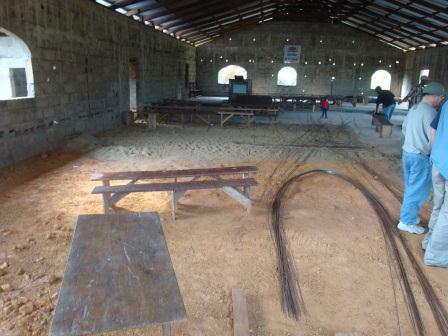
Inside New Hope UMC
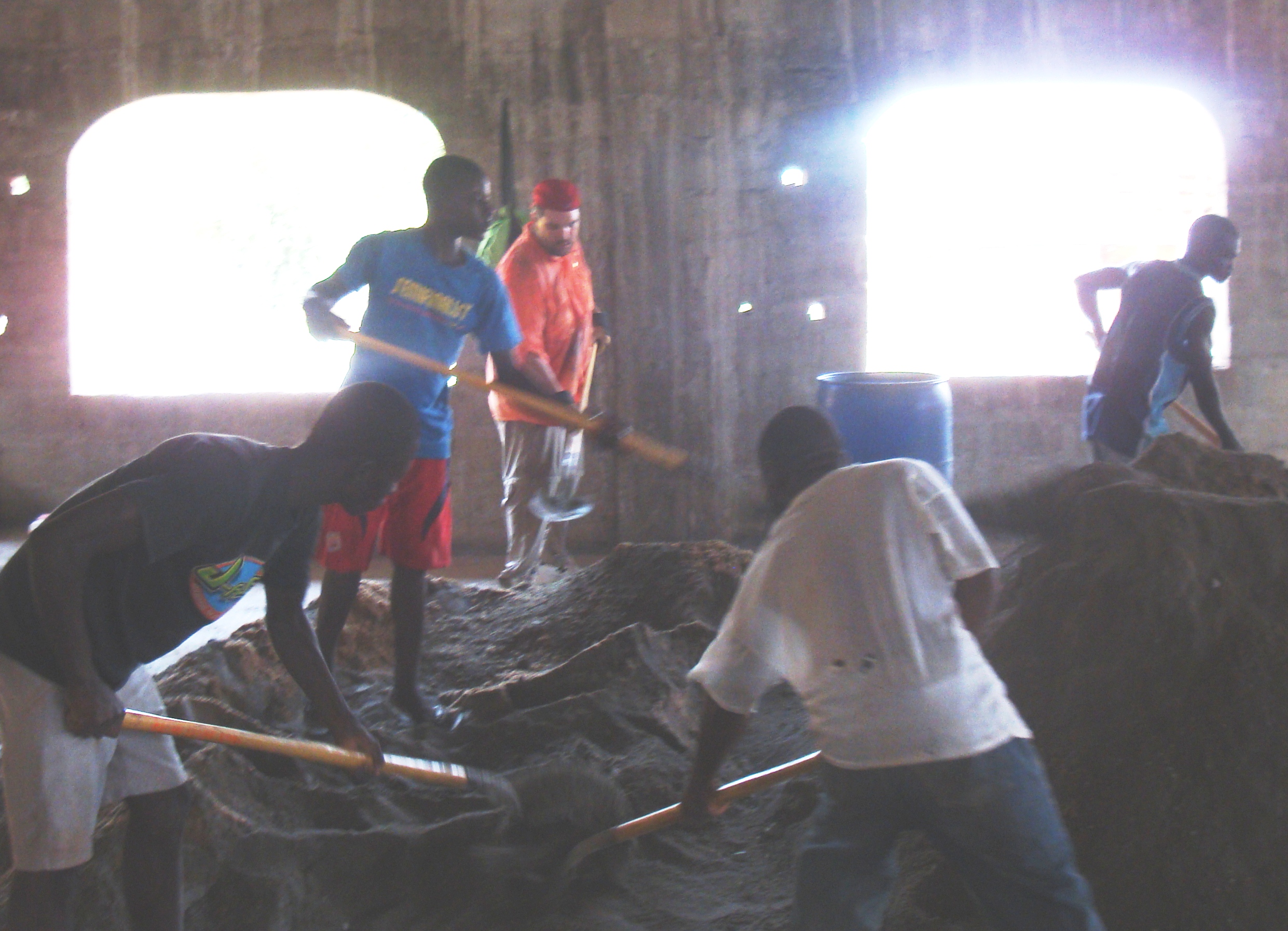
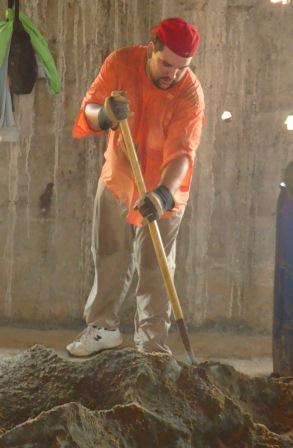
The floor of New Hope United Methodist Church was not yet finished, but it was closer than it was at the beginning of the day. We had spent the morning and early afternoon working hard. First we hauled forty wheel barrows of sand into the church. Then carried twenty 110 pound bags of cement into the church. After dumping the cement onto the sand, we mixed it up with spades. The Liberian men that were there knew what they were doing. We learned by watching, and pitched in. I feared that we might be slowing them down – or worse – taking away work that they wouldn’t get paid for. But their smiles and gestures of help allayed my fears.
Working together at New Hope UMC
The process was long and slow. Others in our group affixed wires to the undergrid. Others spread sand on the dirt floor, providing even ground on which to pour the cement. Then we hauled in 30 wheel barrows of rock and dumped them on the huge pile of sand-cement mixture. Then came the water, and more mixing. When the cement was finally mixed and wet, it was put into a wheel barrow and dumped on the floor, where skilled masons spread it out and made it level.
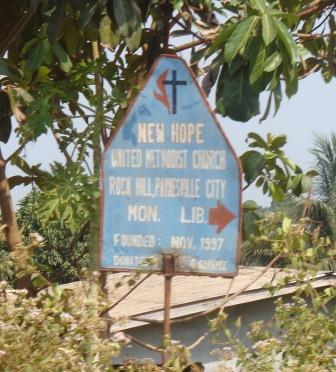
I love that the sign in Monrovia pointing to the United Methodist Church looks just like the one in Chenoa.
New Hope United Methodist Church sits on a hill on the outskirts of Monrovia. It is the biggest building in the little neighborhood. Inside there was a sign that read “2011-Our year of divine breakthrough.” The people of New Hope used to worship at homes, and then in a structure of sticks holding up a tin roof. The new New Hope UMC is a structure of cinderblocks with a vaulted ceiling. The roof is supported by wooden trusses under tin sheets. The floor was half cement, half dirt. By the end of the week, the floor will be complete.
Those working were a mix of clergy and laity, American and Liberian, black and white, skilled worker and unskilled laborer, man and woman, educated and uneducated, paid employee and volunteer. What we held in common was much stronger than the things that could divide us. And in that moment in the back of the church, what united us came out in song.
I was a part of a group made up of mostly newly ordained clergy, we had spent the last two weeks doing various projects in and around Liberia. This was the last day of work. We gathered to make sure we were all together before we walked down the hill to get in our van and head back to the United Methodist guesthouse in the city. I’m not sure who started singing, but the singing started quietly. It was a song we had learned from the Liberian people.
“I just want to say thank you, thank you my Lord…”
And then an amazing thing happened. Many of the Liberians that were still hard at work came over. They put down their spades. They put down their wheel barrows, and they joined us. We took each other by the hand and formed a circle. We were no longer Americans and Liberians. We were no longer black and white. We were simply God’s children. We were one in Christ, and we sang. We sang as loud as our lungs could muster. I was already covered in sweat and cement dust. Now tears were added to the mixture. The pastor of New Hope United Methodist Church prayed. We gave thanks to God for the cement floor, but also for so much more.
We thanked God for the relationship between the people of Liberia and the people of the Illinois Great Rivers Conference. We thanked God for the connection of the United Methodist Church. We thanked God for the respect and friendship that was forged in our sweat. We thanked God for hope.
The Fat Pastor working hard.
We broke the circle and it took us a few minutes to actually leave. We shared hand shakes. We shared hugs. A few small tokens of appreciation were exchanged. A few last pictures were taken. There were many smiles, and then we got in the van and drove away. None of us truly left.
The music pounded out a beat. The nine-piece band and two singers were really letting it go. They sang of God’s goodness. They sang of God’s providence, of God’s peace and God’s justice. I stood there and allowed the music to envelope me. I swayed a little, closed my eyes and prayed. I tried to sing the words, but my voice faltered. I gathered myself, tried to sing again, but nothing would come.
Tears came instead. The music continued, and I could feel a great weight being lifted off of me. I could feel myself letting go of so much tension. Now the tears were flowing freely. Still no words to sing, only a voice crying out, drowned out by the music and the singing – “I’m scared.”
A simple, two-word prayer. Again, I cried, “I’m so scared.” Now a three-word prayer, it was the limit of my ability to articulate what I was thinking and feeling. I reached over to grab my wife’s hand. I squeezed it, held her close and said to her, “I’m so scared.”
It was a lamentation. All I could do was cry out to God in lamentation. I know God is with me. I know that God is good. I know that I can do all things through Christ. I know that nothing will separate me from the love of God in Christ Jesus. Yet in that moment the Holy Spirit was able to break into my heart and allowed me to simply lament. Does it mean that I have any less faith? I don’t think so. It was a powerful and incredibly healing moment.
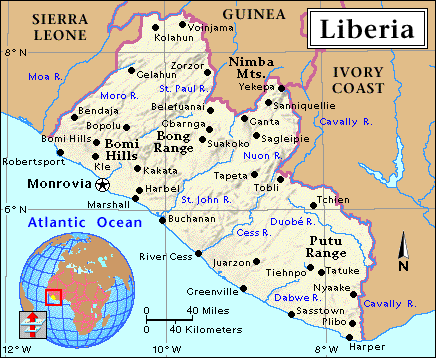
We’ll be spending most of our time in the capital city of Monrovia, building a school in the West Point section; and Ganta.
I’m scared. I’m excited too, but in that moment all I could do was cry, “I’m scared.” I’m scared of going to Liberia for two weeks. I’m scared of 13 hours in a seat not designed for Fat Pastors. I’m scared of leaving my girls. I’m scared of missing their bedtime story. I’m scared of missing their kisses. I’m scared of mosquitoes and infected water. I’m scared of sweltering heat. I’m scared of fugitives and the desparately poor and the contagiously sick. I’m scared of stories of evil and brutality for which my heart is not prepared.
I’m scared of moving to Moline a week after I get back from Liberia. I’m scared of packing up all our junk. I’m scared of getting it all done in time. I’m scared of leaving Chenoa, my church, my friends. I’m scared of leaving behind all that we have built. I’m scared for ministries that might lose momentum. I’m scared of not preaching every week. I’m scared of not knowing every single person I worship with on Sunday. I’m scared of getting lost – not just in a new city, but in the biggest church I’ve ever worked. I’m scared of starting from scratch. Despite this fear, I believe.
I believe I’m going to have an amazing trip. I believe I’m going to be transformed in ways I cannot even anticipate. I believe I will hear stories of hope and redemption that will fill my heart with joy. I believe I am going to build relationship with people that will last a lifetime. I believe that when I get back to Chenoa we will pack up all our stuff on time. I believe that the church in Chenoa will go on strong without me. I believe that the leadership will not lose sight of their mission. I believe that there are tremendous people, opportunities and resources in Moline that will allign well with my talents and passion. I believe that together we will do great work for Kingdom of God. I believe these things, and yet I’m scared.
I sit here and feel both strong and scared at the same time. It is okay for me to be both excited and terrified. It is right, and a good and joyful thing for me to wipe away tears one moment, and then smile wide the next. I’m excited. It doesn’t make me love my family or the people of Chenoa any less. I’m sad. That doesn’t mean I can’t enjoy Liberia or Moline.
I’m scared. It doesn’t make me any less of a man. It doesn’t mean I don’t believe in God. It doesn’t make me a worse pastor. It just means that I’m human. I’m scared, but I move on. I move on with my family. I move on with God. I move on straight into my fear, and that is all that matters.
I’ve collected enough money to get there and back. All the money I collect now will go directly to churches and people in Liberia. Click on the thermometer to be taken to my Donation page. Click on donate to make a $10 donation through Paypal.
“You’re going where?” I’ve been asked that more than a few times recently. Depending on the tone of the question, it can be loaded with shock, worry or confusion. “Is that near Egypt?” Is the common follow-up question.
“No, you might be thinking of Libya,” I say. “You know how Africa has a bump on the side? Liberia is sort on the bottom of that bump.”
“Are you going to be safe?” they ask. “Right now, the most dangerous things are the water and the mosquitoes. They’ve had peace since 2003, and a legitimate democratic government since 2006. Their president is a United Methodist.”
Some wonder why I’m going. Sometimes, especially now that it is so close, I wonder why I’m going. It really doesn’t make any sense. Why would I leave my home – a warm house, a comfortable bed, two daughters that light up when they see me, a wife who makes my heart leap when I hold her. Why would I leave all of this for two days, let alone two weeks?
Why would I travel 10,000 miles to live for two weeks in sweltering heat, without reliable electricity (sorry, no air-conditioning), without land-line telephones, without clean tap water? Why would I go to a place that is going to be 100 degree heat indexes, but is dangerous to wear short sleeves because the mosquitoes often carry malaria? It doesn’t make any sense.
I’m going for two weeks to do what? Paint a hospital – anyone can do that. Attend annual conference – really? I’m going 10,000 miles to sit at a budget approval meeting? Build a school in Monrovia – I don’t know anything about building a school. Why would I spend two weeks and $1,500 to do things that Liberians can do just as well – if not better – than me? It doesn’t make any sense.
You know what though? Sometimes the Kingdom of God doesn’t make sense. This is the parable of the mustard seed. It is one of the shortest parables of Jesus. This is Matthew 13:31-32 (NRSV).
He put before them another parable: ‘The kingdom of heaven is like a mustard seed that someone took and sowed in his field; it is the smallest of all the seeds, but when it has grown it is the greatest of shrubs and becomes a tree, so that the birds of the air come and make nests in its branches.’
Most people read this story hear only the part about a small seed turning into a large tree, but let’s look at this short parable a little closer. Jesus says that the Kingdom of Heaven is like someone taking a mustard seed and sowing it in a field. Really? Who would do that? If you had a field or a garden, and were hoping to grow something that produced a crop, would you really sow a mustard seed? The parable says that the seed turns into a shrub, and then a huge tree – big enough for birds to make nests. Drive through rural Illinois or Iowa – there are lush, green fields as far as the eye can see. How many huge trees are there in the midst of the corn and soybeans?
Think also about a garden. A huge tree – complete with birds and other small animals – is the last thing you would want in it. Sowing a mustard seed in a field just doens’t make sense. Jesus compares the Kingdom of God to planting a tree in a field, or a weed in a garden. Today he might have said, “The Kingdom of God is like planting dandelions on your front lawn. One pops up, and before you know it, your whole yard is covered in them.”
It just doesn’t make sense. The Kingdom of God doesn’t make sense.
It doesn’t make any sense for me to go to Liberia, but sometimes the Kingdom of God is about doing something that doesn’t make sense. The Kingdom of God is about learning something totally new about “what makes sense.” When someone strikes you on the face, it doesn’t make any sense to turn the other cheek. When someone steals your cloak, it doesn’t make any sense to give him your cloak as well. It makes sense to love your neighbor and hate your enemy. But Jesus told us that’s not how the Kingdom of God works.
Common sense tells us to work, accumulate, gain status, grow in stature and garner power. Common sense tells us to get revenge when we can, to punish when we are able and to win at all costs. The Kingdom of God isn’t about making sense. It didn’t make any sense for Jesus to forgive the tax collectors. It didn’t make any sense when Jesus healed the sick or fed the hungry. It didn’t make any sense for Jesus to allow himself to be put on a cross because of my sins. And it definately didn’t make any sense for him to conquer the grave and leave the tomb empty.
The Kingdom of God doesn’t make sense, and the only way we’re going to get there is if people are willing to do some things that don’t make sense. It doesn’t make sense to fogive. It doesn’t make sense to seek reconciliation. It doesn’t make sense to be love mercy, do justice and walk humbly with your God.
It doesn’t make sense for me to go to Liberia. But I’m going anyway. I’m going to meet people, share stories, and build relationships. I am going to walk amongst a people that still proclaim “God is so good” even though it doesn’t make sense. I’m going to a place that faced 13 years of the most brutal war the world has ever seen. I’m going to a country that saw 200,000 people die, 2,000,000 become homeless. I’m going to a place where girls raped, kidnapped and turned into “brides” for brutal warlords. I’m going to a place where boys saw their parents murdered, were kidnapped, given heroine and guns and forced to become soldiers.
I’m going to a place that has no reason to have hope. It doesn’t make any sense for people to be kind and generous. It doesn’t make any sense for people to come to worship and declare “God is so good.” It doesn’t make any sense. And that’s why I’m going, because sometimes we all have to do something that just doesn’t make sense.
5K 36:00 (Race for the Cure, Jun. '12)
35:15 (Firecracker Run, Jul. '12)
33:47 (Crimestoppers, Aug. '12)
31:40 (Lagomarcino's, Oct. '12)
26:52 (CASI St. Patrick's Day, Mar. '13)
26:28 (Railroad Days, Jun. '13)* *2nd place in age division
26:40 (Casa Guanajuato, Nov. '13)
30:30 (Modern Woodmen Knockout Hunger, Sep '14)** **3rd place in age division
Debut on 10/02/2008
1,000 total views on 12/04/2008
100,000 total views on 11/30/2011
200,000 total views on 5/26/2012
300,000 total views on 9/7/2013
400,000 total views on 5/23/2014
500,000 total views on 8/22/2015
All of the writing on this, and all pages at fatpastor.wordpress.com, are the sole possession of Robb McCoy, and are in no way affiliated with the United Methodist Church, or with any local congregation of the United Methodist Church.
Permission to use the written material on this site is granted for non-profit use, as long as credit is given to Robb McCoy and a reference to https://fatpastor.wordpress.com is used.
Comments and discussion are encouraged. However, any comment that is degrading, profane, violent, vulgar, or offensive will be removed.
All opinions and ideas are my own, unless otherwise noted. All opinions and ideas are subject to change depending on my own social location, events of the day, or my mood (it's all about the context, man!)








 The Fat Pastor