On May 19, 2012, we’re having an Elephant Wash. There won’t be any elephants (I asked the people at the zoo, and they said ‘”no”). Instead, the elephant wash will be full of kids and youth reaching out to their community. I’m hoping that there will be lots of cars and lots of generous people willing to buy lemonade. The Elephant Wash is Riverside United Methodist Church’s entry into Change the World Saturday.
A few months ago the kids at Riverside United Methodist Church picked a community outreach project. They decided that they wanted to help the local zoo build a new habitat for their elephants. The kids of our church love the Niabi Zoo, and they really got excited about helping with the zoo’s efforts to raise $4 million for a new elephant habitat. We are going to have a car wash and encourage people to make a donation. Before the car wash, someone from the zoo is going to come and do an educational session with the kids and volunteers. The zoo is also going to donate a painting for the silent auction. The artist will be one of the elephant residents of the zoo. Is an elephant wash going to change the world?
It depends on what you mean by that. At the very least, it will help the zoo take care of two of God’s amazing creatures. And it could do a lot more. It could help our kids learn how it feels to serve others. It could teach them to be disciples of Jesus by spending their time in fellowship and service. It could start a conversation with someone that didn’t know anything about Riverside Church. It could transform the heart of someone that thinks that churches aren’t interested in the community.
If you click here to search for a Change the World event, you can enter 61265 into the zip code, and see ours. Or you can put in your own zip code and see an event near you. You can register and volunteer right now, and your name and email will be sent to the organizers of the event. It is easy to argue that one event at one church couldn’t make much of an impact. What about 1500 events involving over 20,000 people? As of right now, that is how many people and churches are getting behind this movement. 20,000 people are rethinking what it means to be church. And that can indeed change the world.
Change the World weekend is a project of United Methodist Church across the connection coming together for two days of community action. Many of the projects support Imagine No Malaria, an initiative to eradicate malaria deaths through education, treatment, net distribution, and training; but Change the World is not about a single cause.
Change the World is about churches coming together for a day to get out of the church. It is about rethinking what it means to “do church.” It is about helping people to think about church as a verb instead of a noun. Church can be something we do, not just somewhere we go.
Busch Stadium in St. Louis, one of my favorite places on earth.
I start to get excited as soon as I can see the lights of the stadium. It doesn’t matter which stadium – Wrigley, Busch, Comiskey (I don’t care what they’re calling it now. It will always be Comiskey). I start to get excited as soon as I can see the lights. Approaching the stadium, the excitement builds. People are coming in off the El or crossing the street in hoards. I always buy my peanuts from a guy outside the stadium because it’s a buck cheaper.
I love the colors of baseball. Blue, gold, white, and green. These are the colors of baseball for me. Blue sky. Green grass. Golden infield with crisp white lines. I always pause at the first site of the field. Everything is perfect. Nobody has kicked up the batter’s box. Nobody has groomed their own place in the field. The rubber and the bases shine. The scoreboard is big and bright and full of information, but right now there are only zeroes on it.
I love the smell of baseball. The cinamon from the churro stand. Onions caramelizing on the grill. Hot dogs sizzling on their roasters. I breathe it in. I don’t bring my glove to games (because I’m a grown man), but I can still smell the leather. I’ve buried my face in my glove enough times to recall the smell – especially at a ballgame. I find my seat and evaluate my odds of getting a foul ball. I fill out the lineup card and let the sun pour over me. I look at the names on my scorecard and wonder, “Who’s going to hit a home run? Who will get the first hit?”
I love the sounds of baseball. The vendors are hawking their $9 beers. The crowd is a low murmur, ready to explode in an instant. The organ plays tunes that were not meant to be played by pipe organs, but somehow they fit. The game starts, and I wait for the greatest sound of them all: bat on ball. The crowd comes alive. The players move in perfect synchronicity to the place they need to be – covering every possible angle that the ball may travel.
I’ve never been to a game on Opening Day, but I can only imagine the sense of excitement. For those in the city that that celebrated just a few months ago, or those in places that have been waiting generations, the excitement of Opening Day is connected directly to hope. Hope springs eternal on Opening Day The team hasn’t lost a game yet. Everyone’s in first place. Every team has a chance. Every fan knows that on Opening Day, anything can happen.
For those of us that love the game, baseball is the soundtrack of the summer. It will be on the radio and TV. We will check scores from phones, and open up the agate page in the sports page. Phrases like “rubber match, games back, get-away day,” will reenter our vocabulary. Every fan hopes that what begins with a cool day in April will end with a cool celebration in October.
The season will be filled with ups and downs. There will be winning streaks and hitting streaks; losing streaks and slumps. There will be lazy fly balls and screaming line drives. There will be thrilling comebacks and heartbreaking losses. Our team will win. Our team will lose, and the summer will move on. Eventually, the season will be over, and we all want it to end with a parade through our city.
Isn’t that what life is all about? When I die, I don’t expect that there will be a parade, but I have assurance to know that there will be a great celebration. Jesus gave us some simple instructions for life, “Follow me,” he said. Follow him in service, compassion, grace, and love. He told us to love ourselves, love our neighbors, and love our God. He told us to break bread with each other, forgive and be forgiven, and be willing to sacrifice for the sake of others.
We go through this season of life and surely there are going to be slumps, bad outings, and losing streaks. Everyone faces the dog-days of summer and the nagging insecurities of a fallen world and a sinful nature. Today though, we have hope. Today can be Opening Day. There are a lot of questions we have to answer. There is potential that we can still unlock. There are stories to be told, and lives that we can touch. There swings to be swung, pitches to be pitched, and games to be won. Today is Opening Day.
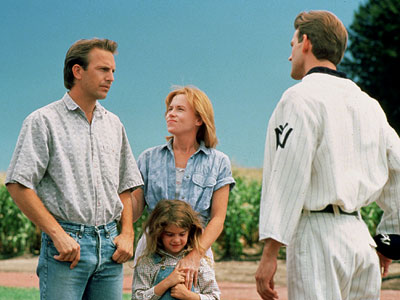
“A Field of Dreams” has long been my favorite movie, but probably not for the reason you think. I’ve seen it so many times, I can practically recite it for you, word for word. Most people think of it as a baseball movie about a man’s relationship with his father. Much of the main character’s motivation is to “prove he’s not like his father.” The two suffered an emotional detachment, manifested in Ray’s refusal to play catch with his father. The emotional climax of the movie for Ray Kinsella is when he sees that among those that have come back from “the corn” to play baseball is his Dad. Ray then introduces his Dad to his wife and daughter, and the tears begin to flow freely when he says, “Dad, Wanna have a catch?” I still get choked up whenever I see this part of the movie.
While reconciliation and healing is one of the primary themes of the movie, another is vocation. Ray’s pursuit of the mystical inner voice telling him “if you build it, he will come” drives the story. His ability to pursue his own dream over the demands of society, bills, and culture provide the primary conflict. Vocation is also the primary theme for two other characters: Moonlight Graham and Terrance Mann.
Archibald “Moonlight” Graham was a ballplayer that got into one major league baseball game as a late-inning defensive replacement. He never got to bat. Through the movie’s strange turn of events Ray finds Moonlight Graham as an old man. Moonlight Graham is now “Doc” Graham, the doctor in a small Minnesota town. Ray tries to convince Doc Graham to come with him to Iowa, but Graham refuses. He knows his place is in Chisholm, Minnesota. Exasperated, Ray says, ” Fifty years ago, for five minutes you came within… y-you came this close. It would kill some men to get so close to their dream and not touch it. God, they’d consider it a tragedy”
“Son,” Doc says, “If I had only been a doctor for five minutes, that would have been a tragedy.” Later in the movie Graham appears as a wide-eyed youth, getting to play baseball with his heroes on Ray’s magical field in the corn. Once again, he chooses to be a doctor over a ballplayer and saves Ray’s daughter.
The Terrance Mann character is loosely based on JD Salinger. During the movie he is described as “the voice of his generation… He coined the phrase ‘make love, not war.'” As an adult, Mann becomes a modern-day hermit. After being on the cover of Time, and hanging out with the Beatles, Mann withdraws from the public eye. He grew weary of everyone looking to him for answers. He became burned out by “leading the cause.” Kinsella pursues him, and takes him to Iowa. It is Mann that recites the famous “People will come Ray” monologue. It is a beautiful ode to baseball, and the character’s deep love of baseball is clear. All through the movie though, Mann’s role is unclear.
Finally, after one of the games between the All-Heaven’s All-Stars, Joe Jackson invites Mann to come with them “out there.”
In the heated exchange between Ray, Joe, and Terrance, the three come to realize why Terrance was there. Terrance, who hadn’t written a book in twenty years says that he will write a story about it. “You’re going to right about it?” Ray says, with not a small hint of hope in his voice. “It’s what I do,” Terrance replies.
“It’s what I do.” Mann was a writer. Moonlight Graham was a doctor. These were not just the things they did, these things are their vocation. It is who they are. The entire movie is about a search. It is about a man with a mid-life crisis, trying to discover who he is. He discovers that he is a husband and a father and that is enough. A doctor relives his boyhood dream, but knows that in the end he is defined by being a healer, not as an outfielder. A burned-out activist remembers what is deeply inside him, and he promises to write again.
This week’s study on Journey to Hope is about work. Do you find hope in your work? I think there is an important distinction between work and vocation. I have had a lot of jobs. I’ve been a painter, a gas station clerk, a coach, a sportswriter, a bag boy, and many more things. All of those jobs paid me, but only some of them fed me.
My hope is not in my work. Though this is easy to say as one that is gainfully employed. I understand that to some, finding work would be a great source of hope, but I’m talking about something deeper than a paycheck. My hope is in my vocation. It is in knowing that God has created me with a mission. God has gifted me with talents, but more than this, I have been given a reason for living. My vocation is writing, preaching, and teaching. These are the things that feed my soul. These are the things that feed my fire and passion for God. They are more than the things I do. They are a part of who I am.
I am lucky because my job aligns closely with my vocation. I am able to be compensated for doing those things that I would be doing otherwise. I think it was the football player Ray Lewis that said, “They (the team that pays me) get Sundays for free. They pay me for the rest of the week.” That is similar to how I feel. I worship, preach, and teach for free. It is the other stuff that the church has to pay me for.
When you think about your job and your vocation, how are they related? Spending time and energy in pursuit of things that are not your vocation will lead to tiredness, exhaustion, and burnout. If your job and your vocation are closely aligned, then you can count yourself blessed. If they are not, then you need to be extra vigilant. I would suggest to search deeply for what feeds you, and pursue that in addition to your job. Sabbath rest becomes crucial when you are spending energy in places that do not feed you. Sabbath provides a time and space for you to be refilled by the Spirit. It gives you a chance to discover your vocation through prayer and quiet time.
Hope is eternal. A job isn’t, so if your hope rests in your job I pray that you will find something else more eternal in which to place your hope. Seek out your vocation. Remember that it is “not as a goal to be achieved but as a gift to be received. Discovering vocation does not mean scrambling toward some prize just beyond my reach but accepting the treasure of true self I already possess. Vocation does not come from a voice ‘out there’ calling me to become something I am not. It comes from a voice ‘in here’ calling me to be the person I was born to be, to fulfill the original selfhood given me at birth by God.” (Parker Palmer, “Let Your Life Speak”, p. 10)
Listen to your inner voice. It might be telling you to build a baseball field in the middle of a cornfield. The neighbors, the bank, and the rest of society might think you’re crazy. Pursue your vocation anyway. Be who you were called to be.
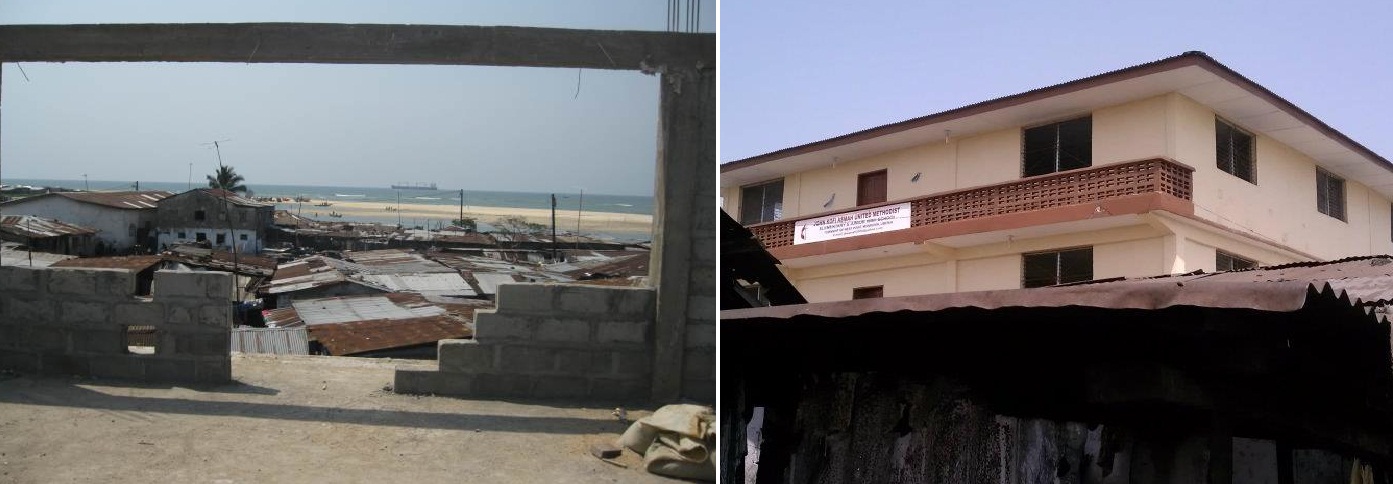
These pictures of are of the John Kofi Asmah School in the West Point community of Monrovia, Liberia. On the left was the project as my group left it in February 2011. The picture on the right was taken by Michael Whitaker. He was a part of the IGRC group that went in March 2012 and saw the dedication of the completed school.
I went to Liberia last year as a part of newly ordained clergy from the Illinois Great Rivers Conference of the United Methodist Church. Illinois Great Rivers and Liberia have had a flourishing partnership since 2006. Hundreds of clergy and laity have made the journey between the war-torn West African nation that is struggling with a fledgling democracy and the heart of Illinois.
During the last six years much has been built through this partnership. Along with schools, wells, clinics, and churches, things like trust, friendship and community have been built. The partnership between Illinois and Liberia is a strong one, and it has helped bring hope to the people of Liberia and Illinois. There is hope that churches can rise up out of years of decline with the power that comes with reaching beyond the walls of the building. There is hope that a nation can rise up from the ashes of civil war with the power that comes with education, clean water, and friendship.
I was forever touched by the people of Liberia. One place that especially touched me was West Point. I cannot properly describe West Point. It is a small peninsula that juts off of Monrovia, and has two roads that enter it. Once inside, the roads are so narrow that a car can barely pass, and only when the vast amounts of people get out of the way. At its widest, it is less than a kilometer, and it is about a kilometer in length. In this tiny land area, there are approximately 75,000 people.
Towering over most of the community of West Point is John Kofi Asmah School. This school is one fruit of the partnership between the Illinois Great Rivers and Liberian Conferences of the United Methodist Church. It is the only middle and senior high school in West Point.
When I was in Monrovia in February 2011, I spent two brief days on the third floor of the school, mixing mortar for the walls of the school. During my brief time there, we build a couple of interior walls of the third floor. The work I did there was almost insignificant. It was but one thread to the larger fabric of this partnership. We were told it could take another $50,000 to buy the materials and pay the labor to finish the project. Most of us came back to Illinois with a very clear mission – complete that school.
In February 2012, another group of ordinands from Illinois traveled to Liberia (about 3-4 work groups a year make the journey. Each group consists of laity and clergy. They can work on a variety of projects, and there is one trip each year that is especially geared for teachers to go to train other teachers at the schools that have been built). They came back with wonderful news. In the year since my group left, the project has been completed. They were a part of the dedication service. I was told that at the dedication, some of the students thanked the people of Illinois for their help. I wish I could return that thanks.
I am thankful for the partnership between Illinois Great Rivers and Liberia. I know I am better for having been to Liberia. I am better for working in the heat of the Liberian sun. I am better for singing songs of praise with Liberian people. I am better for knowing Sam.
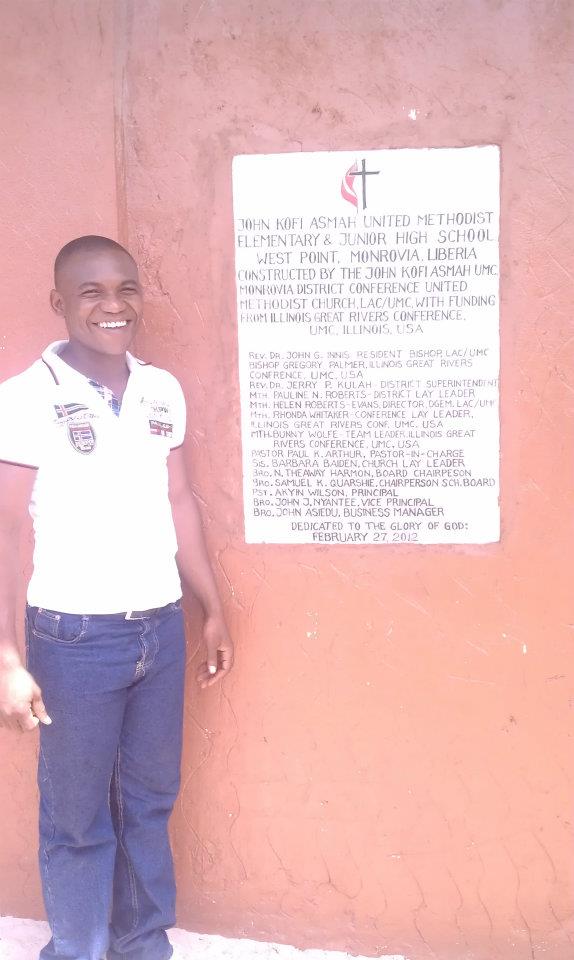
“Welcome to beautiful West Point.” That is how Sam Quarshie welcomes people to his church and his school. Sam is the associate pastor, but is known to the people of West Point as “Uncle Sam.” Below, Sam is standing next to the cornerstone plaque on the school. Sam is an inspirational man. As amazing as that school is, my hope for Liberia does not rest in buildings. Even though my own sweat is in the mortar, my hope is stronger than any concrete mixture. My hope for Liberia and my hope for Illinois lies in people like Sam Quarshie. My hope rests in the power of Jesus Christ to make all things new.
Associate Pastor Sam Quarshie in front of the cornerstone of the John Kofi Asmah United Methodist School in West Point, Monrovia. Photo taken by Michael Whitaker.
President Ellen Johnson-Sirleaf. Photo taken by Rev. Robb McCoy.
The Illinois Great Rivers Conference and the Liberian Conference of the United Methodist Church have a deep and growing partnership. I became a deeper part of this relationship in February 2011, when I went with a group of new clergy to Liberia. The people of Liberia remain in my heart, and my heart has been troubled over the last few weeks.
Prayers for Liberia are needed. For months people have been looking to October 2011 as a major test of Liberia’s fragile peace. The wounds of 14 years of civil war are still fresh, and many of the major players in that war are still in positions of leadership in the Liberian government. The Presidential election of 2011 was basically a three-way race between current President Ellen Johnson-Sirleaf, Winston Tubman, and Prince Johnson.
On October 11 the election saw a voter turnout of 71%. In that election, it was Johnson-Sirleaf (44%), Tubman (33%), Johnson (12%). Since no candidate won a majority of the votes, a run-off election was planned for November 8. After the election Johnson threw his support behind President Sirleaf, essentially ensuring her victory. Despite the fact that all independent election authorities called the elections fair and transparent, Tubman declared that there was mass voter fraud and disputed the results.
He advised his followers to boycot the run-off election and staged demonstrations across the country which intimidated people from voting. Some of the demonstrations became violent. Clashes between the Liberian National Police and demonstrators caused at least two deaths. The leader of the LNP recently resigned after pressure from President Sirleaf.
In the run-off elections, the turn-out fell to 38.6%, and President Sirleaf received over 90% of the vote. Tubman’s party, the Congress for Democratic Change (CDC) continues to protest the elections. They have promised to make Liberia “ungovernable” if their demands are not met. They are calling for a second set of elections, and seem to be holding the nation hostage with threats of violence.
All of these stories come from a source called allAfrica.com. It seems to be a credible source.
There is still relative peace, but the situation is fragile.
Brief summary of the primary candidates in the 2011 election:
Prince Johnson was a primary leader in the civil war. He gained much notoriety for capturing, torturing and executing President Samuel Doe. In the early stages of the war, he was an ally of Charles Taylor, but the two ended up bitter rivals.
Winston Tubman is an Americo-Liberian and was a member of the Doe administration. He was Johnson’s primary competition in the election after joining with George Weah. Weah was Tubman’s running mate, and was the runner-up to Johnson in the 2005 elections.
George Weah is probably the most famous Liberian in the world. In 1996 he won the FIFA Football Player of the Year Award, and was named the African Football Player of the Century. He ran for President in 2005, but lost in the run-off with Johnson.
Ellen Johnson-Sirleaf has been a public figure in Libria for three decades. She is a Harvard-educated financier, and worked for many years for the World Bank. Her international and business experience is second-to-none in Liberia. In 2011 she was awarded the Nobel Peace Prize.
This is the new, more honest, Fair Trade logo. According to a local store owner I talked to, the old logo has loosened their standards for what is deemed “Fair Trade.”
Halloween is supposed to be scary. Chocolate shouldn’t be.
It is Halloween season again, and soon kids across the country will be going from house to house in search of treats. There will be scary decorations and fun costumes. Some will watch scary movies. Some will go to haunted houses. It is fun to be scared – especially in a safe way.
On Friday night at my church, we will be hosting a Trunk or Treat. It is meant to be a community outreach. Kids have been invited to come and trick or treat in our church parking lot. We have many volunteers that will come to give out candy. There will be games and crafts as well. I’ll be brewing hot chocolate and coffee. We also plan on having brochures to give to parents about our church’s children ministries. We’re hoping that many kids come and have a great time.
I’m pretty sure that not one of those kids will have spent the day working in hot tropical fields, wielding machetes and being exposed to harmful pesticides. I think it’s a safe bet that none of the children getting their chocolate treats were sold into work camps by their parents, desperate to provide for siblings that are starving.
Unfortunately, such an existance is common place in West Africa, where the majority of the world’s exported cocoa beans are grown. Equal Exchange is one group that is making a difference in the world by fighting poverty at its root. By bringing the products of small farms to consumers in the United States, Equal Exchange has been able to empower people to maintain economic stability. Their Interfaith Store is a way for churches and individuals to buy products that they can trust – and feel good about.
We will set up a special table to tell people about Fair Trade chocolate. I’ve bought a bunch of chocolate bars for people to sample. The coffee and hot chocolate is Equal Exchange brand. I bought all the chocolate and coffee and a great little store in Davenport called SIS International Shop. Most big towns (Peoria, Champaign, Bloomington, Davenport, Moline and several in Chicago area) have a shop like the SIS International Shop. It might be too late for this Halloween, but Christmas is coming. Search for a Fair Trade shop in your area. Ten Thousand Villages is another great resource. Here is their store locator, but click on the “listing for all shops in the US” don’t use the locator by Zip Code or State.
It was hot. We were sweaty. I was dirty and sore and tired. And then we started to sing. We took each other by the hand and made a circle, and we sang:
“I just want to say thank you, thank you my Lord.
I just want to say thank you, thank you my Lord.
For your blessings we say thank you, thank you my Lord.
I just want to say thank you, thank you my Lord.”
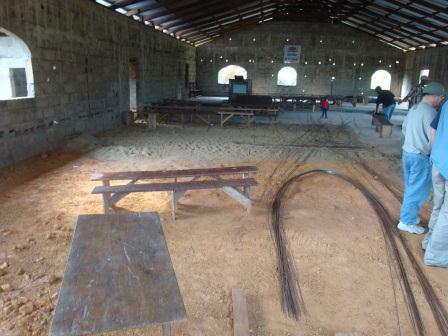
Inside New Hope UMC
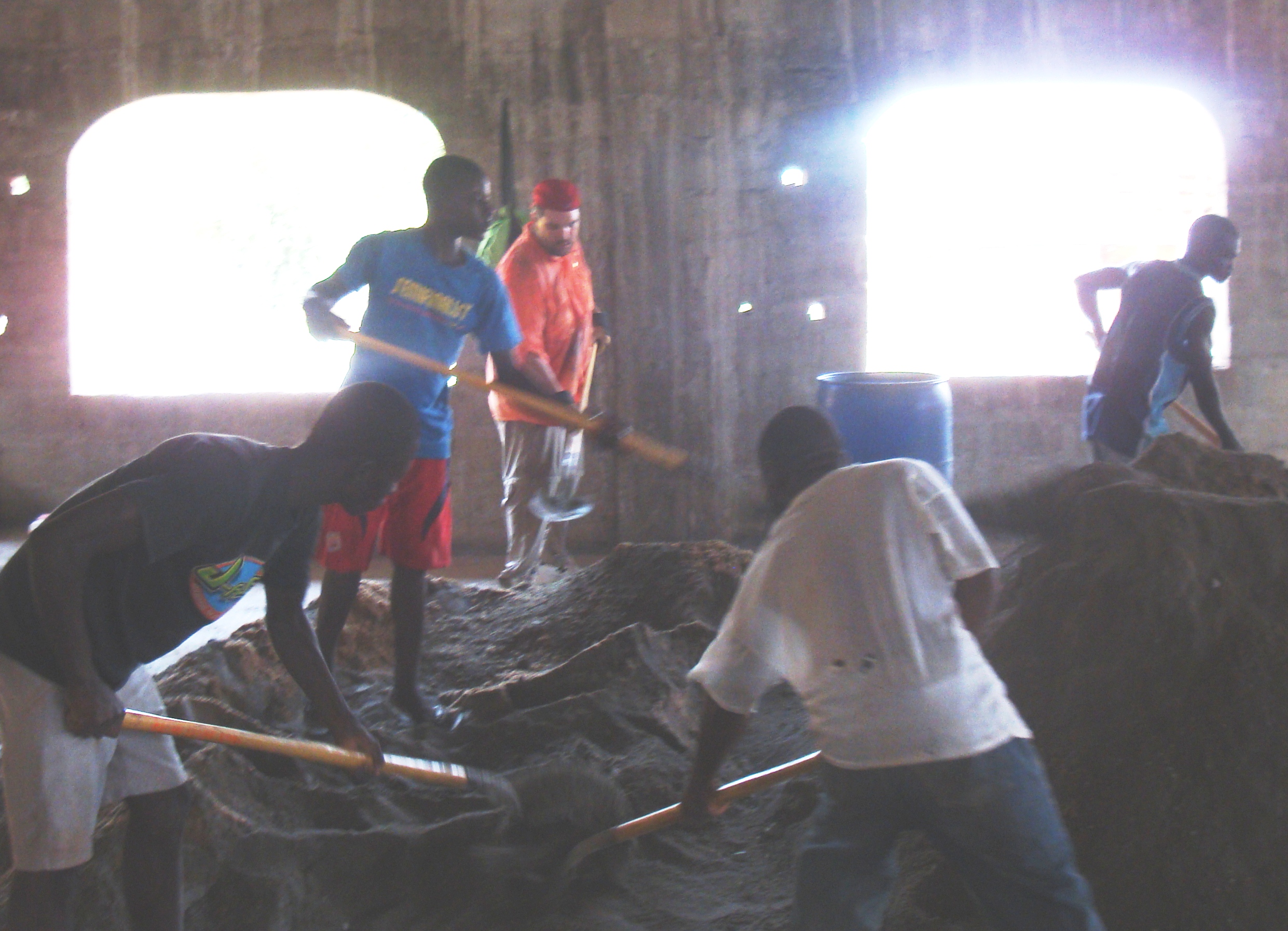
The floor of New Hope United Methodist Church was not yet finished, but it was closer than it was at the beginning of the day. We had spent the morning and early afternoon working hard. First we hauled forty wheel barrows of sand into the church. Then carried twenty 110 pound bags of cement into the church. After dumping the cement onto the sand, we mixed it up with spades. The Liberian men that were there knew what they were doing. We learned by watching, and pitched in. I feared that we might be slowing them down – or worse – taking away work that they wouldn’t get paid for. But their smiles and gestures of help allayed my fears.
Working together at New Hope UMC
The process was long and slow. Others in our group affixed wires to the undergrid. Others spread sand on the dirt floor, providing even ground on which to pour the cement. Then we hauled in 30 wheel barrows of rock and dumped them on the huge pile of sand-cement mixture. Then came the water, and more mixing. When the cement was finally mixed and wet, it was put into a wheel barrow and dumped on the floor, where skilled masons spread it out and made it level.
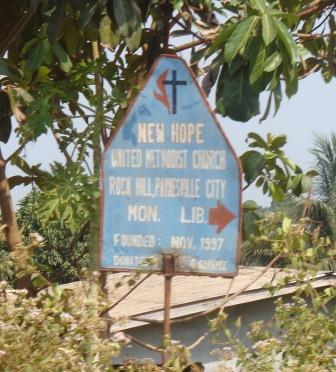
I love that the sign in Monrovia pointing to the United Methodist Church looks just like the one in Chenoa.
New Hope United Methodist Church sits on a hill on the outskirts of Monrovia. It is the biggest building in the little neighborhood. Inside there was a sign that read “2011-Our year of divine breakthrough.” The people of New Hope used to worship at homes, and then in a structure of sticks holding up a tin roof. The new New Hope UMC is a structure of cinderblocks with a vaulted ceiling. The roof is supported by wooden trusses under tin sheets. The floor was half cement, half dirt. By the end of the week, the floor will be complete.
Those working were a mix of clergy and laity, American and Liberian, black and white, skilled worker and unskilled laborer, man and woman, educated and uneducated, paid employee and volunteer. What we held in common was much stronger than the things that could divide us. And in that moment in the back of the church, what united us came out in song.
I was a part of a group made up of mostly newly ordained clergy, we had spent the last two weeks doing various projects in and around Liberia. This was the last day of work. We gathered to make sure we were all together before we walked down the hill to get in our van and head back to the United Methodist guesthouse in the city. I’m not sure who started singing, but the singing started quietly. It was a song we had learned from the Liberian people.
“I just want to say thank you, thank you my Lord…”
And then an amazing thing happened. Many of the Liberians that were still hard at work came over. They put down their spades. They put down their wheel barrows, and they joined us. We took each other by the hand and formed a circle. We were no longer Americans and Liberians. We were no longer black and white. We were simply God’s children. We were one in Christ, and we sang. We sang as loud as our lungs could muster. I was already covered in sweat and cement dust. Now tears were added to the mixture. The pastor of New Hope United Methodist Church prayed. We gave thanks to God for the cement floor, but also for so much more.
We thanked God for the relationship between the people of Liberia and the people of the Illinois Great Rivers Conference. We thanked God for the connection of the United Methodist Church. We thanked God for the respect and friendship that was forged in our sweat. We thanked God for hope.
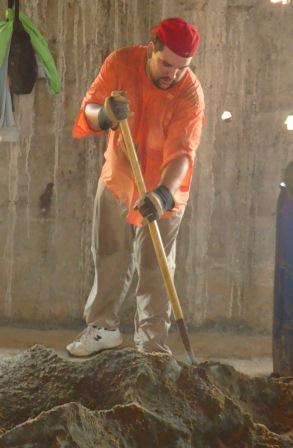
The Fat Pastor working hard.
We broke the circle and it took us a few minutes to actually leave. We shared hand shakes. We shared hugs. A few small tokens of appreciation were exchanged. A few last pictures were taken. There were many smiles, and then we got in the van and drove away. None of us truly left.
The music pounded out a beat. The nine-piece band and two singers were really letting it go. They sang of God’s goodness. They sang of God’s providence, of God’s peace and God’s justice. I stood there and allowed the music to envelope me. I swayed a little, closed my eyes and prayed. I tried to sing the words, but my voice faltered. I gathered myself, tried to sing again, but nothing would come.
Tears came instead. The music continued, and I could feel a great weight being lifted off of me. I could feel myself letting go of so much tension. Now the tears were flowing freely. Still no words to sing, only a voice crying out, drowned out by the music and the singing – “I’m scared.”
A simple, two-word prayer. Again, I cried, “I’m so scared.” Now a three-word prayer, it was the limit of my ability to articulate what I was thinking and feeling. I reached over to grab my wife’s hand. I squeezed it, held her close and said to her, “I’m so scared.”
It was a lamentation. All I could do was cry out to God in lamentation. I know God is with me. I know that God is good. I know that I can do all things through Christ. I know that nothing will separate me from the love of God in Christ Jesus. Yet in that moment the Holy Spirit was able to break into my heart and allowed me to simply lament. Does it mean that I have any less faith? I don’t think so. It was a powerful and incredibly healing moment.
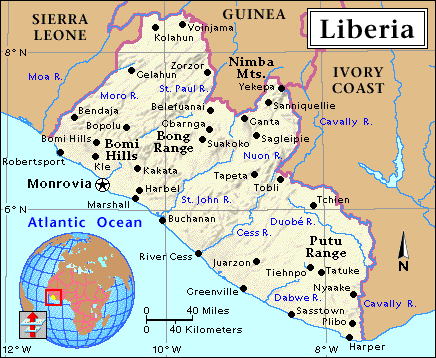
We’ll be spending most of our time in the capital city of Monrovia, building a school in the West Point section; and Ganta.
I’m scared. I’m excited too, but in that moment all I could do was cry, “I’m scared.” I’m scared of going to Liberia for two weeks. I’m scared of 13 hours in a seat not designed for Fat Pastors. I’m scared of leaving my girls. I’m scared of missing their bedtime story. I’m scared of missing their kisses. I’m scared of mosquitoes and infected water. I’m scared of sweltering heat. I’m scared of fugitives and the desparately poor and the contagiously sick. I’m scared of stories of evil and brutality for which my heart is not prepared.
I’m scared of moving to Moline a week after I get back from Liberia. I’m scared of packing up all our junk. I’m scared of getting it all done in time. I’m scared of leaving Chenoa, my church, my friends. I’m scared of leaving behind all that we have built. I’m scared for ministries that might lose momentum. I’m scared of not preaching every week. I’m scared of not knowing every single person I worship with on Sunday. I’m scared of getting lost – not just in a new city, but in the biggest church I’ve ever worked. I’m scared of starting from scratch. Despite this fear, I believe.
I believe I’m going to have an amazing trip. I believe I’m going to be transformed in ways I cannot even anticipate. I believe I will hear stories of hope and redemption that will fill my heart with joy. I believe I am going to build relationship with people that will last a lifetime. I believe that when I get back to Chenoa we will pack up all our stuff on time. I believe that the church in Chenoa will go on strong without me. I believe that the leadership will not lose sight of their mission. I believe that there are tremendous people, opportunities and resources in Moline that will allign well with my talents and passion. I believe that together we will do great work for Kingdom of God. I believe these things, and yet I’m scared.
I sit here and feel both strong and scared at the same time. It is okay for me to be both excited and terrified. It is right, and a good and joyful thing for me to wipe away tears one moment, and then smile wide the next. I’m excited. It doesn’t make me love my family or the people of Chenoa any less. I’m sad. That doesn’t mean I can’t enjoy Liberia or Moline.
I’m scared. It doesn’t make me any less of a man. It doesn’t mean I don’t believe in God. It doesn’t make me a worse pastor. It just means that I’m human. I’m scared, but I move on. I move on with my family. I move on with God. I move on straight into my fear, and that is all that matters.
I’ve collected enough money to get there and back. All the money I collect now will go directly to churches and people in Liberia. Click on the thermometer to be taken to my Donation page. Click on donate to make a $10 donation through Paypal.
“You’re going where?” I’ve been asked that more than a few times recently. Depending on the tone of the question, it can be loaded with shock, worry or confusion. “Is that near Egypt?” Is the common follow-up question.
“No, you might be thinking of Libya,” I say. “You know how Africa has a bump on the side? Liberia is sort on the bottom of that bump.”
“Are you going to be safe?” they ask. “Right now, the most dangerous things are the water and the mosquitoes. They’ve had peace since 2003, and a legitimate democratic government since 2006. Their president is a United Methodist.”
Some wonder why I’m going. Sometimes, especially now that it is so close, I wonder why I’m going. It really doesn’t make any sense. Why would I leave my home – a warm house, a comfortable bed, two daughters that light up when they see me, a wife who makes my heart leap when I hold her. Why would I leave all of this for two days, let alone two weeks?
Why would I travel 10,000 miles to live for two weeks in sweltering heat, without reliable electricity (sorry, no air-conditioning), without land-line telephones, without clean tap water? Why would I go to a place that is going to be 100 degree heat indexes, but is dangerous to wear short sleeves because the mosquitoes often carry malaria? It doesn’t make any sense.
I’m going for two weeks to do what? Paint a hospital – anyone can do that. Attend annual conference – really? I’m going 10,000 miles to sit at a budget approval meeting? Build a school in Monrovia – I don’t know anything about building a school. Why would I spend two weeks and $1,500 to do things that Liberians can do just as well – if not better – than me? It doesn’t make any sense.
You know what though? Sometimes the Kingdom of God doesn’t make sense. This is the parable of the mustard seed. It is one of the shortest parables of Jesus. This is Matthew 13:31-32 (NRSV).
He put before them another parable: ‘The kingdom of heaven is like a mustard seed that someone took and sowed in his field; it is the smallest of all the seeds, but when it has grown it is the greatest of shrubs and becomes a tree, so that the birds of the air come and make nests in its branches.’
Most people read this story hear only the part about a small seed turning into a large tree, but let’s look at this short parable a little closer. Jesus says that the Kingdom of Heaven is like someone taking a mustard seed and sowing it in a field. Really? Who would do that? If you had a field or a garden, and were hoping to grow something that produced a crop, would you really sow a mustard seed? The parable says that the seed turns into a shrub, and then a huge tree – big enough for birds to make nests. Drive through rural Illinois or Iowa – there are lush, green fields as far as the eye can see. How many huge trees are there in the midst of the corn and soybeans?
Think also about a garden. A huge tree – complete with birds and other small animals – is the last thing you would want in it. Sowing a mustard seed in a field just doens’t make sense. Jesus compares the Kingdom of God to planting a tree in a field, or a weed in a garden. Today he might have said, “The Kingdom of God is like planting dandelions on your front lawn. One pops up, and before you know it, your whole yard is covered in them.”
It just doesn’t make sense. The Kingdom of God doesn’t make sense.
It doesn’t make any sense for me to go to Liberia, but sometimes the Kingdom of God is about doing something that doesn’t make sense. The Kingdom of God is about learning something totally new about “what makes sense.” When someone strikes you on the face, it doesn’t make any sense to turn the other cheek. When someone steals your cloak, it doesn’t make any sense to give him your cloak as well. It makes sense to love your neighbor and hate your enemy. But Jesus told us that’s not how the Kingdom of God works.
Common sense tells us to work, accumulate, gain status, grow in stature and garner power. Common sense tells us to get revenge when we can, to punish when we are able and to win at all costs. The Kingdom of God isn’t about making sense. It didn’t make any sense for Jesus to forgive the tax collectors. It didn’t make any sense when Jesus healed the sick or fed the hungry. It didn’t make any sense for Jesus to allow himself to be put on a cross because of my sins. And it definately didn’t make any sense for him to conquer the grave and leave the tomb empty.
The Kingdom of God doesn’t make sense, and the only way we’re going to get there is if people are willing to do some things that don’t make sense. It doesn’t make sense to fogive. It doesn’t make sense to seek reconciliation. It doesn’t make sense to be love mercy, do justice and walk humbly with your God.
It doesn’t make sense for me to go to Liberia. But I’m going anyway. I’m going to meet people, share stories, and build relationships. I am going to walk amongst a people that still proclaim “God is so good” even though it doesn’t make sense. I’m going to a place that faced 13 years of the most brutal war the world has ever seen. I’m going to a country that saw 200,000 people die, 2,000,000 become homeless. I’m going to a place where girls raped, kidnapped and turned into “brides” for brutal warlords. I’m going to a place where boys saw their parents murdered, were kidnapped, given heroine and guns and forced to become soldiers.
I’m going to a place that has no reason to have hope. It doesn’t make any sense for people to be kind and generous. It doesn’t make any sense for people to come to worship and declare “God is so good.” It doesn’t make any sense. And that’s why I’m going, because sometimes we all have to do something that just doesn’t make sense.
5K 36:00 (Race for the Cure, Jun. '12)
35:15 (Firecracker Run, Jul. '12)
33:47 (Crimestoppers, Aug. '12)
31:40 (Lagomarcino's, Oct. '12)
26:52 (CASI St. Patrick's Day, Mar. '13)
26:28 (Railroad Days, Jun. '13)* *2nd place in age division
26:40 (Casa Guanajuato, Nov. '13)
30:30 (Modern Woodmen Knockout Hunger, Sep '14)** **3rd place in age division
Debut on 10/02/2008
1,000 total views on 12/04/2008
100,000 total views on 11/30/2011
200,000 total views on 5/26/2012
300,000 total views on 9/7/2013
400,000 total views on 5/23/2014
500,000 total views on 8/22/2015
All of the writing on this, and all pages at fatpastor.wordpress.com, are the sole possession of Robb McCoy, and are in no way affiliated with the United Methodist Church, or with any local congregation of the United Methodist Church.
Permission to use the written material on this site is granted for non-profit use, as long as credit is given to Robb McCoy and a reference to https://fatpastor.wordpress.com is used.
Comments and discussion are encouraged. However, any comment that is degrading, profane, violent, vulgar, or offensive will be removed.
All opinions and ideas are my own, unless otherwise noted. All opinions and ideas are subject to change depending on my own social location, events of the day, or my mood (it's all about the context, man!)

 On May 19, 2012, we’re having an Elephant Wash. There won’t be any elephants (I asked the people at the zoo, and they said ‘”no”). Instead, the elephant wash will be full of kids and youth reaching out to their community. I’m hoping that there will be lots of cars and lots of generous people willing to buy lemonade. The Elephant Wash is Riverside United Methodist Church’s entry into Change the World Saturday.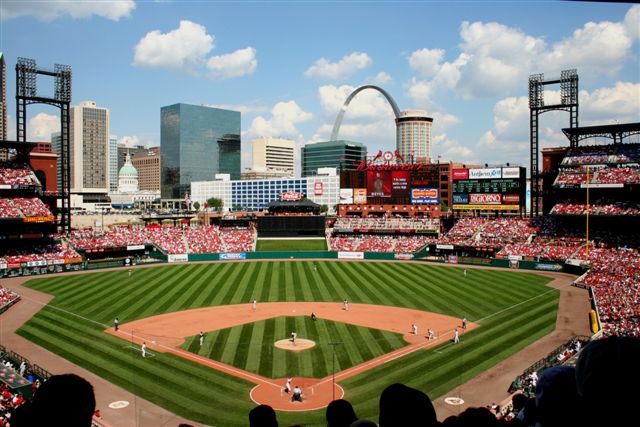





 The Fat Pastor