Tag Archives: United Methodist Church

Bullets on the Tennis Court, or Mission trip to East St. Louis, part 1

Lessie Bates Davis logoThere was a bullet on the tennis court.  Not a spent shell. A fired bullet. Among the mess of leaves, sticks, and broken glass, one of our youth reached down and picked it up, looked at it for awhile then said, “I found a bullet.”  I knew right away he wasn’t joking.  I looked at the little cone-shaped piece of metal.  I don’t know enough about guns and ammo to know anything about its caliber, what weapon it was fired out of, or any details.  There was probably something else we could have done with it, but all I said was, “throw it away.”  So he tossed it in the garbage bag and we went about our business of cleaning up the tennis courts at Lincoln Park in East St. Louis, Illinois.

We were a group of nine youth and three adults.  Some were inside the Mary Brown Center, working with some kids from the neighborhood.  Most of us were outside sweeping.  It was unseasonably cool for late July in Saint Louis.  It was a gray morning, and we were looking for something to do.  Miss Terry had told us that the tennis courts were unusable because of all the broken glass, so we decided to try and sweep it up.  We had some rakes, brooms, trash bags, and a dust pan.  We raked the sticks, leaves, and grass into big piles and swept the broken glass into the dustpan.  Even when we were joined by about a dozen youth from the neighborhood, most working for a few dollars an hour, we realized there was no way we were going to clean up the courts entirely.  By the time we finished though, I would have felt a lot better about kids playing there, as long as they had good shoes on.

Of course, it was entirely possible that once the sun went down, the park would be filled with young people with nothing better to do than throw their empty bottles into the courts.  Miss Terry hoped though, that the presence of people cleaning it up would discourage them.  We could hope.

The first day of the mission trip did not go exactly as we had planned.  We had planned to show up at the Mary Brown Center at 8:15 so we had plenty of time to set up our version of Vacation Bible School for the 25-30 seven to nine year old kids that would arrive at 9:00 a.m.  We had planned to spend the two hours with them in neatly divided groups so we could have 20 minute sessions of worship, devotion, Spanish, art, dance, and closing worship.  We had planned to stay to do some other kind of chores around the center until having lunch, and then going about the rest of our day in Saint Louis.  They say that if you want to give God a good chuckle, tell him your plans.
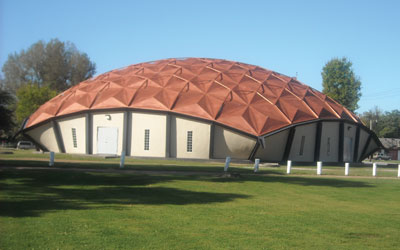
The Mary Brown Center is a part of Lincoln Park.  The geodesic dome houses a beautiful gymnasium.  The Center is also home to most of the youth programs of the Lessie Bates Davis Neighborhood House.

The Mary Brown Center is a part of Lincoln Park. The geodesic dome houses a beautiful gymnasium. The Center is also home to most of the youth programs of the Lessie Bates Davis Neighborhood House.

On the first morning drive to the Mary Brown Center, I got turned around.  I took the wrong exit after crossing the bridge.  I read the map, but the streets I wanted to drive did not go through.  After a process that included about four u-turns, our two minivans arrived at the Center at about 8:50.  We were welcomed graciously by Miss Terry.  She gave us a quick tour of the facility.  There are two main sections of the Center.  There is the beautiful domed structure that houses an immaculate gymnasium, and there is the education wing, home to a computer lab, a youth room, a dining room, offices, and a larger room with tables for seating and table games.

During the tour she told us about the pool, which would be opening for the first time in five years, and the tennis court, which despite having the money set aside for new nets, rackets, and balls, was unusable because it was covered in broken glass.  We unloaded the vans, started setting up our stations, and waited for the kids to start coming.  At about 9:30, there were about four kids.  That’s when I asked Miss Terry what else we could do.  I thought of trying to clean up the courts.

Some stayed inside with the kids that came, and as the morning went on a few more trickled in, and others swept the courts.  That is when I felt the futility of what we were trying to do.  We were invading this space, not sure of our place, unsure of our role, wondering what the mission of this trip was really going to be.  We had all the right plans, but the reality of the situation weighed heavily on my heart.  And then we found the bullet.

“What the heck are we doing here?” I wondered.  Then I kept sweeping.  I could pick up glass, and if that was all I was meant to be doing, then I was going to do it well.  We worked for about an hour and a half.  When we left, there were still young people sweeping in the courts.  There were others outside the fences, laughing at those that were foolish enough to pick up a broom.  Later I talked to our youth about the courage it took to remain there while their friends taunted them.  We agreed that those that remained there to clean up their park were among the bravest people we had ever met.

To Miss Terry’s enormous credit, she sat down with us for awhile before we left and taught us about what the Lessie Bates Davis Neighborhood House was all about.  She told us about her struggles as a community leader.  She told us about the kids on the corner with no hope.  She told us about the adult leaders that give their time and their energy so that they did not have to lose another kid to the street.  When I asked her, “What do you mean by lose them?” I knew that the only answer anyone needed was that bullet we found on the tennis court.

Part 1 – “Bullets on the tennis court.”

Part 2 – “You were made in the image of God”

Part 3 – “Not ‘goodbye,’ just ‘See you later.'”

Follow The Fat Pastor on Facebook

Follow @FatPastor on Twitter

Follow the Lessie Bates Davis Neighborhood House on Facebook
2 Comments

Filed under Christianity

There will be no elephants at our Elephant Wash #ChangeTheWorld

On May 19, 2012, we’re having an Elephant Wash.  There won’t be any elephants (I asked the people at the zoo, and they said ‘”no”).  Instead, the elephant wash will be full of kids and youth reaching out to their community.  I’m hoping that there will be lots of cars and lots of generous people willing to buy lemonade.  The Elephant Wash is Riverside United Methodist Church’s entry into Change the World Saturday.

A few months ago the kids at Riverside United Methodist Church picked a community outreach project.  They decided that they wanted to help the local zoo build a new habitat for their elephants.  The kids of our church love the Niabi Zoo, and they really got excited about helping with the zoo’s efforts to raise $4 million for a new elephant habitat.  We are going to have a car wash and encourage people to make a donation.  Before the car wash, someone from the zoo is going to come and do an educational session with the kids and volunteers.  The zoo is also going to donate a painting for the silent auction.  The artist will be one of the elephant residents of the zoo.  Is an elephant wash going to change the world?

It depends on what you mean by that.  At the very least, it will help the zoo take care of two of God’s amazing creatures.  And it could do a lot more.  It could help our kids learn how it feels to serve others.  It could teach them to be disciples of Jesus by spending their time in fellowship and service.  It could start a conversation with someone that didn’t know anything about Riverside Church.   It could transform the heart of someone that thinks that churches aren’t interested in the community.

If you click here to search for a Change the World event, you can enter 61265 into the zip code, and see ours.  Or you can put in your own zip code and see an event near you.  You can register and volunteer right now, and your name and email will be sent to the organizers of the event.  It is easy to argue that one event at one church couldn’t make much of an impact.  What about 1500 events involving over 20,000 people?  As of right now, that is how many people and churches are getting behind this movement.  20,000 people are rethinking what it means to be church.  And that can indeed change the world.

Change the World weekend is a project of United Methodist Church across the connection coming together for two days of community action.  Many of the projects support Imagine No Malaria, an initiative to eradicate malaria deaths through education, treatment, net distribution, and training; but Change the World is not about a single cause.

Change the World is about churches coming together for a day to get out of the church.  It is about rethinking what it means to “do church.”  It is about helping people to think about church as a verb instead of a noun.  Church can be something we do, not just somewhere we go.

Follow the Fat Pastor on Facebook

Follow on Twitter

Leave a comment

Filed under Christianity

“Welcome to beautiful West Point”

John Kofi Asmah School

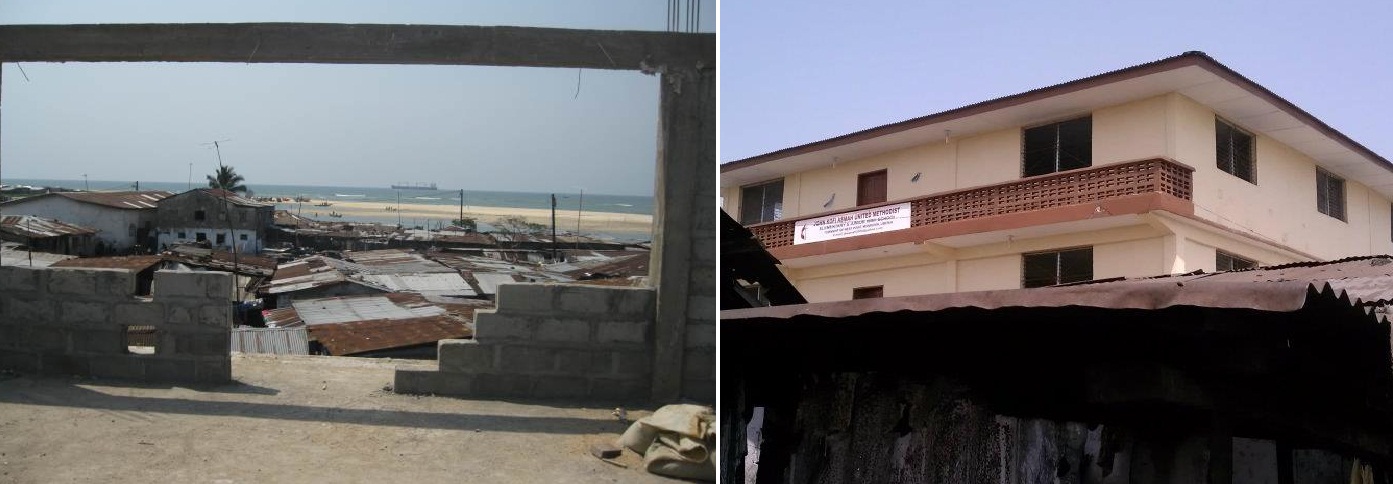
These pictures of are of the John Kofi Asmah School in the West Point community of Monrovia, Liberia. On the left was the project as my group left it in February 2011. The picture on the right was taken by Michael Whitaker. He was a part of the IGRC group that went in March 2012 and saw the dedication of the completed school.

I went to Liberia last year as a part of newly ordained clergy from the Illinois Great Rivers Conference of the United Methodist Church.  Illinois Great Rivers and Liberia have had  a flourishing partnership since 2006.  Hundreds of clergy and laity have made the journey between the war-torn West African nation that is struggling with a fledgling democracy and the heart of Illinois.

During the last six years much has been built through this partnership.  Along with schools, wells, clinics, and churches, things like trust, friendship and community have been built.  The partnership between Illinois and Liberia is a strong one, and it has helped bring hope to the people of Liberia and Illinois.  There is hope that churches can rise up out of years of decline with the power that comes with reaching beyond the walls of the building.  There is hope that a nation can rise up from the ashes of civil war with the power that comes with education, clean water, and friendship.

I was forever touched by the people of Liberia.  One place that especially touched me was West Point.  I cannot properly describe West Point.  It is a small peninsula that juts off of Monrovia, and has two roads that enter it.  Once inside, the roads are so narrow that a car can barely pass, and only when the vast amounts of people get out of the way.  At its widest, it is less than a kilometer, and it is about a kilometer in length.  In this tiny land area, there are approximately 75,000 people.

Towering over most of the community of West Point is John Kofi Asmah School.  This school is one fruit of the partnership between the Illinois Great Rivers and Liberian Conferences of the United Methodist Church.  It is the only middle and senior high school in West Point.

When I was in Monrovia in February 2011, I spent two brief days on the third floor of the school, mixing mortar for the walls of the school.  During my brief time there, we build a couple of interior walls of the third floor.  The work I did there was almost insignificant.  It was but one thread to the larger fabric of this partnership.  We were told it could take another $50,000 to buy the materials and pay the labor to finish the project.  Most of us came back to Illinois with a very clear mission – complete that school.

In February 2012, another group of ordinands from Illinois traveled to Liberia (about 3-4 work groups a year make the journey.  Each group consists of laity and clergy.  They can work on a variety of projects, and there is one trip each year that is especially geared for teachers to go to train other teachers at the schools that have been built).  They came back with wonderful news.  In the year since my group left, the project has been completed.  They were a part of the dedication service.  I was told that at the dedication, some of the students thanked the people of Illinois for their help.  I wish I could return that thanks.

I am thankful for the partnership between Illinois Great Rivers and Liberia.  I know I am better for having been to Liberia.  I am better for working in the heat of the Liberian sun.  I am better for singing songs of praise with Liberian people.  I am better for knowing Sam.

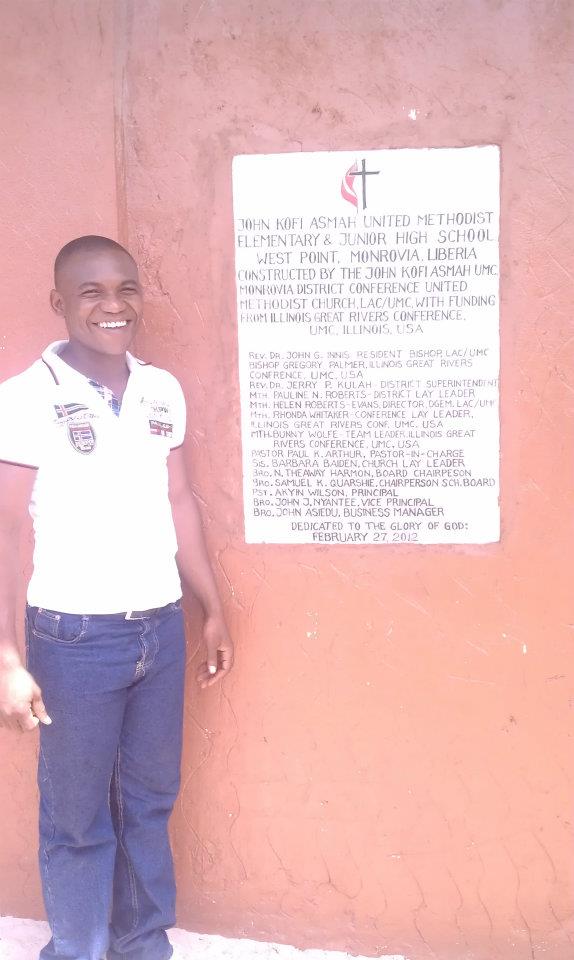
“Welcome to beautiful West Point.”  That is how Sam Quarshie  welcomes people to his church and his school.  Sam is the associate pastor, but is known to the people of West Point as “Uncle Sam.”  Below, Sam is standing next to the cornerstone plaque on the school.  Sam is an inspirational man.  As amazing as that school is, my hope for Liberia does not rest in buildings.  Even though my own sweat is in the mortar, my hope is stronger than any concrete mixture.  My hope for Liberia and my hope for Illinois lies in people like Sam Quarshie.  My hope rests in the power of Jesus Christ to make all things new.

Associate Pastor Sam Quarshie in front of the cornerstone of the John Kofi Asmah United Methodist School in West Point, Monrovia. Photo taken by Michael Whitaker.

Click here to read more about Liberia and to watch a video about the 2011 trip.

Click here to learn more about the partnership between IGRC and Liberia and get information about how you can help or go.

Follow the Fat Pastor on Facebook

Follow on Twitter

3 Comments

Filed under Christianity

My hope rests

The United Methodist Church is dying. I have heard the numbers, and they don’t lie. I’m not going to quote them here, but trust me.  The numbers aren’t pretty.  And it’s not just the United Methodist Church.  In the United States, churches of all brands, denominations, theology, and politics are seeing decline.  There are some that celebrate the death of religion.

But I’m here to tell you that the reports of the death of the United Methodist Church have been greatly exaggerated.  Is it the same Church it was 50 years ago?  No – Thank God.  The numbers tell one story, and it is an important story that we need to pay attention to.  There are many reasons why churches have been in decline for the last forty years.  I was reminded this week that the United Methodist Church is about more than numbers.

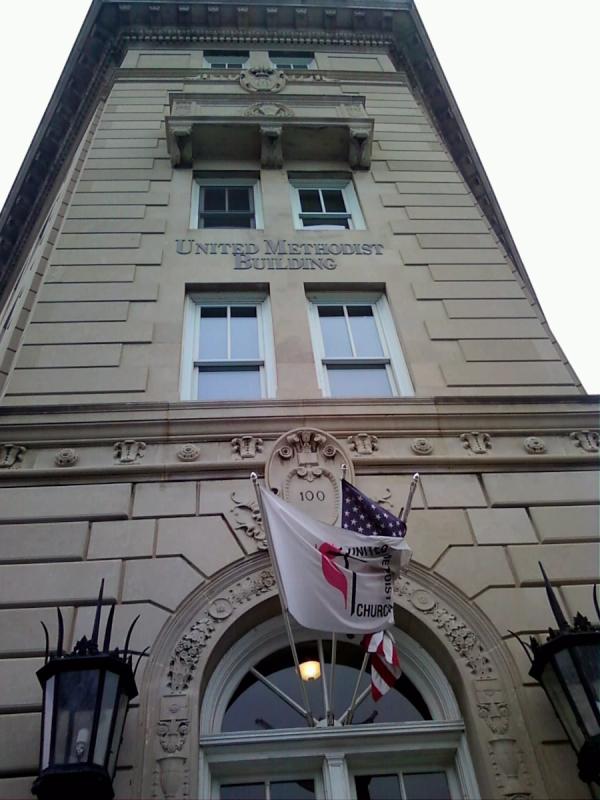
Today I celebrated the wonderful and holy meal of Communion.  I enjoyed this meal in a conference room of the United Methodist Building in Washington DC.  It is a building that sits at a corner.  Across one street is the Supreme Court building.  Across the other street is the US Capitol.  I’ve spent the last few days amongst leaders in the United Methodist Church with the General Board of Church and Society.  It has been a full week.

It has been full of information, meetings, inspiration, prayer, walking, fellowship, and friendship.  I have met two Congressmen, and a General Secretary.  I have stood in awe of the great monuments dedicated to the history of this nation.  My greatest thrill however, has been the chance to meet the amazing young leaders that have dedicated their lives to serving Christ in the United Methodist Church.  I’ve met real people with hopes, passion, talent, and skill.  I’ve shared stories, ideas, and laughs.

This whole experience has been incredibly uplifting.  Today as I walked toward the bread and the cup, I was filled with hope.  I felt an amazing rush of power – Holy Spirit power.  I looked around at the faces of people that were once colleagues, and are now friends.  I saw Jordan, Becky, Chris, Beth, Chris, Bethany, Jessica, Ann, Andrew, and so many others.  I looked at the faces of these servant leaders, and I felt the power of hope.

I still know all the numbers.  I’m not hiding my head in the sand as the church is in decline.  Even while I’ve been here I have heard the stories of church decline, and of the struggles that we face across the United States connection.  This week though has been a great reminder that our church – the imperfect, troubled, struggling church I love – is about more than numbers.

My hope rests above all in the Jesus’ love and righteousness.  My hope resides also in the leaders that are working to open hearts, minds, and doors in the name of Jesus Christ.


Follow The Fat Pastor on Facebook

Follow on Twitter

4 Comments

Filed under Christianity

Vote for Me!

A few weeks ago I threw my name into the hat to be elected to be a delegate for General Conference. At the time, I figured it was worth a shot. All it took was a 100-word essay and a picture. It was simple enough. All I thought was, why not? But now it is almost time to start voting, and I’m thinking that I’d better put a little more thought into it.

Why do I want to be a General Conference delegate?

This comes down a simple statement – I love the United Methodist Church.  I want to be a part of the largest and most important body of United Methodist Christians.  I want to enjoy that kind of fellowship of kindred spirits.  I want to be a part of the legacy that started at the Christmas Conference over 200 years ago.

I know the United Methodist Church is not perfect.  I have seen it at its ugliest.  I have seen it fail to live up to the calling of Jesus Christ.  Yet the United Methodist Church is the place where I have found grace.  It is the Church that has nurtured me from birth.  It is the Church that has shown me what it means to be a Christian, a servant, and a disciple. 

How will I vote?

I probably sound like a politician here, but I honestly do not know how I would vote for controversial issues at General Conference.  there are many issues that face the Church I love, and I want to do what is right for the Gospel of Jesus Christ.  I can say this: I believe that the slogan of the United Methodist Church: “Open minds, open hearts, open doors,” resonates with me.  I also believe that the word “open” that is repeated in that slogan needs to be understood as a verb, not as an adjective.  

It is my sincerest hope and prayer that none of the controversies that the church faces will create widespread schism.  I believe that the things that hold us together – the mission of Jesus Christ and the loving grace that is offered to all – are stronger than any of the controversies that would tear us apart.

What will you get if you vote for me?

You will get a pastor that is dedicated to doing what is best for the United Methodist Church.  I was ordained in 2010, and am still considered “young clergy.”  This is my first chance to be a delegate, and I believe that General Conference needs as many new people involved as possible to continue to breath life into the church.

I will go with great joy.  I will worship with great passion.  I will vote with my whole heart, mind and spirit.  I will bathe myself in prayer, always seeking the Holy Spirit to guide my decisions.  I will seek to be guided by Scripture, tradition, reason and experience.

1 Comment

Filed under Christianity

Partners in Hope

This is a video I put together with pictures I found on the internet plus my pictures and videos from my recent trip to Liberia.

3 Comments

Filed under Christianity

Top 5 questions for #6qumc

One mission

Three simple rules

Four areas of focus

Five practices.  And now… Six questions.

An intriguing new social-network based campaign by the United Methodist Church is 6 Questions.  I am not sure exactly what this is going to look like in the long-run, but this looks like a strong effort at reaching people through social networking groups such as facebook and twitter.  If you go to the link above, you will be able to watch a 40 second intro to the idea.  Then you have to register to get into the meat of the “6 Questions.”

What you will find is actually about 500 questions – all user submitted.  They are divided into many different categories.  At this point, there are no answers.  You can submit your own question, or go through the questions that are there and vote whether or not you like them.

I think the idea is that these questions will be whittled down to six at some point.  I don’t know what will happen once the six questions are asked, but if this can get people to start thinking about the place and role of the United Methodist Church, then it could be a very good thing.

So, for my new Top Five list, I submit to you, my six questions.  If you want to vote on my questions, I included the group you can find them in parenthesis:

  1. Is the candidacy process about discernment and development, or is it about gatekeepers setting up hurdles to clear? (Board of Ordained Minstry)
  2. Do guaranteed appointments help or hinder the mission of the UMC? (Developing principled Christian leaders)
  3. Why do men make up a majority of our pastoral leadership, but a minority of our active lay people? (United Methodist Men)
  4. How do the annual conference budgets allign with our four areas of focus, especially in regards to how we support campus ministry? (2010 Annual conference)
  5. How do clergy protect themselves from violating boundaries while maintaining friendships? (Pastor of a local church)
  6. How can a church foster economic diversity to gather in worship? (Engaging in ministry with the poor)

2 Comments

Filed under Christianity

Thinking about Chicken and Church

The United Methodist Church has come out with a new marketing campaign.  You may have seen one of the commercials.  “RETHINK CHURCH” they declare.  The idea is to think of church as a verb instead of a noun – a thing we do instead of a place we go.  It is a compelling idea, and it was clearly put together by a slick marketing team.  A team so slick, that I think KFC probably hired them to.

Has anyone else noticed the similarities between RETHINK CHURCH and UNTHINK CHICKEN? Besides the fact that, short of a Men in Black mind sweeping gadget or a lobotomy, I’m not sure how to unthink or rethink something (I mean, I know how to think, and I know how to change my mind, but isn’t changing one’s mind actually just another new thought?), couldn’t they have at least come up with different fonts – maybe something in a seriff. 

think

4 Comments

Filed under Christianity

Hii does. Do Wii?


Do we really?

Do we really?

Last week at annual conference I bought a shirt that read, “Hii welcomes all of His children.”  Next to those words was a picture of Jesus that looked like a Nintendo Wii character (or Mii).  Underneath, in smaller letters were the words, “Illinois Great Rivers Conference of the United Methodist Church.”


Annual Conferences of the UMC have been gathering over the last few weeks.  All of the conferences will be voting on a set of amendments to the UMC’s constitution.  These were amendments that were passed by the General Conference last summer, and now have to be ratified by a 2/3 majority of all the annual conference members.  Last week our conference voted on these amendments, and the results of one in particular really saddened me.  This is the amendment:


On May 1, 2008, at a session of the General Conference of The United Methodist Church held in Fort Worth, Texas, the following Constitutional Amendment was made by a recorded vote of 558 Yes, 276 No. It is now presented to the Annual Conferences for vote.
In the 2004 Book of Discipline, Division One, ¶ 4, Article IV, (2008 Book of Discipline, Division One, ¶ 4, Article IV)) amend by deletion and addition as follows:
After “worth” add “and that we are in ministry to all” and after “persons” delete “without regard to race, color, national origin, status or economic condition” and after “sacraments,” add “and” and after “members” delete “, and” and insert a period and add “All persons,” and after “faith” add “and relationship in Jesus Christ, shall be eligible to” and after “body” delete “of the Church because of race, color, national origin, status or economic condition”.
If voted and so declared by the Council of Bishops, ¶ 4 (¶ 4) would read:
Inclusiveness of the Church — The United Methodist Church is a part of the church universal, which is one Body in Christ. The United Methodist Church acknowledges that all persons are of sacred worth and that we are in ministry to all. All persons shall be eligible to attend its worship services, participate in its programs, receive the sacraments, and upon baptism be admitted as baptized members. All persons, upon taking vows declaring the Christian faith and relationship in Jesus Christ, shall be eligible to become professing members in any local church in the connection. In the United Methodist Church no conference or other organizational unit of the Church shall be structured so as to exclude any member or any constituent body.

On May 1, 2008, at a session of the General Conference of The United Methodist Church held in Fort Worth, Texas, the following Constitutional Amendment was made by a recorded vote of 558 Yes, 276 No. It is now presented to the Annual Conferences for vote.

In the 2004 Book of Discipline, Division One, ¶ 4, Article IV, (2008 Book of Discipline, Division One, ¶ 4, Article IV)) amend by deletion and addition as follows:

After “worth” add “and that we are in ministry to all” and after “persons” delete “without regard to race, color, national origin, status or economic condition” and after “sacraments,” add “and” and after “members” delete “, and” and insert a period and add “All persons,” and after “faith” add “and relationship in Jesus Christ, shall be eligible to” and after “body” delete “of the Church because of race, color, national origin, status or economic condition”.

If voted and so declared by the Council of Bishops, ¶ 4 (¶ 4) would read:

Inclusiveness of the Church — The United Methodist Church is a part of the church universal, which is one Body in Christ. The United Methodist Church acknowledges that all persons are of sacred worth and that we are in ministry to all. All persons shall be eligible to attend its worship services, participate in its programs, receive the sacraments, and upon baptism be admitted as baptized members. All persons, upon taking vows declaring the Christian faith and relationship in Jesus Christ, shall be eligible to become professing members in any local church in the connection. In the United Methodist Church no conference or other organizational unit of the Church shall be structured so as to exclude any member or any constituent body.

The amendment, put briefly would make it clear that all persons are welcomed into membership of the United Methodist Church.  There were many arguments against this amendment.  The one that made the least sense was the argument that this amendment would force Pastors into allowing anyone into membership without any standards.  At first, I was torn on this amendment because of this issue, but after re-reading I saw the word “eligible.”  This is not a mandate compelling churches to include anyone that wants to join. 

There are a lot of smoke-screen arguments against this amendment, but the only viable reason anyone would vote against it is that they don’t want a gay person sitting next to them in church.   

I thought that this would be the line that people wouldn’t cross.  I thought this was the dividing point between the moderate majority and the extremes.  I understand that people are divided on issues of pastoral authority and marriage.  But I also thought that keeping people out of churches was going to be too far.  

I believed that the moderate majority would rise and say, “we are a welcoming church.”  I thought that people could get beyond the fear-mongering and the politics and the polarization and say, “We have open hearts, open doors, and open minds.”  This amendment wasn’t about homosexual marriage.  It was not about homosexuals in the pulpit.  Really, it wasn’t about homosexuality at all.  It was about a church standing up and saying simply, “We welcome ALL.”  I really thought that the conference I love was going to vote to approve this amendment.

By a vote of 51%-46%, I was proven wrong.

Hii welcomes all of His children.  Apparently Wii don’t.

4 Comments

Filed under Christianity

Fixing the Skandal

A few weeks ago, my friend and colleague Will Deuel had a series of posts on his blog, “A Man Called Preach.”  His series of posts about the Skand-lous mission of the Board of Ordained Minstry created quite a whirlwind, including dozens of responses from well-wishers, sympathizers, and fellow probationary Elders rumbling along the ordination track.

As I think about our current Board of Ordained Ministry in the Illinois Great Rivers Conference, I concur with much of what Will had to say, especially in suggesting that it needs to be re-thought.  So I kept on thinking…

What if the Board of Ordained Ministry was perceived not so much as a board of gatekeepers, but as a team of mentors?

I can imagine a new kind of process, one that does not exist to weed out those that are deemed unworthy, but one that lifts up, empowers, and molds responsible Christian leaders.  I can imagine a team of mentors, prayerfully discerning the strengths and weaknesses of each candidate, shaping a process that meets them where they are.

Instead of treating us as “classes” that have set list of hurdles that must be leapt in order to reach the goal, the ordination process could be a time of spiritual guidance, discernment and empowerment.   Picture this:

A probationary elder, upon being comissioned, sits with a small group of pastors and lay people to examine the material that was presented.  They talk about the Bible study, the sermon, the written work, and Wesley’s historical questions.  They consider the work experience of the candidate, the education, and seminary evaluations.  Together, they create working goals related to different parts of ministry.  If a candidate has a gift of teaching and preaching, she is given resources to develop those gifts.  She is supported in going to preaching conferences (like the annual Festival of Homiletics, which I am dying to go, but have no means), and continuing education seminars.  She is not required to do redundant work that was taught in seminary and examined during the comissioning process.

The candidate struggles with administrative duties, so she is given a mentor – one not based solely on age and gender, but one that is suited to teach her the skills she needs.  During the first round of annual conference forms, she meets with her mentor a couple of times.  They meet again shortly after the annual report forms are filled out.  Throughout the year, the mentor and candidate meet several times to talk about administrative tasks.

The group decides that Clinical Pastoral Education is required of the candidate, but not necessarily for all.  She has some gifts of pastoral care, but could certainly refine her skills.  She is given financial support to enroll in a CPE program.  Her mentor and DS make sure that during the CPE internship, certified lay speakers relieve her from the pulpit two or three times so she doesn’t get overwhelmed by the duties of congregational leadership and her CPE internship.

There are Residence in Ministry Retreats.  They are intentionally about building the connection and meeting learning goals.  The residents meet the bishop, members of the cabinet, and some local pastors and lay leaders from around the conference.  At the retreats, practical ministry techniques and issures are mixed with things like spiritual gifts inventories and personality tests.  The candidates discuss their path toward ordination, about their struggles and their fears.  They are given time for their own prayer, study and reflection.

Each candidate is treated as an individual –  a whole person.  Ordination is a process of discernment and growth – not a series of hoops. 

Sounds nice, doesn’t it?  The question I have is, what’s keeping this from being a reality?

4 Comments

Filed under Christianity