Category Archives: Christianity

Thinking about Chicken and Church

The United Methodist Church has come out with a new marketing campaign.  You may have seen one of the commercials.  “RETHINK CHURCH” they declare.  The idea is to think of church as a verb instead of a noun – a thing we do instead of a place we go.  It is a compelling idea, and it was clearly put together by a slick marketing team.  A team so slick, that I think KFC probably hired them to.

Has anyone else noticed the similarities between RETHINK CHURCH and UNTHINK CHICKEN? Besides the fact that, short of a Men in Black mind sweeping gadget or a lobotomy, I’m not sure how to unthink or rethink something (I mean, I know how to think, and I know how to change my mind, but isn’t changing one’s mind actually just another new thought?), couldn’t they have at least come up with different fonts – maybe something in a seriff. 

think

4 Comments

Filed under Christianity

Call to worship invoking the Trinity

One:  God is a creating God.

All:    Making all things new through the Father’s love and grace.

One:  God is a redeeming God.

All:    Healing our relationship through Jesus, the Son.

One:  God is a sustaining God.

All:    Empowering us for God’s work through the Holy Spirit.

One:  Holy One, Three in One, we open ourselves to you.

All: Holy One, Three in One, create us, redeem us, sustain us.  Now and forever, Amen.

Free to use with attribution to https://fatpastor.wordpress.com

Leave a comment

Filed under Christianity

Evangelism Books

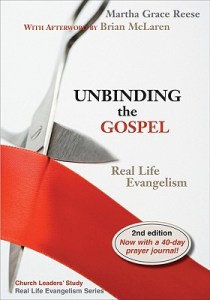
Unbinding the Gospel, by Martha Grace Reese

Unbinding the Gospel, by Martha Grace Reese

Dear readers,

I’m looking for a few good books.  Right now I am reading, and being challenged by, Unbinding the Gospel.  It has been a remarkable read.  I find myself reading paragraphs and chapters over and over again.  One of the main ideas of the book is to form an Evangelism Team.  The E-Team is to be a small, hand-selected, and prayerfully considered group of people.

I have been praying for this team almost constantly.  I believe that God is pushing me to ask four-five people for this team.  I would love to have six.  Once the team is formed, I want to give them each a different book about evangelism.  I have a few ideas, but I want to know if there are books that have inspired or challenged or intrigued you about sharing the good news of Jesus Christ.

I believe that a powerful E-Team can revolutionize a community.  So please, pray for my church.  Pray for the E-Team, and suggest any books, authors, speakers, that you think are powerful. 

Thanks,

Robb

2 Comments

Filed under Christianity

Hii does. Do Wii?


Do we really?

Do we really?

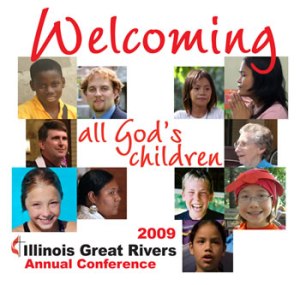
Last week at annual conference I bought a shirt that read, “Hii welcomes all of His children.”  Next to those words was a picture of Jesus that looked like a Nintendo Wii character (or Mii).  Underneath, in smaller letters were the words, “Illinois Great Rivers Conference of the United Methodist Church.”


Annual Conferences of the UMC have been gathering over the last few weeks.  All of the conferences will be voting on a set of amendments to the UMC’s constitution.  These were amendments that were passed by the General Conference last summer, and now have to be ratified by a 2/3 majority of all the annual conference members.  Last week our conference voted on these amendments, and the results of one in particular really saddened me.  This is the amendment:


On May 1, 2008, at a session of the General Conference of The United Methodist Church held in Fort Worth, Texas, the following Constitutional Amendment was made by a recorded vote of 558 Yes, 276 No. It is now presented to the Annual Conferences for vote.
In the 2004 Book of Discipline, Division One, ¶ 4, Article IV, (2008 Book of Discipline, Division One, ¶ 4, Article IV)) amend by deletion and addition as follows:
After “worth” add “and that we are in ministry to all” and after “persons” delete “without regard to race, color, national origin, status or economic condition” and after “sacraments,” add “and” and after “members” delete “, and” and insert a period and add “All persons,” and after “faith” add “and relationship in Jesus Christ, shall be eligible to” and after “body” delete “of the Church because of race, color, national origin, status or economic condition”.
If voted and so declared by the Council of Bishops, ¶ 4 (¶ 4) would read:
Inclusiveness of the Church — The United Methodist Church is a part of the church universal, which is one Body in Christ. The United Methodist Church acknowledges that all persons are of sacred worth and that we are in ministry to all. All persons shall be eligible to attend its worship services, participate in its programs, receive the sacraments, and upon baptism be admitted as baptized members. All persons, upon taking vows declaring the Christian faith and relationship in Jesus Christ, shall be eligible to become professing members in any local church in the connection. In the United Methodist Church no conference or other organizational unit of the Church shall be structured so as to exclude any member or any constituent body.

On May 1, 2008, at a session of the General Conference of The United Methodist Church held in Fort Worth, Texas, the following Constitutional Amendment was made by a recorded vote of 558 Yes, 276 No. It is now presented to the Annual Conferences for vote.

In the 2004 Book of Discipline, Division One, ¶ 4, Article IV, (2008 Book of Discipline, Division One, ¶ 4, Article IV)) amend by deletion and addition as follows:

After “worth” add “and that we are in ministry to all” and after “persons” delete “without regard to race, color, national origin, status or economic condition” and after “sacraments,” add “and” and after “members” delete “, and” and insert a period and add “All persons,” and after “faith” add “and relationship in Jesus Christ, shall be eligible to” and after “body” delete “of the Church because of race, color, national origin, status or economic condition”.

If voted and so declared by the Council of Bishops, ¶ 4 (¶ 4) would read:

Inclusiveness of the Church — The United Methodist Church is a part of the church universal, which is one Body in Christ. The United Methodist Church acknowledges that all persons are of sacred worth and that we are in ministry to all. All persons shall be eligible to attend its worship services, participate in its programs, receive the sacraments, and upon baptism be admitted as baptized members. All persons, upon taking vows declaring the Christian faith and relationship in Jesus Christ, shall be eligible to become professing members in any local church in the connection. In the United Methodist Church no conference or other organizational unit of the Church shall be structured so as to exclude any member or any constituent body.

The amendment, put briefly would make it clear that all persons are welcomed into membership of the United Methodist Church.  There were many arguments against this amendment.  The one that made the least sense was the argument that this amendment would force Pastors into allowing anyone into membership without any standards.  At first, I was torn on this amendment because of this issue, but after re-reading I saw the word “eligible.”  This is not a mandate compelling churches to include anyone that wants to join. 

There are a lot of smoke-screen arguments against this amendment, but the only viable reason anyone would vote against it is that they don’t want a gay person sitting next to them in church.   

I thought that this would be the line that people wouldn’t cross.  I thought this was the dividing point between the moderate majority and the extremes.  I understand that people are divided on issues of pastoral authority and marriage.  But I also thought that keeping people out of churches was going to be too far.  

I believed that the moderate majority would rise and say, “we are a welcoming church.”  I thought that people could get beyond the fear-mongering and the politics and the polarization and say, “We have open hearts, open doors, and open minds.”  This amendment wasn’t about homosexual marriage.  It was not about homosexuals in the pulpit.  Really, it wasn’t about homosexuality at all.  It was about a church standing up and saying simply, “We welcome ALL.”  I really thought that the conference I love was going to vote to approve this amendment.

By a vote of 51%-46%, I was proven wrong.

Hii welcomes all of His children.  Apparently Wii don’t.

4 Comments

Filed under Christianity

Gone fishin’

There are two ways that a church can do evangelism.   Jesus told his disciples that they would no longer be fishermen, but instead that they would fish for men.  I don’t know a lot about fishing, but I think there are basically two ways to fish.

One is put out a net and kind of float along, hoping that some fish swim in.  The other is to set some bait, cast out a rod, and try to attract them to come.  Both probably work when it comes to fishing.

Most churches today are doing evangelism like the first kind of fishing.  They are floating along with a net out, hoping that some fish come along.  Fewer churches are out there, going where the fish are, setting hooks and actively doing some fishing.

Immediately after Jesus died, the disciples gathered in the upper room and locked the door.  Even after they encountered the risen Christ, they were not quick to go out and start making more disciples.  At Pentecost the Spirit empowered them to go out and really start fishing.

Churches have a lovely language.  It is full of words like grace, forgiveness, love, redemption, resurrection, and invitation.  Many good churches have been happy floating around, getting ready for people to wander in.  When someone does come in, they are quick with the church-language.  They offer grace, forgiveness, love, redemption and resurrection.  If a church does this much, they are probably ahead of the game from most churches that are wrapped up in judgment, scorn, cliques, customs and status.

These good churches that are floating around, dragging their nets are going to catch some fish every now and then, probably just enough to survive, and not enough to really affect change in the world.

Pentecost churches have taken up the disciples’ call.  They go out and are actively searching for those that do not speak their language.  They are empowered by the Spirit to learn new ways of doing things, and bait their hook with mission and service.  They are catching some fish, making disciples, and changing the world.

Leave a comment

Filed under Christianity

Memorial Day

Many people use the term Bible-believing as code for conservative, evangelical Christian.  I do not consider myself to be conservative.  I believe that the term evangelical Christian should be redundant (not a political affiliation), and I believe in the Bible.

That is why on this day, as I think about those that have lost their life in wars, I turn to the Bible.  A woman at church on Sunday told me that Memorial Day is a tough day for her, because she had seven brothers and uncles that went away to World War II, and “not all of them came back.”  My heart breaks for this 92 year-old woman who, after all these years, still feels the pain of war.

This morning when I hung my flag out in memory of those that have died, those that have given up more than I have dared risk, those men and women of every creed, race, and background, I said a simple prayer: “No more.”  It is a prayer that will not be answered today.

We live in a broken world.  We live in a world where the ambitions and greed of a few can cost the lives of thousands.  We live in a world where sons and daughters leave home to defend their loved ones, and often do not return.

Still, I believe.  I believe not in the Bible as an idol that can be used to swat away ideas and new ways of thinking.  I believe in the words of the Bible, powerful words like these:

He shall judge between the nations,
and shall arbitrate for many peoples;
they shall beat their swords into ploughshares,
and their spears into pruning-hooks;
nation shall not lift up sword against nation,
neither shall they learn war any more

(Isaiah 2:4)

The world will be healed.  It might not happen in my lifetime, but I believe in the words of the Bible, and I believe in the power of God to heal all things.  Until then, I hang my flag with pride.  Not because we live in a country that is perfect, but because we live in a country full of brave men and women that want to do and be better.  Until it is healed, I hang my head.  Not out of sorrow or despair, but in humility and prayer to a God that keeps promises.

I believe in the Bible.  I believe in this country.  I believe in humanity that was created in the image of God.

To those that have served, I humbly thank you.

I close with this small prayer, “No more.”

Another post about Memorial Day called “Sometimes ‘Thank you’ seems inadequate.”

Follow the Fat Pastor on Facebook

Follow on Twitter

2 Comments

Filed under Christianity

Fixing the Skandal

A few weeks ago, my friend and colleague Will Deuel had a series of posts on his blog, “A Man Called Preach.”  His series of posts about the Skand-lous mission of the Board of Ordained Minstry created quite a whirlwind, including dozens of responses from well-wishers, sympathizers, and fellow probationary Elders rumbling along the ordination track.

As I think about our current Board of Ordained Ministry in the Illinois Great Rivers Conference, I concur with much of what Will had to say, especially in suggesting that it needs to be re-thought.  So I kept on thinking…

What if the Board of Ordained Ministry was perceived not so much as a board of gatekeepers, but as a team of mentors?

I can imagine a new kind of process, one that does not exist to weed out those that are deemed unworthy, but one that lifts up, empowers, and molds responsible Christian leaders.  I can imagine a team of mentors, prayerfully discerning the strengths and weaknesses of each candidate, shaping a process that meets them where they are.

Instead of treating us as “classes” that have set list of hurdles that must be leapt in order to reach the goal, the ordination process could be a time of spiritual guidance, discernment and empowerment.   Picture this:

A probationary elder, upon being comissioned, sits with a small group of pastors and lay people to examine the material that was presented.  They talk about the Bible study, the sermon, the written work, and Wesley’s historical questions.  They consider the work experience of the candidate, the education, and seminary evaluations.  Together, they create working goals related to different parts of ministry.  If a candidate has a gift of teaching and preaching, she is given resources to develop those gifts.  She is supported in going to preaching conferences (like the annual Festival of Homiletics, which I am dying to go, but have no means), and continuing education seminars.  She is not required to do redundant work that was taught in seminary and examined during the comissioning process.

The candidate struggles with administrative duties, so she is given a mentor – one not based solely on age and gender, but one that is suited to teach her the skills she needs.  During the first round of annual conference forms, she meets with her mentor a couple of times.  They meet again shortly after the annual report forms are filled out.  Throughout the year, the mentor and candidate meet several times to talk about administrative tasks.

The group decides that Clinical Pastoral Education is required of the candidate, but not necessarily for all.  She has some gifts of pastoral care, but could certainly refine her skills.  She is given financial support to enroll in a CPE program.  Her mentor and DS make sure that during the CPE internship, certified lay speakers relieve her from the pulpit two or three times so she doesn’t get overwhelmed by the duties of congregational leadership and her CPE internship.

There are Residence in Ministry Retreats.  They are intentionally about building the connection and meeting learning goals.  The residents meet the bishop, members of the cabinet, and some local pastors and lay leaders from around the conference.  At the retreats, practical ministry techniques and issures are mixed with things like spiritual gifts inventories and personality tests.  The candidates discuss their path toward ordination, about their struggles and their fears.  They are given time for their own prayer, study and reflection.

Each candidate is treated as an individual –  a whole person.  Ordination is a process of discernment and growth – not a series of hoops. 

Sounds nice, doesn’t it?  The question I have is, what’s keeping this from being a reality?

4 Comments

Filed under Christianity

Fireproof stirs something

My last post, about the movie “Fireproof,” has been one of the most successful posts I have made. By successful I mean a couple of things – my object with this blog is not to convince anyone of anything. I am not trying to tell you how to feel or think or believe. I am simply sharing some insights or thoughts I have about a variety of topics. My goal is to start conversations, or to help people think of things in ways that they hadn’t before.

To me, a successful post is one that: a. a lot of people read, and b. people think about and react to. On an objective level, this can be measured by the number of visits and the number of comments.

My fireproof post was one of the most successful posts on both counts. Now, the term “a lot” is relative. Anytime one of my posts goes over 50 hits, I consider it “a lot.” So far, the Fireproof post has had 63, and has a chance at becoming the most viewed post in this blog. It also has brought forth several comments, including a running dialog. To me, this is fantastic.

It seems clear that this movie has hit a chord with a lot of people. Those that like the movie claim that its message is powerful and has been inspiring to people in the context of their marriage relationship. The message (apparently, I still haven’t seen it) is that God must be in the center of a marriage. I certainly believe in that, and have preached that on more than one occasion.

On the other side is the fact that Kirk Cameron is the star of the movie. Some Christians believe him to be a good representative of all that is wrong with American evangelical conservative Christianity. In this, I mostly agree. I am not completely familiar with his work, but I find the movie “Left Behind,” which thrust him into his current role within some Christian communities, to be dangerous and antithetical to the Gospel of Jesus Christ as I understand it.

So, where does this leave us? Should I ignore the movie, or even actively try to dissuade people from seeing it, for fear that it might inadvertently lead them down paths I would certainly want people to avoid? Or should I see the movie and use it as an evangelical tool to guide people in Christian marriage?

As usual, when I am faced with a decision that appears to boil down to options A or B, I choose option 3. I have determined that I am going to see Fireproof. So as not to support the production of it financially, I am going to try to borrow it from a library. After watching it, I will be better able to enter into a conversation with those that have experienced grace from it. But I am probably not going to be putting up movie posters or host a community showing.

3 Comments

Filed under Christianity, Media

Is Fireproof safe?

It seems like I can’t turn around without seeing something about the movie “Fireproof.” I have heard from so many people that, “You just have to see this movie – it is so good.” Before you go out and check your local listings, know that Fireproof is not going to be at the theater anytime soon, and I’m not really sure if it ever was.

From what I can gather from the posters I have seen advertising various showings at local churches, the title has a double meaning. Apparently the main character is a fireman, but the movie is really about how to protect your marriage (thus making it, fireproof). Usually when someone tells me how great this movie is and tells me to rush out to see it with my wife as soon as possible, I just smile and say, “Oh yeah, I’ve heard of it.” I try to hide my utter lack of excitement.

The reason for my tepid reaction starts with the male star, Kirk Cameron. I loved him in “Growing Pains,” but I feel like his career has taken a turn for the strange. He has become the face of Evangelical Christian media, resurrecting (excuse the pun) his career with the movie “Left Behind.”

I’m sorry, but I have a strong distrust of anything vaguely attached to anything that is vaguely attached to “Left Behind.” I find the theology of Tim LaHaye so abhorrent that, unless Cameron condemns the books as perverting the Biblical narrative in such a way that is exploitative and dangerous, anything he does is tainted to me.

So, I have avoided “Fireproof.” I have realized though, that I need to see this movie. As a pastor in a church where couple might go and see it on their own, I have to be able to respond in an informed manner. Just hiding my head in the sand will not make this movie go away.

Plus, to avoid it completely is to fall into the classic liberal trap of hypocrisy. I claim to have an open table, and an open mind. I want to be able to learn from differences and not demonize people that simply disagree with me. I want to walk humbly with God, which means that I have to allow that sometimes I might not be fully right, and Tim LaHaye might not be fully wrong.

So instead of calling “Left Behind” the most dangerous theo-babble that has been spewed in the last half century (because it could quite literally lead to nuclear war and environmental devastation); I should instead engage those that claim “Left Behind,” with earnest discussion and try to learn from them.

Our divergent ways to understand and interpret Scripture might leave us with little common ground, but hopefully we can confirm “There is no longer Jew or Greek, there is no longer slave or free, there is no longer male and female; [or liberal or conservative] for all of you are one in Christ Jesus” (Galatians 3:28, bracket added by me).

I should not hide from “Fireproof.” There might very well be some good points to it. I doubt I will agree with all of it, but maybe it will make me think for a moment. Maybe it will remind me, just once, to be kinder to my wife. Maybe it will help me enter into a conversation with someone. Maybe it will open up a relationship that wasn’t there before, and that is reason enough to see it.

7 Comments

Filed under Christianity, Media

Prayer in schools: No thank you

A state judge recently ruled that an Illinois law mandating a moment of silence in public schools is a violation of the separation of church and state. I applaud the decision.

Prayer is an important part of a spiritual life, and I wish that more children had a regular prayer life. Heck, I wish that I had a more regular prayer life. I do not, however, feel that it is appropriate for a public school to have a time set aside for “prayer and reflection.”

Students should be allowed to pray in school, and unless school has changed a lot since I was there (which it probably has), there are plenty of times when a student can engage a prayer life. Saying a small grace before lunch, saying a prayer of thanksgiving during recess, praying for guidance before a quiz or a test, or getting to school early to pray before class starts, or on the bus ride, or while a teacher hands out worksheets – all of these times are perfect opportunities for anyone to pray.

A mandated moment of silence for prayer and reflection, however, is not. I even believe that a moment of silence is a good thing. Allowing kids to take a few moments to pause, allow their brain to slow down, or even wander periodically during the day is a good thing. Most brain studies have shown that the brain needs rest too. If the law had simply required a “a moment of silence,” that might have been okay, but I’m not sure that is matter of state lawmakers to decide. Every teacher should allow their students moments of silence, with or without a state law.

I have nothing against prayer in school, I have nothing against moments of silence in school. In fact, I am a proponent of both. What I am against is the government mandating either. School teachers are trained to teach academics – math, reading, writing, music, art, physical education. They should not be teaching their spiritual practices or their religious beliefs. Do their religious beliefs inform their teaching? Of course, but I do not want my daughter to be taught how to pray at school.

That is what church is for. Separation of Church and State should be something that all religious people should demand, because I do not want the government telling me how and when I can or should worship and pray. When the government starts mandating religious doctrine, it will inevitably be dumbed-down, watered down civic religion that replaces country with God.

I am all for prayer in school. Students and teacher should be allowed to pray as much or as little as they want, but a school is not a house of prayer.

For those that are outraged because their child has been deprived of a moment of silence, I suggest that instead you take this as an opportunity to pray with your child – today – right when they get home from school, and again before dinner, and again before you go to bed, and again when you wake up in the morning. Pray at home, pray at church, and even teach your child the right times to pray at school. We cannot get enough prayer in our lives, and in our world. Pray without ceasing. Please, do not ask our government to tell us when to pray. It’s just un-American.

2 Comments

Filed under Christianity